

Limescale vs calcium buildup is usually less of a choice between two different problems than it sounds. In everyday home use, both terms often describe the white, off-white, or chalky mineral film left after hard water dries or is heated. The practical question is whether you are seeing removable mineral scale, soap residue, corrosion, or a damaged fixture finish.
Start with the least aggressive check. Mineral scale often feels rough or crusty, appears around a faucet aerator, showerhead, kettle, or glass shower door, and may soften with a suitable vinegar-based cleaning method. A stain that is rusty, flaky, pitted, or unchanged after careful cleaning needs a different response. Do not keep scrubbing a surface that may be damaged.
The U.S. Geological Survey explains that hard water contains calcium and magnesium. When hard water is heated, calcium-carbonate deposits can form. That is why scale often shows up first where water evaporates or where hot water is used.
| What you see | What it may be | Low-risk next step |
|---|---|---|
| White, chalky, rough deposit near water flow | Hard-water mineral scale, often called limescale or calcium buildup | Check a small compatible area with a manufacturer-approved cleaner or vinegar method. |
| Dull film that feels slippery or waxy | Soap residue mixed with minerals | Clean with the fixture-safe method, then rinse and dry. |
| Orange, brown, green, or flaky area, especially with pitting | Corrosion or a metal-related stain | Do not use stronger acid or abrasion. Ask a plumber or the fixture maker for guidance. |
| A mark that does not lift and the surface coating looks thin, dull, or peeling | Finish damage or etching | Stop scrubbing and check the fixture manufacturer’s care instructions. |
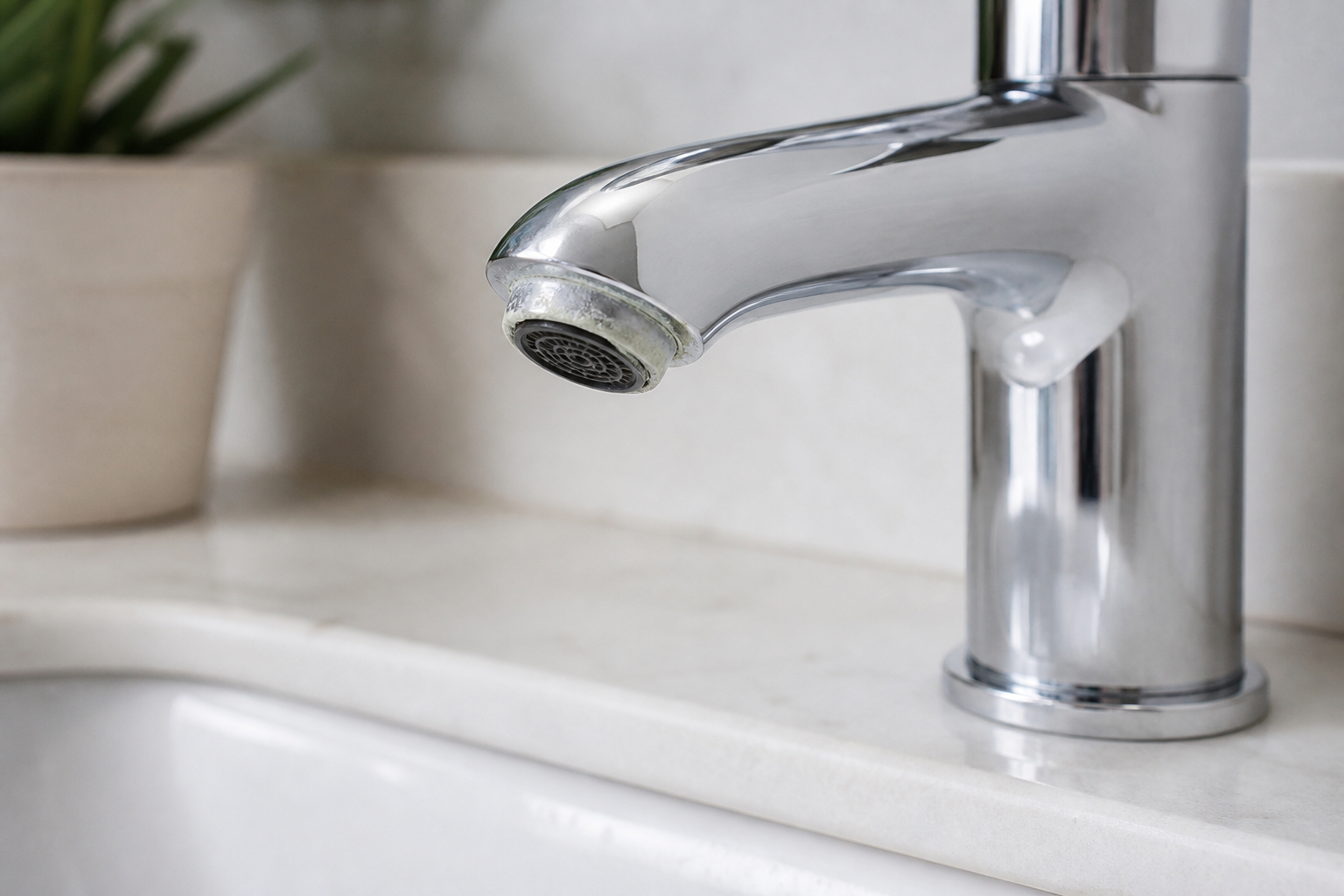

Table of Contents
Table of Contents
- Is Limescale the Same as Calcium Buildup?
- How to Identify a White Deposit
- How to Remove Limescale Safely
- When Repeated Scale Means You Should Test Hardness
- How to Prevent Calcium Buildup From Returning
- Frequently Asked Questions
Is Limescale the Same as Calcium Buildup?
In most household conversations, the terms overlap. Limescale is a common name for the mineral scale associated with hard water. “Calcium buildup” describes what people see, but it does not confirm the exact material in every case. A white deposit near water can include calcium-based scale, other minerals, soap residue, or a mix of these materials.
Why does that distinction help? It keeps you from choosing a strong cleaner based only on appearance. You can safely begin with the fixture instructions and a small test area. If the deposit softens and wipes away, mineral scale is a reasonable working explanation. If the surface pits, flakes, stays discolored, or has a leak or flow problem, do not treat it as a simple cleaning job.
Hardness is caused mainly by dissolved calcium and magnesium. USGS notes that hard water can leave scale as water moves through plumbing or is heated. Virginia Cooperative Extension also links hard water with mineral deposits on fixtures, dishes, cookware, and water-using appliances. That makes limescale a useful clue that your water may be hard, not a complete diagnosis of your water quality or fixture condition.
Want to put a number to that clue? Our guide to testing water hardness at home explains the practical options. Then use our water hardness scale guide to read the result in parts per million, milligrams per liter, or grains per gallon.
How to Identify a White Deposit
You usually do not need to identify the mineral with laboratory precision before cleaning a faucet or showerhead. You do need to rule out signs that the surface, plumbing, or water source needs more help.
Signs That Point to Mineral Scale
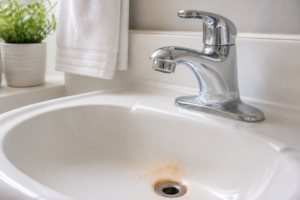
Mineral scale commonly forms where droplets dry, where water escapes from a small gap, or inside small openings that see frequent flow. Look for a rough ring around a faucet base, a crust around an aerator, white spots on glass, or blocked holes in a showerhead. These are also common signs of hard water in a home.
The location can be as useful as the color. A chalky deposit only at the ends of faucets and showerheads is more consistent with a water-related deposit than with a broad coating failure. A kettle or coffee maker can also collect scale because heat encourages mineral deposits. Still, do not assume that every white mark is calcium scale.
Signs That Need a Different Response
Mineral scale is not the same as corrosion. Corrosion can show as rust colors, green marks on some metals, flaking, pits, or a weakened surface. Soap scum can make mineral deposits feel tacky or look gray rather than chalky. A worn finish may look dull or patchy, but it will not return to smooth metal with cleaning.
If your water has sand-like particles, a simple vinegar response can be useful evidence, but it is not a full water test. South Bend’s public guidance notes that calcium deposits can dissolve in vinegar while particles from a water main or softener resin do not. If the particles continue, the water changes suddenly, or pressure drops around the home, ask a plumber, utility, or water-treatment professional to investigate the actual cause.
How to Remove Limescale Safely
The goal is to soften and lift the deposit, not to polish through a finish. Check the fixture or appliance manual first. Manufacturers may limit acidic cleaners on natural stone, plated surfaces, seals, coatings, or specific appliance parts. Never mix cleaners, and never combine vinegar with bleach or another product unless the label says it is safe.
EPA WaterSense advises homeowners to inspect faucets for scaling or calcium buildup and to use white vinegar or another cleaning product to remove deposits that may restrict flow. It gives similar advice for showerhead scale. CDC also recommends following the manufacturer’s cleaning instructions for showerheads and related fixtures.
A Careful Method for Faucets and Aerators
- Turn off the water if you will remove an aerator, and protect the sink so small parts do not go down the drain.
- Follow the fixture instructions to remove the aerator if it is designed to be removed. Take a photo first if the parts have several pieces.
- Soak only the removable, compatible part in white vinegar or use another fixture-safe descaling product as directed. Do not soak an entire fixture unless its instructions allow it.
- Use a soft cloth or soft brush to lift loosened material. Avoid steel wool, sharp tools, and aggressive abrasives on plated or coated surfaces.
- Rinse thoroughly, reinstall the part, and run water briefly. Check for normal flow and leaks.
If you cannot remove the aerator, place a vinegar-dampened cloth on the deposit only when the manufacturer says the finish can tolerate it. Keep the contact time short at first, rinse, and inspect the surface. A cleaner that works on one fixture can damage another one.
A Careful Method for Showerheads
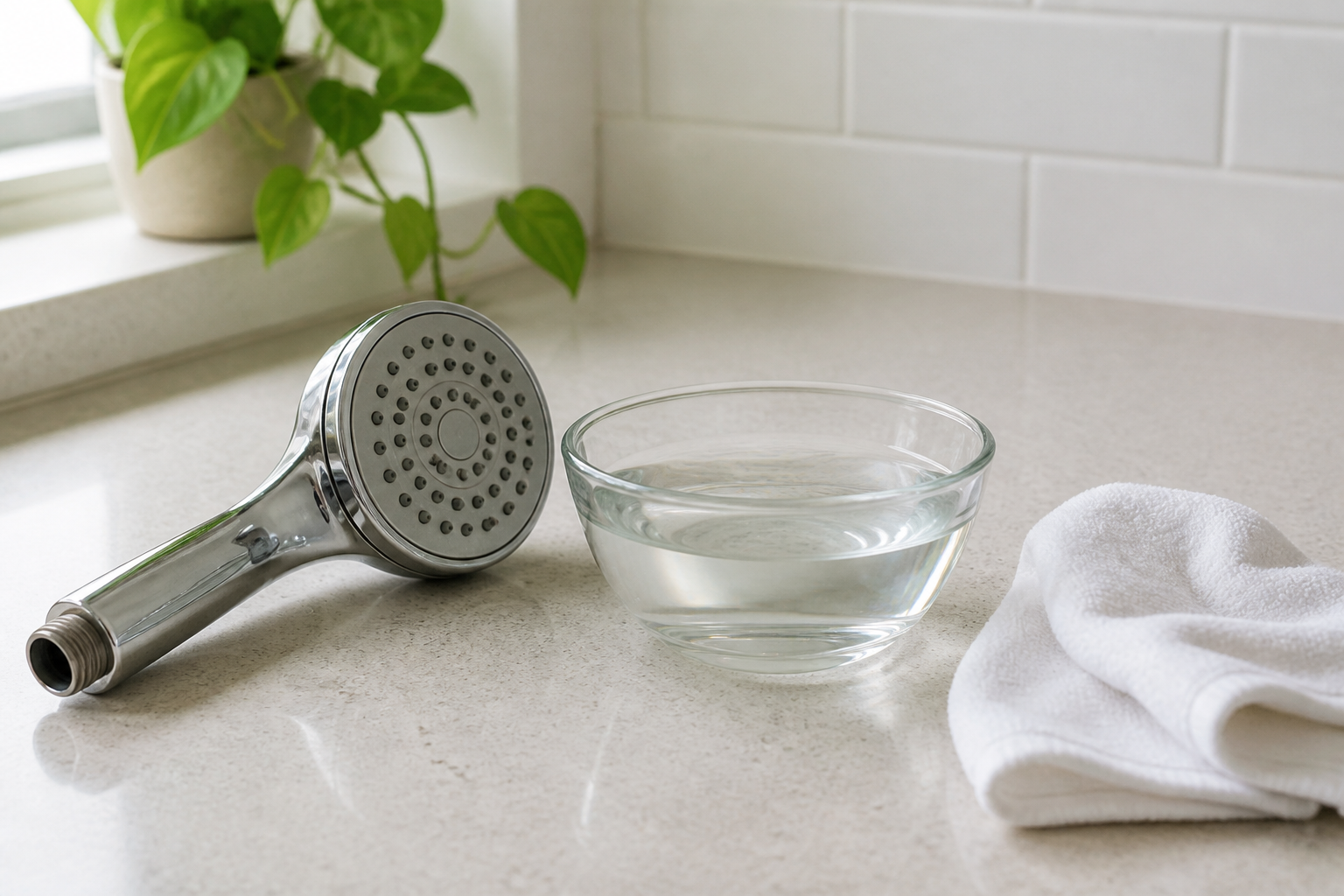
EPA says a suitable cleaning product or white vinegar can remove showerhead scale. If your showerhead instructions allow removal, clean the removable part according to those instructions and rinse it well before reinstalling. CDC notes that showerheads and hoses may need cleaning to remove buildup, but it also directs readers to the manufacturer instructions.
Do not force a stuck showerhead, overtighten plumbing, or use a harsh acid on an unknown finish. Stop and get help if you see a leak at the connection, a cracked fitting, or damage that cleaning will not correct.
What About Glass, Tile, and Appliances?
For a glass door, tile, kettle, coffee maker, or dishwasher, use the care instructions for that surface or appliance. Some materials tolerate a mild acid method, while natural stone, damaged grout, specialty coatings, and appliance interiors may need a different approved product or service process. Do not guess because a cleaning method worked on a faucet.
The safest pattern is simple: use a cleaner that the surface maker permits, work on a small area first, rinse completely, and dry the surface. If deposits have built up inside a water heater, coffee maker, or other appliance, follow the appliance manual. Do not pour a cleaner into equipment that does not list a descaling process.
When Repeated Scale Means You Should Test Hardness
One white ring does not prove that you need a water softener. Repeated deposits across several fixtures, cloudy glassware, poor soap lather, or scale in water-using appliances make a hardness measurement more useful. A test tells you whether calcium and magnesium are likely part of the ongoing maintenance problem.
You can start with our how to test for hard water without a kit guide for household clues. When a treatment setting, appliance decision, or persistent problem depends on the result, confirm it with a suitable test instead of relying on a soap observation alone.
If your home uses public water, your utility’s water-quality report may give useful local context. Our guide to finding your local water hardness level shows how to use that information without assuming it matches every tap in your home. Private-well owners should ask a local health department or certified laboratory which tests fit their location and concern.
Do not treat a hardness result as a complete water-safety result. Hardness measures mineral content that affects scale. It does not answer questions about bacteria, lead, nitrate, or another contaminant. Match the test to the water question you need to answer.
How to Prevent Calcium Buildup From Returning
Prevention starts with reducing the time water stays on a surface. Wipe down glass, faucets, and shower areas after use when practical. Repair small leaks, because a steady drip can leave concentrated deposits in one spot. Clean aerators and showerheads before the openings become blocked.
If the deposits return quickly in several places, measure hardness and review your water use. A measured result can help you decide whether routine cleaning is enough, whether an appliance setting needs adjustment, or whether you should research a treatment option. EPA describes cation exchange as a treatment process that removes hardness ions such as calcium and magnesium, but treatment should follow a documented need and the equipment instructions.
You do not need a large system for every spot on a faucet. First remove the deposit safely. Then look for the pattern: one fixture may need maintenance, while whole-home scale may justify a hardness test and a broader plan.
Frequently Asked Questions
Is limescale just calcium?
Limescale is commonly used for hard-water mineral scale, and calcium compounds are often part of that scale. The exact makeup can vary. A visible white deposit is a useful clue, but it is not a laboratory result.
Will vinegar remove calcium buildup from every surface?
No. EPA lists white vinegar as an option for scale or calcium buildup on faucets and showerheads, but the fixture or appliance instructions control what is safe for that material. Avoid using a vinegar method on a surface when the maker prohibits acidic cleaners.
Does calcium buildup mean my water is unsafe?
No. Calcium buildup can point to hard-water minerals and a maintenance issue. It does not determine whether water is safe to drink or test for every possible water-quality concern.
When should I call a plumber instead of cleaning?
Call for help when you find a leak, a cracked fitting, widespread pressure loss, rust-colored or flaky corrosion, damaged metal, or a deposit that does not respond to the fixture-safe cleaning method. These signs can have causes beyond removable mineral scale.
The Bottom Line
Limescale vs calcium buildup usually describes the same household maintenance clue: hard-water minerals may be drying or heating into a visible deposit. Begin with a surface-safe cleaning method, not a stronger chemical or a hard scraper. If the deposit keeps returning across the home, test hardness and use the result to guide the next step.
That approach protects your fixtures and gives you better information. A white deposit may be a useful reason to measure hardness. It is not, by itself, a reason to guess about water safety or buy treatment equipment.