

Want to find water hardness by ZIP code before you start seeing spots on every glass or shopping for a water softener? A ZIP-code lookup can give you a useful local starting point, but it is not always the final answer for the water coming from your own faucet.
The best approach is simple: use your ZIP code or city to identify the likely water system, check that supplier’s annual report, and then test your tap water if the number will guide a treatment decision. That extra step matters because a single ZIP code can include more than one public water system, and private-well water does not come from a community system at all.
Fortunately, you do not need to turn this into a chemistry project. This guide shows you where to look, what a local hardness number can tell you, and when a quick home test is the smarter next move.

Table of Contents
Table of Contents
- Can You Find Water Hardness by ZIP Code?
- Start With a Local Water Hardness Lookup
- Confirm Your Actual Water Supplier and Report
- How to Read Local Water Hardness Units
- When a Home Test Is More Useful Than a ZIP Code
- What to Do With Your Local Hardness Result
- Frequently Asked Questions
Can You Find Water Hardness by ZIP Code?
Yes, you can often find a local water hardness estimate by ZIP code, city, or state. Water-hardness map and lookup sites commonly collect public-water data and present it in parts per million (PPM), milligrams per liter (mg/L), or grains per gallon (GPG). That can help you decide whether hard water is a likely explanation for scale on fixtures, cloudy glassware, or extra soap use.
But what does that number represent? Usually, it represents a city, service area, or public water system, not a current sample from your kitchen sink. Water can vary across a service area, and a ZIP-code boundary does not always match the boundary of the water utility that serves your address.
Think of a ZIP-code result as a map pin, not a final diagnosis. It gives you a place to begin. If you are deciding how to set a softener, comparing treatment options, or trying to explain a sudden change in your water, confirm the result with your supplier’s information or a measured test.
If you want to understand what a confirmed number means, our water hardness scale explains the common soft, moderately hard, hard, and very hard ranges in plain language.
Start With a Local Water Hardness Lookup
How do you start without getting lost in conflicting numbers? Search for your city or ZIP code together with “water hardness,” then look for a result that names the water system, source date, or source report. A lookup that only gives a state average can still provide background, but it is less useful for choosing equipment for your home.
Write down these details when you find a result:
- The reported hardness value.
- The unit, such as mg/L, PPM, or GPG.
- The water-system name or city listed with the result.
- The report date or source date, if shown.
- Whether the result is described as an average, a range, or a measured sample.
Why keep the details? Two sites can show different numbers without either one being obviously wrong. They may be using different sampling locations, different years, or different units. A local average can be useful for a first estimate, while a treatment decision needs a number you can trace to your own water source.
Do not use a ZIP-code lookup as a drinking-water safety report. Hardness is mainly a measure of dissolved calcium and magnesium, according to the U.S. Geological Survey’s hardness overview. It can explain mineral scale, but it does not tell you whether your water contains bacteria, lead, nitrate, or another concern that needs a different test.
Confirm Your Actual Water Supplier and Report
Once you have a local estimate, how do you find the report that is most relevant to your home? Start with your water bill, then look for the supplier name. If you do not have a bill handy, the EPA’s local drinking water information page links to tools for finding local drinking-water reports and water providers.
Community water systems send customers an annual Consumer Confidence Report (CCR), also called an annual drinking-water quality report. The EPA explains that the report gives customers information about their local drinking water and where it comes from. It may not list hardness in every case because hardness is not the same thing as a regulated contaminant report, but it can help you identify the correct system and ask the utility for its current hardness information.
Here is a practical way to work through it:
- Match the utility name to your address. Do not assume the largest nearby city serves every neighborhood, apartment building, or subdivision.
- Open the newest available report. Look for a sampling date, source-water description, and a customer-service contact.
- Search the report for hardness, calcium, magnesium, or grains per gallon. If hardness is not listed, contact the supplier and ask whether it has a current range or average for your service area.
- Compare the report with the ZIP-code estimate. Similar numbers build confidence. A large difference is a reason to check dates, units, and the exact system name before relying on either one.
What if you have a private well? Skip the public-water lookup as your final source. A private well is your own source, so a city or ZIP-code average may have little to do with your tap water. The CDC’s private-well testing guidance can help you plan broader water-quality testing. For hardness specifically, a home test or laboratory result is more useful than a regional estimate.
How to Read Local Water Hardness Units
The numbers can look confusing at first. Fortunately, the unit tells you how to compare them. Local reports and lookup tools may use PPM, mg/L as calcium carbonate, or GPG. For water hardness, PPM and mg/L are commonly treated as equivalent when both are expressed as calcium carbonate.
| Unit you see | What it means | Quick comparison |
|---|---|---|
| mg/L as CaCO3 | Milligrams of hardness per liter, expressed as calcium carbonate. | Often shown on utility information. |
| PPM | Parts per million. For hardness expressed as calcium carbonate, it is commonly used like mg/L. | Useful for comparing many map results. |
| GPG | Grains per gallon. This is common in water-softener discussions. | 1 GPG is about 17.1 mg/L as CaCO3. |
For example, a local result of about 171 mg/L as calcium carbonate is roughly 10 GPG. That conversion can help when your water report uses mg/L but a softener manual asks for GPG. Still, check the instructions for your specific equipment because some settings ask for additional information, such as iron, that a basic hardness lookup does not cover.
Our guide to how to test water hardness at home walks through the common ways to get a more home-specific measurement. If you already have a strip result, use our guide to reading water hardness test strips before treating a color range as an exact number.
When a Home Test Is More Useful Than a ZIP Code
When should you move beyond a local lookup? Use a home test or laboratory test when the result will affect money, equipment, or troubleshooting. A ZIP-code estimate is helpful for research, but a measured sample is better in these situations:
- You are setting up a new water softener or changing its hardness setting.
- You are comparing softener capacity or asking an installer for a quote.
- You have a private well.
- Your water source, plumbing, or treatment equipment recently changed.
- You see new scale, dishwasher spots, or a change in soap lather that does not match an older local number.
- You need to compare water before and after a treatment system.
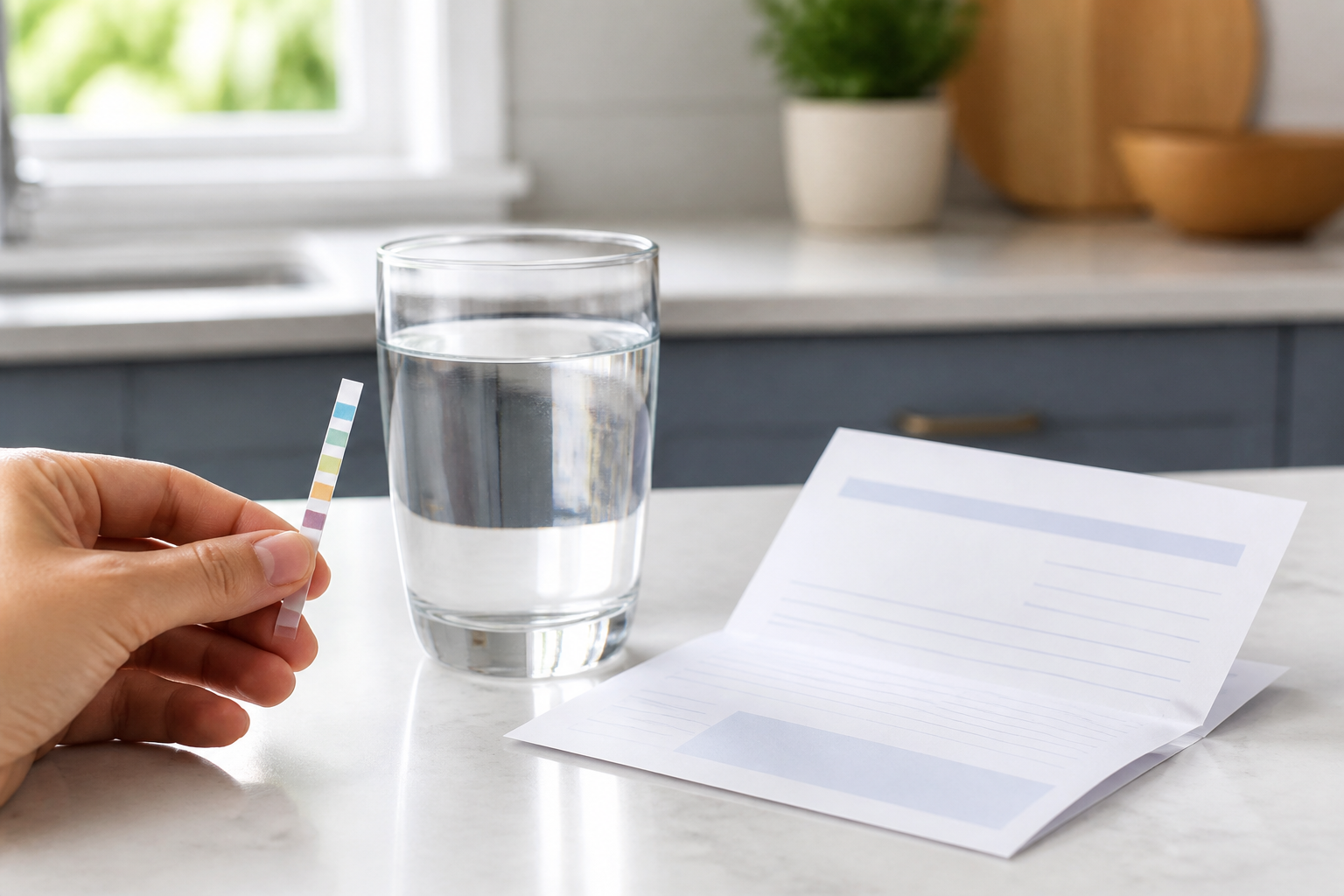
What kind of test should you choose? A strip is useful for a quick range. A liquid-drop hardness test can give a more specific number when you carefully follow the kit instructions. A laboratory test may make sense when you need a documented result or have several water-quality questions at once.
If you only want a rough clue, a soap-and-water check can point to a possible hard-water pattern, but it cannot measure a hardness level. Our no-kit hard-water check explains how to use that clue without treating it as proof.
What to Do With Your Local Hardness Result
You have a number. What should happen next? Start by connecting it to the problem you are trying to solve.
If the number is low and you do not have scale or soap problems, you may only need to keep the result with your household records. If the number is high and you are seeing mineral buildup, compare it with the water hardness scale and decide whether you need a more precise test before spending money on treatment.
If you are considering a softener, use a measured incoming-water result with your household’s water use and the equipment guidance. Our water-softener sizing guide for a family of four shows why a hardness number is only one part of the sizing decision.
It also helps to record where and when you sampled. Was the water taken before or after an existing softener? Did you use the kitchen tap, an outdoor spigot, or a utility report? Keeping those details next to the number makes future comparisons far more useful.
Frequently Asked Questions
Is water hardness by ZIP code accurate?
It can be accurate enough for a local estimate, especially when the source identifies your water system and report date. It may not match your exact tap water because ZIP codes, utility service areas, water sources, and sampling dates can differ. Confirm a decision-making number with your supplier or a test at home.
Can I find my water hardness on my water bill?
Your bill may name the utility that serves you, which is often the fastest route to the correct report. The annual Consumer Confidence Report or the utility’s customer-service team may provide more useful local water information. Hardness is not guaranteed to appear on every report, so ask for the current hardness range if you cannot find it.
Is PPM the same as grains per gallon for water hardness?
No. PPM and mg/L as calcium carbonate are commonly used in the same way for hardness, while GPG is a different unit. One GPG is about 17.1 mg/L as calcium carbonate. Check the unit before comparing a map result with a softener setting.
Does a ZIP-code result work for private well water?
No. A ZIP-code result may describe nearby public water, but it cannot measure water drawn from your private well. Use a home test or laboratory result for a hardness number that reflects your own well.
Should I test again if my local lookup has not changed?
Test again when you need a current number for equipment, notice a meaningful change at the tap, or have changed water sources or treatment equipment. Our guide on how often to test water hardness can help you choose a practical retesting schedule.
The Bottom Line
Finding water hardness by ZIP code is a smart first step when you want a quick local picture. Use the result to identify your likely water system, check the latest supplier information, and learn which unit you are looking at. Then confirm the number at your tap when it will guide a softener setting, a purchase, or a treatment decision.
That short sequence keeps a local estimate in the right role: helpful background, not a substitute for the water you actually use every day.
Don’t treat a map value as a softener setting. A quick confirmation now can prevent a costly wrong turn later.