

If your water softener is not working, start by testing the water instead of guessing from a spot on a faucet or how soap feels. Compare a sample before the softener, if you have an untreated tap, with a cold-water sample from a softened tap. Then check the bypass, the salt tank, and the control settings before you try a regeneration cycle. That order helps you avoid buying salt or parts for the wrong problem.
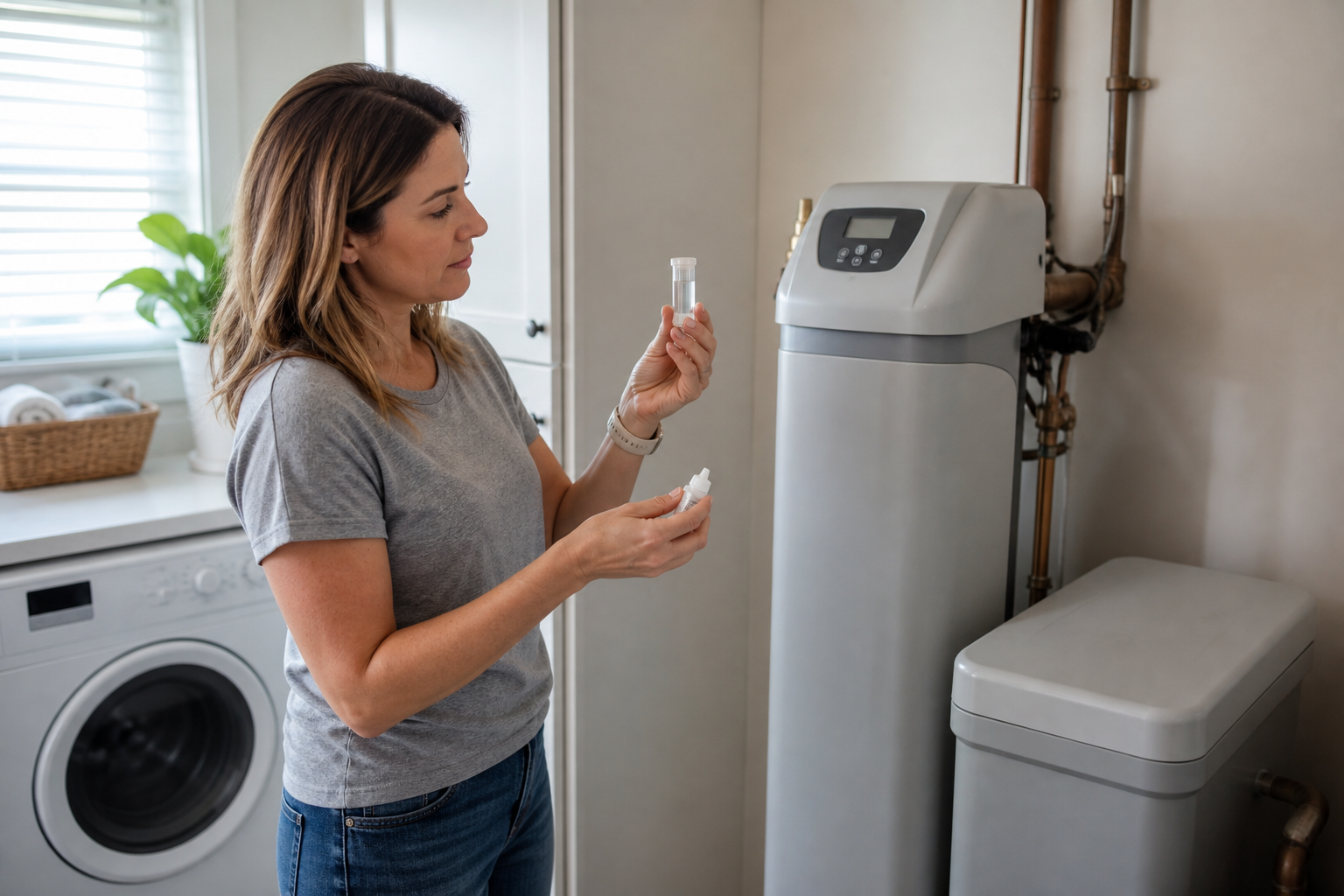

A conventional ion-exchange softener should reduce calcium and magnesium hardness. It does not remove every water-quality issue, and a softener that seems ineffective can have a plumbing, setting, salt, regeneration, iron, or resin problem. This guide gives you safe checks that apply to many residential systems. Your owner manual is the authority for controls, valve parts, cleaners, and service procedures for your model.
Table of Contents
Table of Contents
- Confirm That the Water Is Still Hard
- Check the Simple Causes First
- Inspect the Brine Tank Without Guessing
- Use a Regeneration Cycle as a Diagnostic Check
- When Settings, Iron, or Capacity Are the Problem
- When to Stop and Call for Service
- Frequently Asked Questions
Confirm That the Water Is Still Hard
Hard-water symptoms are useful clues, but they do not prove the softener has failed. White scale can remain on fixtures after a past hard-water period. A slippery feel can vary with soap, temperature, and personal preference. A current hardness result gives you a usable baseline.
Use a water-hardness test method that reports a number, then write down where and when you took each sample. A drop-count kit can give a more precise result than a basic strip, while strips can still help you see a large difference between treated and untreated water. Our guide to testing water hardness at home explains the options and how to compare ppm, mg/L, and grains per gallon.
Penn State Extension notes that hardness is commonly reported as ppm or mg/L and as grains per gallon. One grain per gallon is about 17 mg/L or ppm. That number matters because the softener setting should match the incoming hardness, not an old estimate or a neighbor’s result. If you use water from a private well, include iron and manganese in the question when the test or local conditions suggest it.
A simple comparison plan
- Run cold water for a short time at the softened tap and collect a sample.
- If your plumbing has an untreated outdoor tap or other known raw-water location, collect a separate sample there. Do not assume every outdoor tap is untreated.
- Test both samples using the kit instructions and record the results.
- Compare the treated result with the raw result, the softener setting, and the expected result in your manual.
Do not use a TDS meter as the proof that a softener works. Ion exchange changes the ions in water but does not necessarily lower total dissolved solids. A hardness-specific test is the better diagnostic tool for this job.
Check the Simple Causes First
Before you inspect any internal component, check the system position and the information it uses to decide when to regenerate. These checks are low risk and often explain why hard water is reaching the house.
Is the softener in bypass?
A bypass lets water flow around the treatment tank. It is useful during repairs, but it also means hard water can reach the house. Look at the bypass valve position and compare it with the diagram in your manual. If you are unsure which direction is service or bypass, stop there rather than forcing a valve.
Does the control have power and the correct time?
Check that the display is on, the clock is correct, and the control has no error message. A power interruption, an incorrect time, or a disconnected unit can prevent a timed softener from regenerating when expected. Make a note of any code before you reset anything. The manufacturer support page or owner manual can explain codes for your model.
Does the hardness setting match a current result?
If the programmed hardness is far lower than the incoming water, a demand-controlled unit may wait too long to regenerate. If it is much higher, the unit can use more salt and water than necessary. Do not raise the setting at random. Use your incoming-water result and follow the model’s instructions. Our guide to setting water hardness on a softener can help you prepare the right information before changing the control.
Inspect the Brine Tank Without Guessing
Salt in the tank is necessary, but a full-looking tank is not proof that the softener can make brine. A hard salt crust, called a salt bridge, can leave empty space below it. Water cannot contact enough salt, so the system cannot make the brine it needs for regeneration.
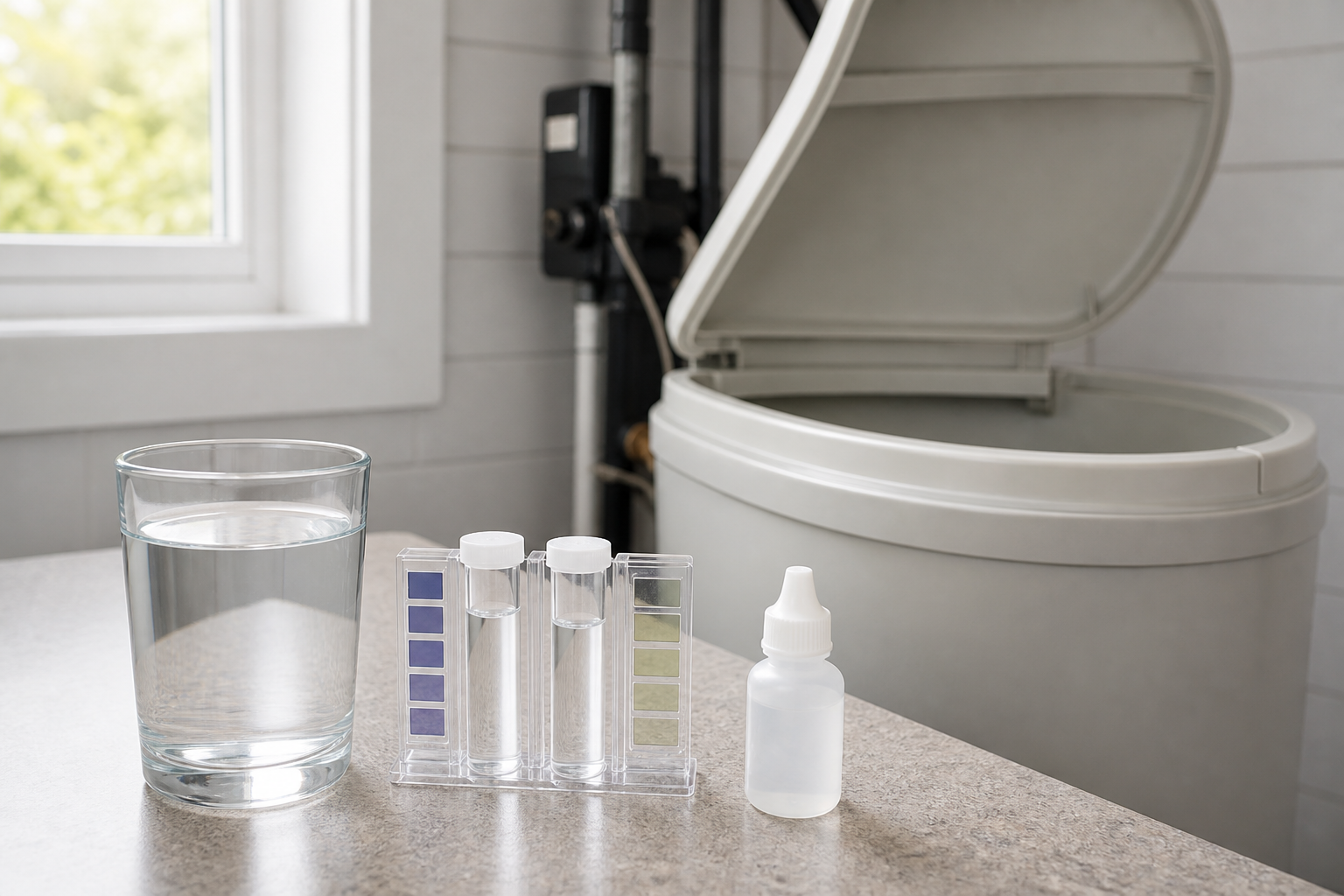
With the system manual nearby, open the salt-tank lid and look for these conditions:
- Low or empty salt: Refill only with the type of salt your manual permits. A new bag does not instantly restore soft water. The system must complete a correct regeneration first.
- A possible salt bridge: GE Appliances describes a salt bridge as a hard crust with brine and open space below it. Use a long blunt handle carefully to check whether loose salt extends down to the bottom. Do not strike the tank walls, float assembly, or brine well.
- Salt mush or unusual standing water: These can point to a brine-system issue, but the cause and safe cleanup steps vary by model. Follow the manual or arrange service rather than adding chemicals or disassembling a valve.
The salt type matters too. A product should be labeled for water softeners and match the salt form and chemistry allowed by the equipment manufacturer. See how to choose water-softener salt before changing products. A different bag is not a universal fix for an injector, valve, drain, or resin problem.
Use a Regeneration Cycle as a Diagnostic Check
If the bypass, power, setting, and brine-tank checks do not explain the issue, use the manual’s manual-regeneration procedure. Do not take apart the control valve or remove electrical covers. Your goal is to observe whether the expected stages occur, not to diagnose internal parts yourself.
Many residential manuals describe stages such as fill, brine draw, backwash, and rinse. A GE softener manual, for example, tells the owner to observe water entering the brine tank during fill, a gradual drop in brine level during brine draw, and adequate flow to the drain during backwash and rinse. Those are model-specific instructions, but they show why the manual’s sequence is valuable.
During the cycle, note only what you can safely see or hear:
| What you observe | What it may mean | Safe next step |
|---|---|---|
| The control will not start a manual cycle | Power, programming, or a model-specific control problem | Record the display and use the manual’s troubleshooting section. |
| No water enters during the specified fill stage | A fill, tubing, or control issue may be present | Stop the test and arrange model-specific service. |
| Brine level does not drop during the specified draw stage | A salt bridge, restricted brine path, or valve issue may be present | Check the bridge only as the manual allows, then call for service if it persists. |
| Drain flow is weak or absent when the manual expects it | A drain restriction or control issue may be present | Do not operate the unit repeatedly. Arrange service. |
| The cycle completes but treated water still tests hard | Settings, raw-water changes, iron, capacity, or resin may need investigation | Compare the two hardness samples and contact a qualified professional. |
After a manual cycle, let the system complete the rinse steps required by its manual before you test again. Repeatedly forcing regeneration can waste water and salt, and it may hide the pattern a technician needs to see.
When Settings, Iron, or Capacity Are the Problem
If the system cycles and the brine tank seems normal but the treated sample still has significant hardness, look beyond the salt level. A change in raw-water hardness, household use, or iron can change how a softener performs. Penn State Extension advises testing water before choosing or adjusting treatment because hardness is only one part of a water analysis.
For example, a home with more people, more water use, or harder source water may reach its programmed capacity sooner. A softener that was sized or set for an earlier household pattern may need a new calculation. Our guide to water-softener sizing for a family of four explains the measured inputs that an installer uses for this decision.
Iron can also complicate a hardness problem, especially for well water. Do not assume orange staining is only hardness or add a resin cleaner without checking the manual. If the equipment maker allows a cleaning procedure, use the exact product and amount it specifies. Our guide to cleaning a water-softener resin tank explains the maintenance boundary, but a lab result or qualified water-treatment professional is the better next step when iron, manganese, odor, or unusual color is involved.
When to Stop and Call for Service
Call a qualified plumber or water-treatment technician when you see a leak, an electrical problem, a cracked tank, a persistent error code, an overflowing brine tank, or a regeneration stage that does not follow the manual. Also call when treated water remains hard after you confirm the bypass, settings, salt contact, and a complete regeneration cycle.
Take these notes with you:
- model and serial number
- current raw-water and treated-water hardness results
- the programmed hardness and regeneration settings
- salt type and recent refill date
- photos of the control display and brine tank, if safe to take
- any change in water source, well conditions, household size, or water use
Those details help a technician separate an input-water change from a mechanical problem. They also reduce the chance of replacing parts before the cause is known.
Frequently Asked Questions
How can I tell if my water softener is working?
Test a cold-water sample from a softened tap and compare it with a known untreated sample when possible. Use a hardness-specific test and compare the result with the system setting. Scale or soap feel alone cannot confirm performance.
Why is my water softener full of salt but the water is still hard?
The salt may be bridged above open space, the softener may be in bypass, the control may be set incorrectly, or the system may not be drawing brine during regeneration. Start with the safe checks in your manual and use a hardness test before you buy parts.
Can I run regeneration twice to fix hard water?
Only run a manual regeneration as your owner manual allows. If the system completes the cycle and treated water still tests hard, repeated cycles can waste water and salt without solving a control, brine, drain, iron, capacity, or resin issue.
Is a water softener supposed to remove iron?
Some equipment can address limited iron conditions when the manufacturer permits it, but the answer depends on iron type, concentration, pH, and the specific system. A water test and the equipment documentation should guide the treatment plan.
When should I replace my water softener?
Replacement is a decision for after diagnosis, not the first response to hard water. Get current test results and a service assessment if there are persistent mechanical issues, damaged components, or treatment needs that the existing system cannot meet.