


The best water softener salt is the type your specific system allows, in a clean, high-purity form labeled for water softeners. That sounds simple, but the bags on a store shelf can look almost identical while serving different uses. Pellet, solar, rock, block, sodium chloride, and potassium chloride labels describe different forms or chemistry. Your owner’s manual is the final check.
Start with the system you have, not the bag that happens to be on sale. Some manufacturers list more than one acceptable salt type. For example, a Pentair performance manual lists sodium-chloride pellet or solar salt for its listed systems. Other equipment may have different instructions. If the manual specifies blocks, pellets, solar salt, or potassium chloride, follow that instruction before using a substitute.
Do you need a new bag because the tank is low, or are you trying to solve scale, salty water, iron staining, or a softener that is not regenerating? Those are different problems. This guide helps you match the salt type to the system and know when a water test or service call is the better next step.
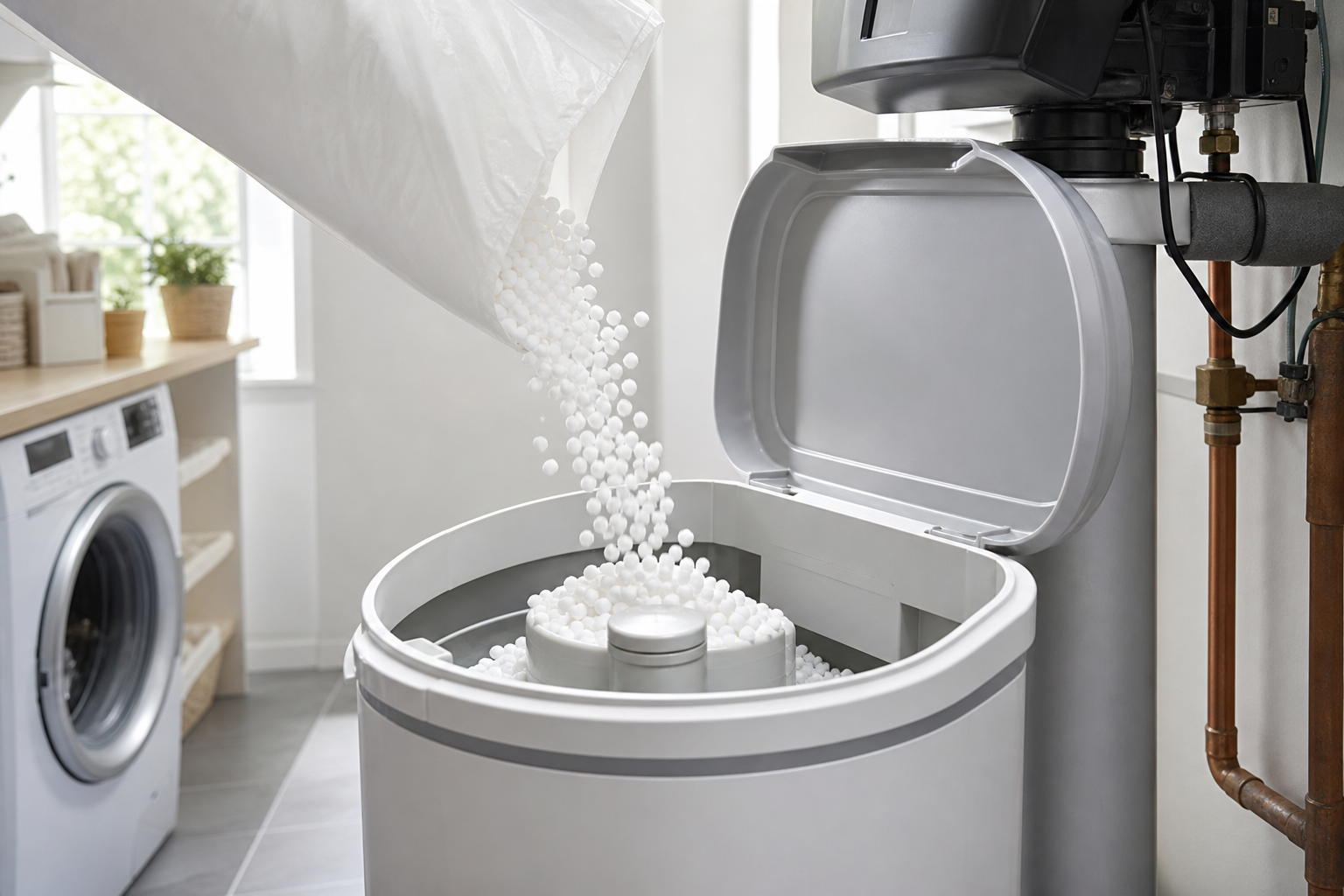

Table of Contents
Table of Contents
- The Short Answer
- Why a Water Softener Needs Salt
- Common Water Softener Salt Types
- Read the Label Before You Buy
- How to Choose the Right Bag
- When Iron or a Salt Bridge Changes the Plan
- How Much Salt to Add
- Frequently Asked Questions
The Short Answer
What is the best water softener salt for most homes? There is no universal bag that is right for every machine or water supply. Choose a clean product labeled for water softeners that matches the salt form and chemistry in your manual. For many systems, the practical decision is between sodium-chloride pellets, solar salt, and potassium chloride. Do not use ice-melt rock salt, table salt, or a livestock block unless your equipment documentation specifically says it is acceptable.
The RainSoft salt requirements give a useful general rule: water-softener salt should be clean, high purity, and labeled for water softeners. That manual warns against ice-melt rock salt because impurities can clog the brine system. It also advises against very fine granulated salt because it can cause service problems.
Before you change what you buy, confirm that the softener is set for your incoming hardness. A wrong hardness setting can waste salt or allow hard water through even when the tank is full. Our guide to setting water hardness on a softener explains how to start with a current measurement instead of guessing.
Why a Water Softener Needs Salt
A conventional ion-exchange softener uses resin to exchange hardness minerals, mainly calcium and magnesium, for another ion. The brine made in the salt tank regenerates that resin so it can continue treating incoming water. The salt is therefore a system supply, not a cure for every water problem.
How hard is your water now? A current result gives you a better starting point than a white mark on a faucet. Use our guide to testing water hardness at home to choose a method, then compare the result with the unit setting and the manual. Morton explains that hardness is commonly expressed in grains per gallon, milligrams per liter, or parts per million, and that one grain per gallon equals 17.1 mg/L or ppm in its guidance.
More hardness and more household water use generally mean more regeneration and more salt use. But the exact amount also depends on the softener’s capacity, programmed salt dose, and demand settings. Do not increase the salt setting just because the brine tank looks low. A model’s efficiency rating can depend on its stated salt dosage, as the Pentair manual notes.
Common Water Softener Salt Types
The bag label should tell you both the material and the intended application. Here is what the common choices mean.
Sodium-chloride pellets
Pellets are a common water-softener format. They are easy to pour and are often selected when the manual calls for pellets or allows a clean bag salt. Check the package for its intended use and follow the manufacturer’s refill guidance. A pellet shape does not, by itself, tell you whether it is suitable for every softener or whether it contains an added cleaner.
Solar salt
Solar salt is another common sodium-chloride option and is often sold as crystals or pellets. Some equipment manuals specifically allow solar salt. For example, the Pentair document above lists pellet or solar salt as acceptable for the systems covered by that manual. Do not transfer that rule to a different brand or model without checking its manual.
Potassium chloride
Potassium chloride is a sodium-reduced alternative that some softeners can use. Morton states that its potassium chloride pellets can be used in place of water-softener salt in its systems, but a manufacturer’s answer for one product line is not a substitute for your own manual. RainSoft also says to consult its dealer before using potassium chloride.
Potassium chloride is not the right choice for every household. The Morton FAQ advises people with certain medical conditions or a potassium restriction to consult a clinician before consuming potassium-softened water. Do not make a diet decision from a salt-bag claim alone. Ask the clinician who manages the restriction and check whether a separate drinking-water tap is appropriate for your home.
Rock salt, ice melt, and unapproved blocks
Rock salt and ice-melt products can contain impurities that are unsuitable for a brine system. Avoid products sold for de-icing. Also avoid fine granulated salt and blocks not labeled for water softeners unless your equipment documentation explicitly calls for them. A softener that needs a block is a reason to buy the specified block, not to force pellets into the tank.
Read the Label Before You Buy
The front of a bag can use broad words such as “clean,” “natural,” or “protect.” Treat those as a starting point, not proof that the bag matches your machine. Read the small print for the product’s intended application, salt form, and any added cleaner. Then compare that information with your manual.
| Check on the label or manual | Why it matters | What to do |
|---|---|---|
| Intended use | Ice melt, food salt, and water-softener salt are not interchangeable. | Choose a product labeled for water softeners. |
| Salt form | A system may call for pellets, crystals, solar salt, or blocks. | Use only a form that your model permits. |
| Chemistry | Sodium chloride and potassium chloride are different regenerants. | Confirm the chemistry before switching. |
| Added cleaner | An additive may be marketed for a specific maintenance concern. | Treat it as a maintenance product, not as an iron test or treatment plan. |
| Refill directions | The correct fill level varies by equipment design. | Follow the manual instead of filling to the top by habit. |
If the label does not clearly state that it is for water softeners, leave it on the shelf. Keep the receipt and note the bag type when you try an approved alternative. That simple record helps a service technician see whether the problem started before or after a change in supplies.
How to Choose the Right Bag
Use this short process at the shelf or before you order online.
- Read the manual first. Find the approved salt chemistry and form for your exact softener model.
- Match the label to the manual. Look for a product labeled for water softeners, not a de-icer, food salt, or animal product.
- Check the water result. Measured hardness, iron, and household use affect the system setting and maintenance plan.
- Inspect the brine tank. A bridge, mush, standing water, or visible residue may need maintenance before another bag solves anything.
- Make one change at a time. If you change salt type, keep the manual’s programmed settings in view and note whether the system continues to regenerate normally.
If you are still selecting or replacing equipment, the right salt does not fix an undersized softener. See what size water softener a family of four may need for the test-first sizing factors to discuss with an installer. Don’t rely on bag choice to correct a capacity problem.
When Iron or a Salt Bridge Changes the Plan
Iron and hardness are separate measurements. Iron can cause orange or brown staining, while hardness more often shows up as scale and soap-film problems. A salt with an added cleaner may be marketed for iron concerns, but it is not proof of the iron level in your water or a replacement for the treatment your water requires.
If you use a private well, test before choosing a specialized salt. Our guide to what a water softener does to well water explains why a conventional softener can address hardness but does not test for or treat every well-water issue. If staining, odor, a sudden water change, or a failed test is present, use a broader water test and consult a qualified water-treatment professional before relying on a bag additive.
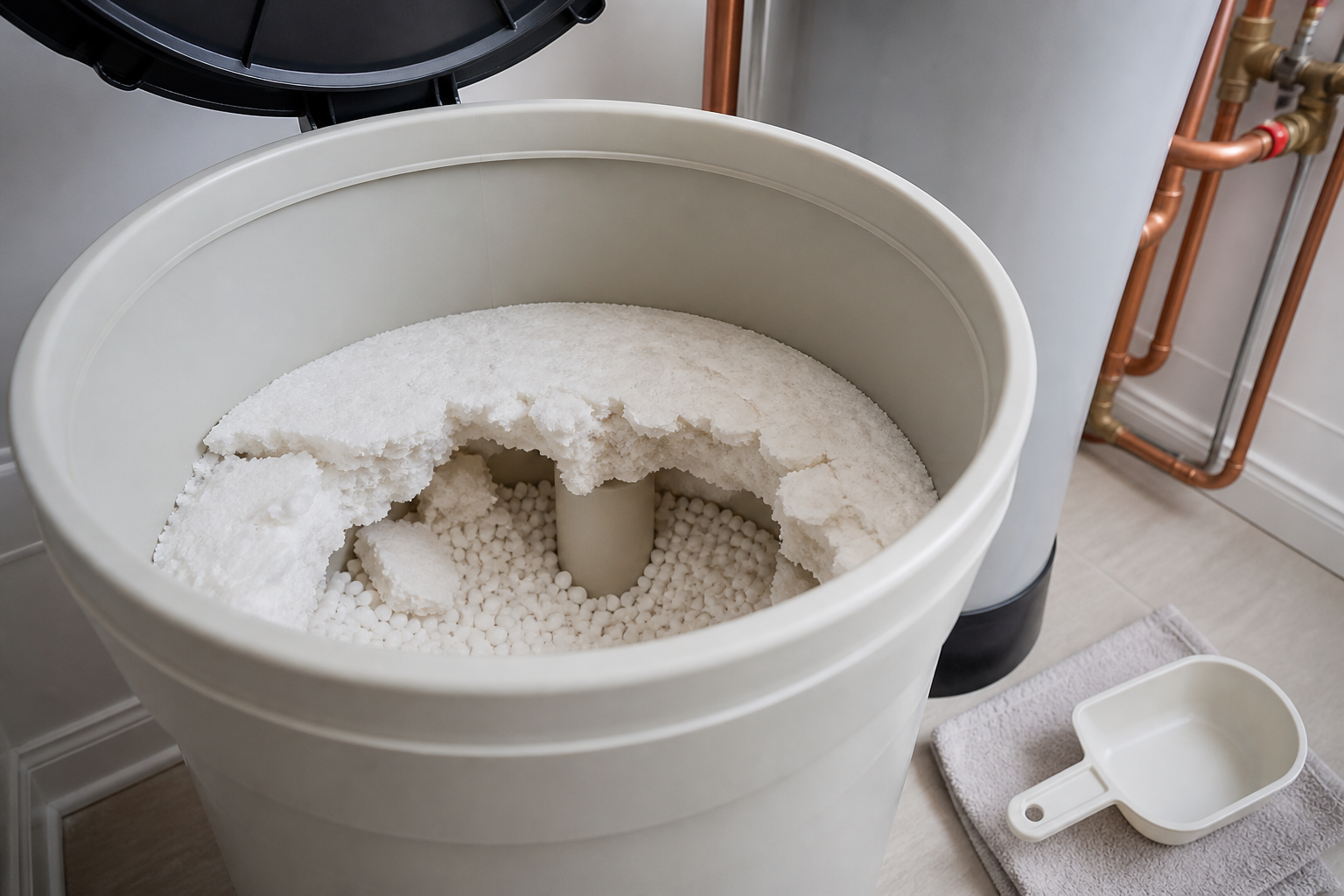
A salt bridge is a hard crust that spans the brine tank and can leave an empty space below it. The tank may look full even though the softener cannot make brine. Follow your owner’s manual for safe access and cleaning. Do not strike the cabinet, force tools into the brine well, or add water and salt at random. If the bridge returns, the tank has heavy residue, or the unit is not regenerating, schedule service.
How Much Salt to Add
Add salt according to the fill level and refill method in the manual. A full tank is not always better. Overfilling can make it harder to see a bridge or residue and can leave salt sitting unused for long periods. Morton says household use varies with hardness and water use, so its own average use figure should not be treated as a target for every home.
A practical routine is to check the tank before it is empty, add the amount your manual allows, and record the date. Keep bags dry, use the same approved product while you troubleshoot, and check the tank more often after a long vacation or a change in household water use. If your home has recurring scale in appliances, also inspect the underlying hardness setting and actual water result. Our guide to hard water and plumbing appliances can help you separate a general hard-water pattern from a single appliance fault.
Frequently Asked Questions
Can I use any salt in my water softener?
No. Use a clean product labeled for water softeners and match the chemistry and form to your exact model’s manual. Avoid ice-melt salt, table salt, and unapproved blocks or fine granulated products.
Are pellets or solar salt better?
Neither label is universally better. Check what your manual permits, then select a clean product labeled for water softeners. A model may accept one, both, or a specific form.
Can I use potassium chloride instead of sodium chloride?
Some systems allow it. Confirm with the unit manual or manufacturer before switching. If anyone in the home has a potassium-restricted diet or a related medical concern, consult the appropriate clinician before using potassium-softened water for drinking or cooking.
Does more salt make water softer?
Not automatically. A softener needs the correct programmed setting, adequate regenerant, and working valves and resin. Adding more salt does not correct an incorrect hardness setting, a bridge, an iron issue, or a mechanical fault.
What should I do if the water tastes salty?
Do not assume a different salt bag will fix it. Morton says a properly operating softener should rinse brine from the system. Check the manual and contact a qualified service provider if the taste persists, especially if the system has a stuck valve, a programming issue, or another fault.
Choose by Your System, Then Maintain It
The best water softener salt is a documented match for your softener, your water result, and your maintenance plan. Follow the manual, buy a clean product labeled for water softeners, and do not treat special additives or a larger salt dose as a substitute for a diagnosis.
Start with a hardness result, confirm the setting, and inspect the brine tank before you buy another bag. That sequence helps you keep the softener working and makes it easier to know when the real issue is iron, a bridge, a sizing problem, or a service need.