

Does a whole house filter soften water? Usually, no. A standard whole-house sediment or carbon filter can address a named filtration concern, but it does not normally remove the dissolved calcium and magnesium that make water hard. If scale, spots, and soap film are your main problem, you need to look for a true water softener, not rely on the word “filter” in a product name.
Fortunately, the decision is easier when you separate the problem from the equipment label. A whole-home package can include both filtration and softening. But only the softening stage, usually ion-exchange resin with a salt or potassium-chloride regeneration system, is designed to reduce hardness throughout your plumbing.
Start with a water-hardness test before you buy anything. This guide explains what a whole-house filter can do, when a softener makes more sense, and what to verify if you need both.
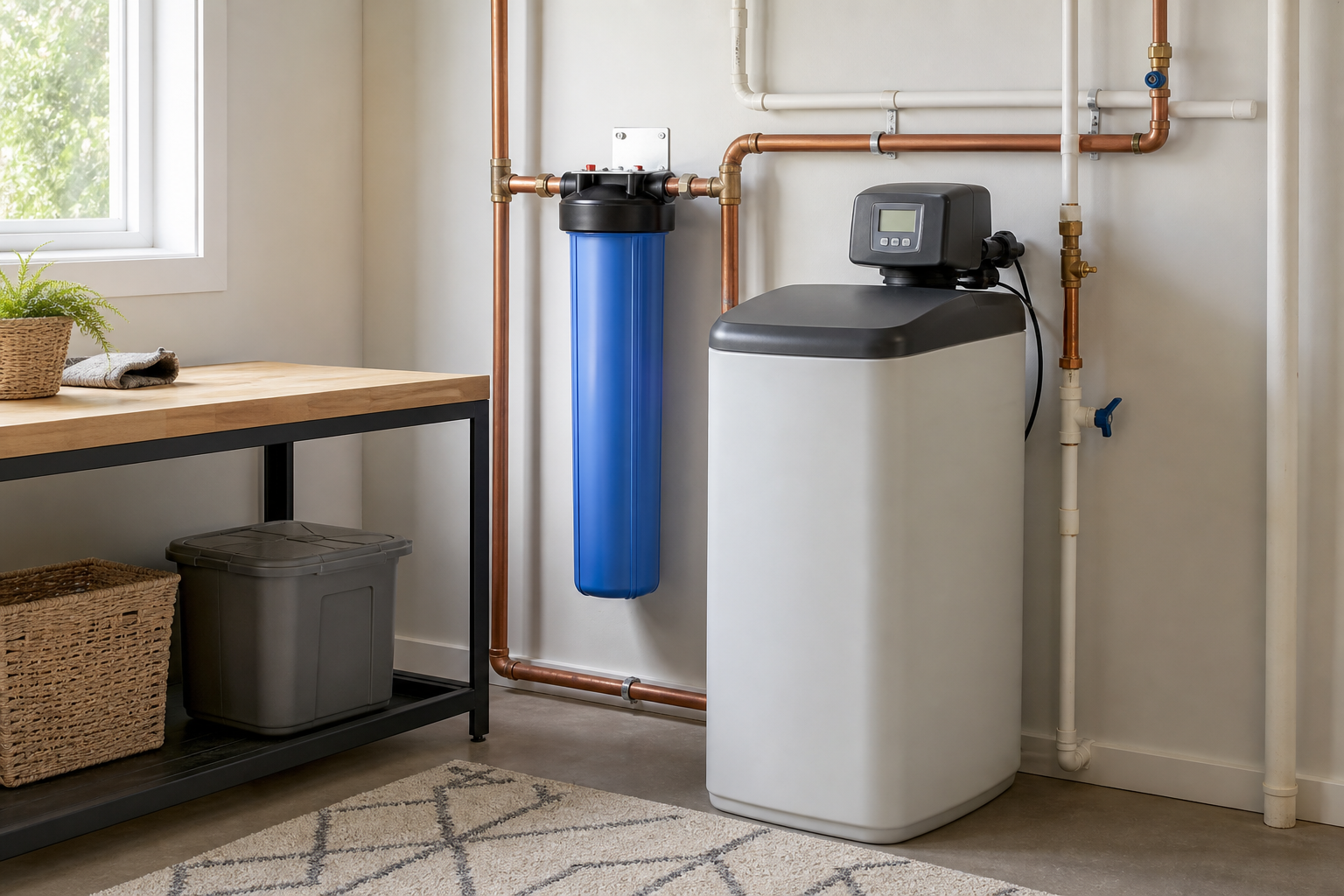

Table of Contents
Table of Contents
- The Short Answer
- Why a Standard Whole-House Filter Does Not Soften Water
- What a Water Softener Does Differently
- Filter, Softener, or Both?
- How to Buy the Right Whole-Home System
- Frequently Asked Questions
The Short Answer
Most whole-house filters do not soften water. They may use sediment media, activated carbon, or other treatment media to address particles, chlorine taste or odor, or a different stated condition. Those are filtration jobs. Hardness is different because it comes mainly from dissolved calcium and magnesium in the water.
The U.S. Geological Survey describes water hardness as the amount of dissolved calcium and magnesium. Those minerals can leave white scale on fixtures, make soap harder to rinse, and build up in equipment that heats water. A cartridge that catches rust particles does not automatically remove dissolved hardness minerals.
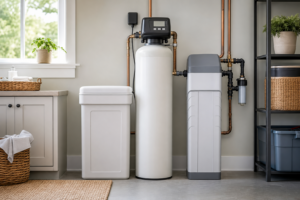
There is one important exception. A company may sell a combined whole-home system that includes a filter and a conventional softener. That package can soften water if it has an ion-exchange softening stage. Check the specifications for terms such as “cation exchange,” “softening resin,” “hardness reduction,” or a documented NSF/ANSI 44 certification or claim. Do not assume that a system softens water simply because it sits on the main water line.
What should you do if the product description is vague? Ask the seller to identify the exact media, the hardness-reduction claim, the test conditions, the capacity, and the maintenance requirements. If they cannot do that, treat it as a filter, not as a substitute for a softener.
Why a Standard Whole-House Filter Does Not Soften Water
A whole-house filter is installed at the point where water enters your home. The CDC explains that whole-home systems treat most or all of the water that enters a house. That location can be useful when a verified condition affects many fixtures or appliances. It does not tell you what the system removes.
Common whole-house filter stages can have useful but limited jobs:
| Filter type | What it may address when the model documents the claim | Does it soften water? |
|---|---|---|
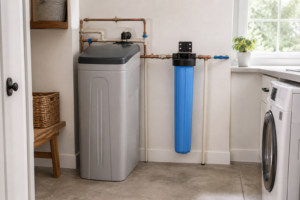
| Sediment filter | Sand, rust particles, or other suspended material. | No. |
| Activated-carbon filter | Chlorine taste or odor and other stated filtration claims. | No. |
| Iron or sulfur treatment filter | A documented iron, manganese, or sulfur condition. | Not unless it also includes a true softening stage. |
| Ultraviolet treatment | A documented disinfection application when the water and system meet the required conditions. | No. |
| Combined filter and softener | Separate filtration and ion-exchange stages. | Yes, if the softener stage is specified for hardness reduction. |
Why does this distinction matter? Calcium and magnesium are dissolved in the water, not simply floating particles that a basic screen can catch. A filter can make water look clearer or change its taste while the hardness result stays the same. You may still see scale on a kettle, shower door, dishwasher, or water heater.
If you have a test result, use our water hardness scale guide to read the number in mg/L, ppm, or grains per gallon. USGS lists a common guide: 0 to 60 mg/L as soft, 61 to 120 mg/L as moderately hard, 121 to 180 mg/L as hard, and more than 180 mg/L as very hard. The number is a starting point. Your plumbing, water use, and scale problems also affect whether treatment is worthwhile.
What a Water Softener Does Differently
A conventional water softener is designed for hardness reduction. It uses cation-exchange resin to exchange calcium and magnesium ions for sodium or potassium ions. That is why a softener needs a regeneration process, while a basic whole-house filter normally needs filter-media replacement instead.
NSF explains that NSF/ANSI 44 applies to cation-exchange water softeners that reduce calcium and magnesium hardness. This is the type of claim to look for when hard water is your real concern. It is more useful than a broad statement that a unit “improves water quality.”
What does a softener not do? It does not automatically address sediment, chlorine, lead, PFAS, bacteria, or every other possible water condition. Each issue needs a matching, documented treatment claim. That is why a home can need a softener for hardness and a separate filter for another tested concern.
The EPA WaterSense home-maintenance guidance notes that softeners use resin and brine regeneration. It also recommends programming regeneration from incoming hardness or water flow rather than using a fixed schedule when possible. Before you buy, consider where the unit will drain, how much water it uses during regeneration, and whether local rules affect softener discharge.
Would a salt-free conditioner solve the same problem? Do not assume so. A conditioner and an ion-exchange softener use different technologies and claims. Read the exact product documentation, especially the stated scale-reduction or hardness-reduction result. If you need measurable hardness reduction across the home, choose equipment that clearly states that function.
Filter, Softener, or Both?
The best choice follows the test result and the problem you want to solve. Here is a practical way to compare the options.
| Your verified concern | The system role to consider | What to verify before buying |
|---|---|---|
| Scale, soap film, spots, and a hardness result | Conventional whole-home softener. | Hardness-reduction claim, flow rate, capacity, regeneration needs, and installation requirements. |
| Sediment or a named filtration concern at many fixtures | Whole-house filter selected for that condition. | The exact reduction claim, cartridge or media life, flow rate, and maintenance instructions. |
| Hardness plus a separate verified concern | A softener plus a separate filter, or a combined system with distinct stages. | The purpose and documentation for each stage, not only the package name. |
| A drinking-water concern at one tap | Point-of-use treatment selected for that condition. | The exact system claim, installation requirements, and replacement schedule. |
For a broad comparison, see water softener vs. water filter. It explains why a softener is for hardness, while a filter must be selected for a specific claimed reduction. If you are also comparing brands or whole-home filter designs, our whole-house water filter guide can help you ask the right system-selection questions.
Do you need both? You might if your test shows hardness and another condition that the softener does not address. For example, a home might use a softener for hard-water scale and a separate treatment stage for a different documented concern. The correct order depends on the equipment, water chemistry, and manufacturer instructions. A qualified installer can help with plumbing design, but you should still keep the test result and treatment claims in the decision.
How to Buy the Right Whole-Home System
You don’t need to guess based on a product photo or a broad promise. Use this checklist before you buy a whole-house water filter for hard water.
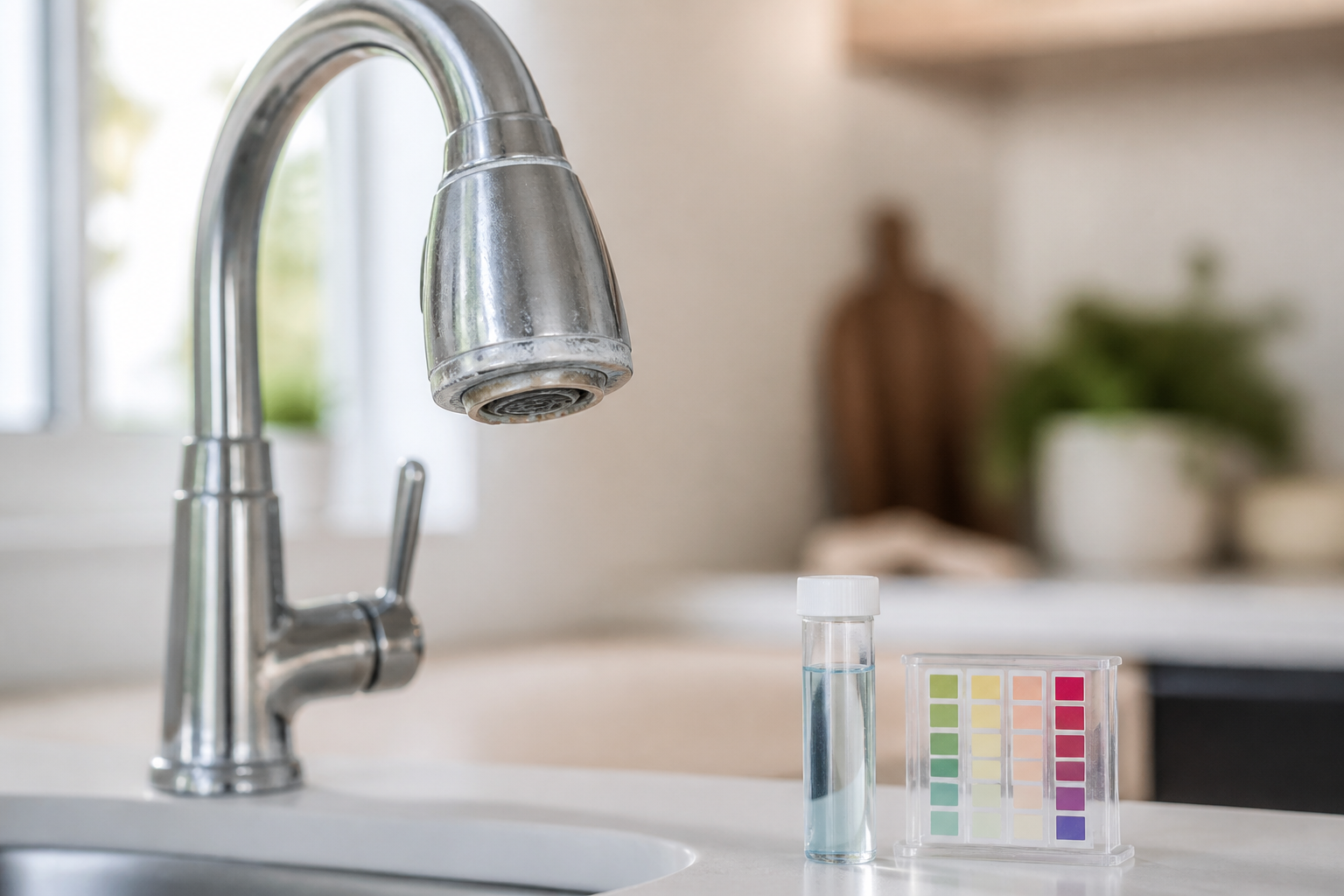
- Test the incoming water. Confirm hardness at the supply and identify any separate condition you want to treat. A broader test is especially useful for private-well water.
- Name the outcome you want. Are you trying to reduce hardness and scale, improve a taste or odor issue, manage sediment, or address another documented result?
- Match the technology to that outcome. For hardness reduction, look for a true ion-exchange softener. For another condition, look for a filter or treatment system with a claim for that exact condition.
- Read the exact model documentation. Check flow rate, capacity, pressure limits, installation needs, replacement schedule, and what the claim does not cover.
- Plan the maintenance. A softener needs salt or potassium chloride and regeneration maintenance. A filter needs replacement media or cartridges on the stated schedule.
What size softener do you need if hardness is confirmed? Household water use and incoming hardness both matter. Our water-softener sizing guide for a family of four shows how those details affect capacity planning.
Frequently Asked Questions
Can a whole-house carbon filter remove hard water?
No. A whole-house carbon filter can have useful, documented filtration claims, but it is not normally designed to reduce dissolved calcium and magnesium hardness. For measured hardness reduction, look for a conventional ion-exchange softener or a combined system with a specified softening stage.
Does a whole-house filter stop limescale?
Not by itself when the scale is caused by hard water. If the hardness result remains high, the minerals that form scale are still present. A softener can reduce those hardness minerals, while a filter should be selected for a different documented water condition.
Can a combined whole-house system filter and soften water?
Yes, but only if it includes separate treatment stages that do both jobs. Check for the softener’s hardness-reduction claim and the filter stage’s exact reduction claim. A combined product name is not enough evidence.
Do I need a softener if I already have a whole-house filter?
You may if your test confirms hardness and you want to reduce scale or soap-performance problems. The filter may still be useful for a separate concern, but it does not replace a softener unless its specifications include an actual hardness-reduction stage.
Should I test water before buying a whole-house system?
Yes. Test results tell you whether hardness is the issue and whether another condition needs separate treatment. That makes it easier to choose one system, or a combination of systems, with a clear job for each stage.
The Bottom Line
A standard whole-house filter does not soften water. It may be useful for sediment, a taste or odor concern, or another documented condition, but it does not normally remove the calcium and magnesium that cause hardness. If your goal is less scale throughout the home, start with a hardness test and look for a true ion-exchange softener.
If your water has more than one verified need, a filter and a softener can work together. The useful question is not whether a system is called “whole house.” It is whether every stage has a clear, documented job that matches your water test.