

As an Amazon Associate, Water Advisor earns from qualifying purchases. Product picks are based on public specs, certifications, and buyer-feedback signals; we do not personally test products.
Have you ever looked up what’s actually flowing through your pipes? When the EPA set new limits on PFAS (forever chemicals) in drinking water at just 4 parts per trillion, millions of homeowners realized their tap water might not be as clean as they assumed.
You’re not alone if that made you a little uneasy. Finding the best whole house water filter for your home can feel overwhelming when dozens of brands are competing for your attention (and your wallet). And most whole house water filter reviews out there focus on sticker prices without ever breaking down the real long-term costs or explaining which contaminants each system actually removes.
We’ve compared six of the top whole house water filtration systems for 2026, calculated 5-year total costs (not just purchase prices), and laid out which system fits city water vs. well water. By the end, you’ll know exactly which point-of-entry filter matches your water source, your household size, and your budget.
Table of Contents
Do You Actually Need a Whole House Water Filter?
Before you spend $400 to $2,000 on a filtration system, let’s figure out if you even need one. Not every home does. The answer depends on your water source, what’s in it, and what problems you’re trying to solve.
Whole House Filter vs. Under-Sink: Which Makes Sense for You?
A whole house water filter sits at your main water line and treats every drop that enters your home. That means cleaner water for drinking, cooking, showering, laundry, and even your dishwasher. An under-sink system only treats water at one faucet.
Here’s when a whole house system makes more sense:
- You notice chlorine smell or taste throughout the house
- Your water leaves stains on fixtures, clothing, or dishes
- You have well water with sediment, iron, or sulfur issues
- You want to protect your water heater and appliances from scale and corrosion
- You’re concerned about breathing in chlorine or chloramine vapors during hot showers
An under-sink reverse osmosis (RO) filter is the better choice if your only concern is drinking water quality, especially for PFAS. More on that in a moment.
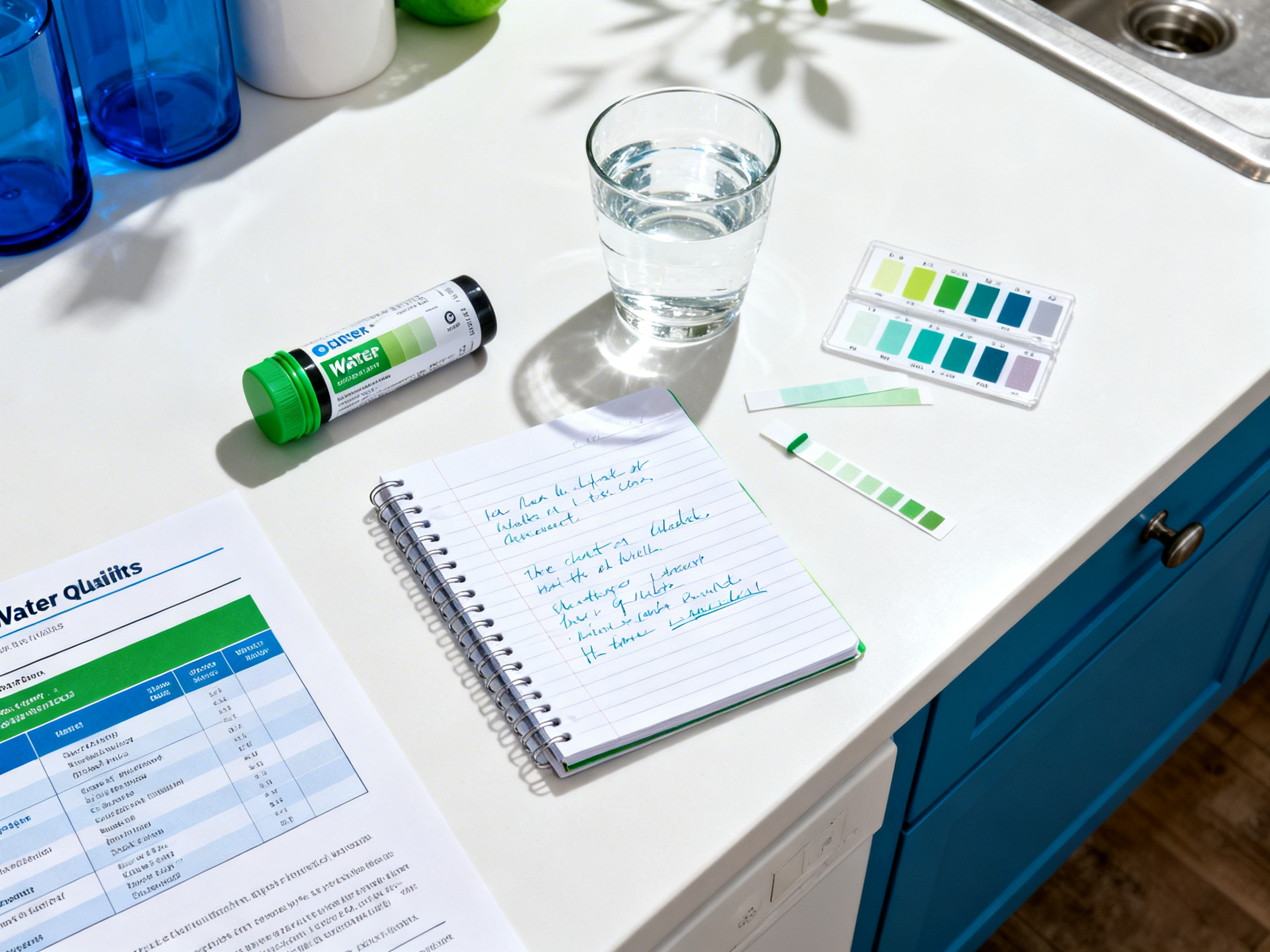
Not sure what’s in your water? Your city publishes a free Consumer Confidence Report (CCR) every year. Search for yours on the EPA’s website. If you’re on well water, a lab test from a service like Tap Score or SimpleLab will tell you exactly what you’re dealing with for around $100 to $200.
Signs Your Home Needs Whole House Filtration
You probably need a whole house filter if you notice any of these:
- Chlorine odor when you run the tap or shower
- Reddish-brown stains on sinks, toilets, or laundry (iron)
- White scale buildup on faucets and showerheads (hard water minerals)
- Rotten egg smell (hydrogen sulfide, common in well water)
- Cloudy or discolored water, especially after rain
- Skin irritation or dry hair after showering
When Tom and Lisa moved into their 1970s ranch house in suburban Phoenix last spring, they noticed white crusty buildup on every faucet within the first month. Their water report showed 22 grains per gallon of hardness, plus chloramine levels at the EPA’s maximum allowable limit.
They installed a whole house carbon filter paired with a water softener for about $1,800 total. Six months later, the buildup was gone, their water heater stopped making popping noises, and Lisa said her hair felt noticeably softer.

Best Whole House Water Filters: Our Top Picks
Here’s a quick comparison of the best whole house water filters for different needs and budgets:
| System | Best For | Price Range | Annual Maintenance | Key Contaminants | Flow Rate |
|---|---|---|---|---|---|
| SpringWell CF1 | Overall performance | $900-$1,100 | $40-$50/yr | Chlorine, chloramine, THMs, PFAS, VOCs | 9-12 GPM |
| iSpring WGB32B | Budget buyers | $350-$450 | $60-$80/yr | Chlorine, sediment, VOCs, rust | 15 GPM |
| Aquasana EQ-1000 | City water homes | $1,400-$1,600 | $100-$130/yr | Chlorine, lead, mercury, PFAS, herbicides | 7 GPM |
| SpringWell WS1 | Well water | $2,000-$2,300 | $40-$60/yr | Iron, manganese, sulfur, sediment | 12 GPM |
| Kind E-1000 | Value mid-range | $700-$800 | $40-$60/yr | Chlorine, chloramine, THMs, VOCs | 10-15 GPM |
| Pelican PC600 | Easy maintenance | $900-$1,100 | $50-$80/yr | Chlorine, chloramine, VOCs, industrial solvents | 10 GPM |
Best Whole House Water Filters Compared


Prices as of Oct 14, 2026. Details may vary.
Best Whole House Water Filters: Detailed Reviews
Best Overall: SpringWell CF1 Whole House Water Filtration System
The SpringWell CF1 earns the top spot for a reason most review sites won’t mention: its 5-year cost of ownership is among the lowest in the mid-range category. At roughly $1,016 upfront and only $40 to $50 per year in maintenance, you’re looking at about $1,250 total over five years.
This system uses a catalytic carbon and KDF (Kinetic Degradation Fluxion) media tank that handles 1,000,000 gallons before the media needs replacing. That’s roughly 8 to 10 years for an average household. No cartridge swaps every few months.
What We Like
- 1,000,000-gallon capacity means years between media replacements
- Lifetime warranty with a 6-month money-back guarantee
- Removes chlorine, chloramine, THMs, PFAS, VOCs, and haloacetic acids
- Bluetooth head with app monitoring for filter status
- 9-12 GPM flow rate handles most 2-4 bathroom homes
What We Don’t Like
- Not designed for well water (won’t handle iron, manganese, or bacteria)
- Requires professional installation for most homeowners ($200-$400 extra)
- Tank is large; needs about 50 inches of vertical clearance
- Backwash cycle can be noisy
Best For: Homeowners on city water who want comprehensive filtration with minimal ongoing maintenance. If your main concerns are chlorine, chloramine, and the contaminants that come with municipal treatment, this is your system.
Looking for a similar system on Amazon? The AO Smith whole house filter offers comparable performance at a lower price point:

A. O. Smith Whole House Water Filter System | 600K Gal | AO-WH-Filter
by A. O. Smith
- Tools & Home Improvement
- Whole House Water Treatment Systems
- Coverage for accidental damage including drops, spills, and broken parts, as well as breakdowns (plans vary)
- 24/7 support when you need it
Price as of Oct 14, 2026. Details may vary.
Best Whole House Water Filter for Well Water: SpringWell WS1
Looking for the best whole house water filter for well water? Well water is a completely different challenge from city water. Wells are rarely contaminated with what municipal treatment creates (chlorine byproducts, chloramine), and city water almost never has the problems wells face (iron, sulfur, manganese, bacteria).
The SpringWell WS1 is purpose-built for well water. It combines an air injection oxidization system with a greensand filter to tackle iron up to 7 PPM, manganese up to 1 PPM, and hydrogen sulfide up to 8 PPM. Those are the three contaminants that cause the most visible problems in well water homes: stains, smells, and discoloration.
What We Like
- Specifically designed for well water’s unique contaminant profile
- Handles iron (up to 7 PPM), manganese (1 PPM), and sulfur (8 PPM)
- Chemical-free treatment using air injection oxidation
- Lifetime warranty
- Self-cleaning backwash cycle
What We Don’t Like
- Premium price ($2,000-$2,300) is a significant investment
- Requires a drain connection for backwash water
- Does not remove bacteria or viruses (add UV treatment separately)
- Professional installation recommended
Who should consider it? Well water homeowners dealing with iron stains, sulfur smell, or manganese discoloration. If your well water test shows elevated iron or hydrogen sulfide levels, this is the system built for your situation.
Important note for well water owners: About 15% of Americans rely on private wells, and unlike city water, well water has zero federal regulation. That means testing and treatment are entirely your responsibility. Get a comprehensive well water test before buying any system.
When Maria bought a farmhouse on five acres outside Nashville, the first thing she noticed was orange staining in every sink and a faint sulfur smell from the hot water tap. Her well water test came back with 4.2 PPM iron and detectable hydrogen sulfide. After installing the SpringWell WS1, the staining stopped within a week, and the sulfur smell disappeared completely. Her plumber estimated the system would also add years to her water heater’s lifespan by keeping iron out of the tank.
If you’re on well water with iron problems, this iSpring model handles iron and manganese specifically:
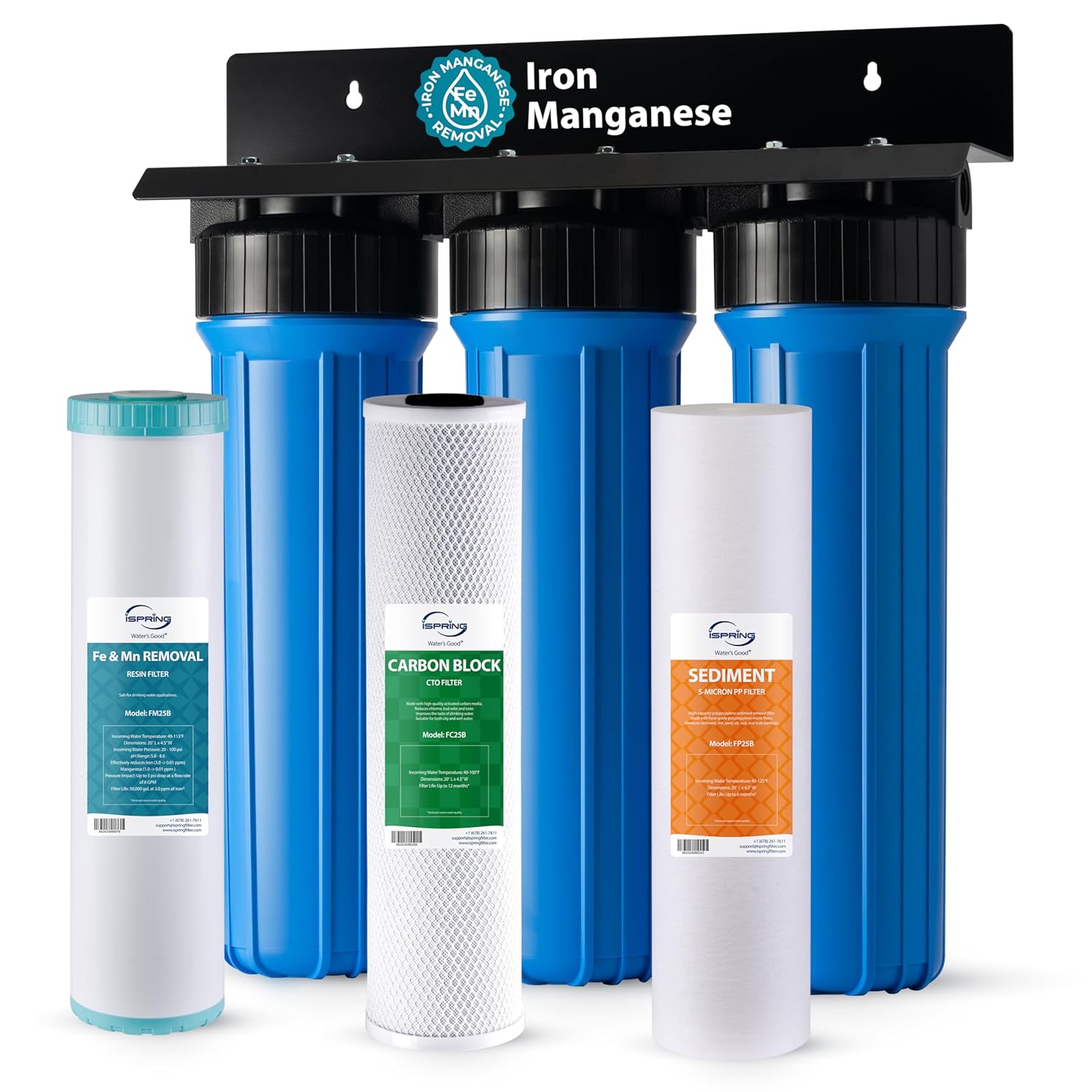
iSpring WGB32BM Iron, Manganese Whole House Water Filter System
by iSpring
- Tools & Home Improvement
- Whole House Water Treatment Systems
- Coverage for accidental damage including drops, spills, and broken parts, as well as breakdowns (plans vary)
- 24/7 support when you need it
Price as of Oct 14, 2026. Details may vary.
Best Budget Option: iSpring WGB32B 3-Stage Whole House Water Filter
Not everyone needs (or can afford) a $1,000+ system. The iSpring WGB32B proves that solid whole house filtration doesn’t have to break the bank.
At $350 to $450, this three-stage system uses a sediment filter, a carbon block filter, and an iron/manganese reducing filter to handle the most common water quality complaints. It’s the go-to budget recommendation across plumbing forums for good reason.
What We Like
- Price point under $500 makes it accessible
- 15 GPM flow rate (highest on this list); no pressure drop complaints
- Standard Big Blue 20-inch housings accept universal filter cartridges (no proprietary lock-in)
- DIY-friendly installation with 1-inch inlet/outlet ports
- Clear first-stage housing lets you visually monitor sediment buildup
What We Don’t Like
- Filter cartridges need replacing every 6-12 months ($60-$80/yr)
- 100,000-gallon capacity per filter set (vs. 1,000,000 for tank-based systems)
- Does not remove PFAS, bacteria, or viruses
- Does not include a pre-filter for heavy sediment
Best For: Budget-conscious homeowners on city water who want basic chlorine, sediment, and taste improvement without a major investment. If your water report looks mostly clean and you just want better-tasting water throughout the house, this delivers excellent value.
When Derek, a first-time homeowner in Columbus, checked his city’s water quality report last fall, he found chlorine and trihalomethane (THM) levels that were technically legal but higher than he wanted his family drinking. A $2,000 system wasn’t in the budget with a new mortgage.
He installed the iSpring WGB32B himself in about two hours using SharkBite fittings. Total cost including fittings and a pressure gauge: $510. His family immediately noticed the chlorine smell was gone, and six months later, his filter replacement cost him $35.

iSpring WGB32B Commercial-Grade Whole House Water Filter System
by iSpring
- Tools & Home Improvement
- Whole House Water Treatment Systems
- Coverage for accidental damage including drops, spills, and broken parts, as well as breakdowns (plans vary)
- 24/7 support when you need it
Price as of Oct 14, 2026. Details may vary.
Best for PFAS Removal: Aquasana EQ-1000 (Rhino)
Can a whole house water filter actually remove PFAS? The answer is complicated. A Duke University study found that activated carbon whole house filters had wildly inconsistent PFAS removal. In four of six systems tested, PFAS levels actually increased after filtration.
The Aquasana EQ-1000 is one of the few whole house systems with independent testing specifically for PFAS compounds. It combines a catalytic carbon filter with a sub-micron post-filter and a copper-zinc oxidation media (KDF) that targets a broader contaminant spectrum than carbon alone.
What We Like
- Tested and verified for PFAS, PFOA, and PFOS reduction
- Removes chlorine, lead, mercury, herbicides, pesticides, and VOCs
- NSF/ANSI certified to Standards 42, 53, and P473 (the PFAS-specific standard)
- 1,000,000-gallon or 10-year capacity
- Optional UV filter add-on for bacterial protection
What We Don’t Like
- Higher annual maintenance cost ($100-$130/yr for pre/post filters)
- 7 GPM flow rate is the lowest on this list; may reduce pressure in larger homes
- The full system with UV costs over $1,800
- Installation is more complex than cartridge-based systems
If you’re shopping for the best whole house water filter for PFAS removal, this is the system with the testing data to back it up. It’s a strong pick for anyone concerned about PFAS, lead, or industrial chemical contamination, especially if you live near military bases, airports, or industrial sites (common PFAS contamination sources).
A word of caution on PFAS: If PFAS is your primary concern and you only need protection at the kitchen sink, an under-sink reverse osmosis system is more effective and far less expensive. RO systems consistently achieve near-complete PFAS removal.
A whole house system makes sense when you also want to address chlorine, chloramine, and other contaminants throughout the home.

Aquasana Whole House Water Filter System | 1M Gal | Carbon & KDF | EQ-1000
by Aquasana
- Tools & Home Improvement
- Whole House Water Treatment Systems
- Coverage for accidental damage including drops, spills, and broken parts, as well as breakdowns (plans vary)
- 24/7 support when you need it
Price as of Oct 14, 2026. Details may vary.
Best Value Mid-Range: Kind E-1000
The Kind E-1000 quietly competes with systems costing 30% to 50% more. It uses a coconut shell carbon media tank similar to the SpringWell CF1 but at a significantly lower price point.
What We Like
- Roughly $700-$800, about 30% cheaper than comparable tank-based systems
- 1,000,000-gallon capacity
- Nearly 80% of verified owners rate it 5 stars
- Solid contaminant removal: chlorine, chloramine, THMs, VOCs
- 10-15 GPM flow rate handles most households easily
What We Don’t Like
- Less brand recognition than SpringWell or Aquasana
- Fewer third-party test results publicly available
- No Bluetooth or smart monitoring
- Customer service response times vary based on user reports
Want tank-based, low-maintenance filtration without the premium-brand markup? The Kind E-1000 fits that sweet spot. It’s an excellent choice if you’ve decided against cartridge-based systems but $1,000+ feels steep.
Best for Easy Maintenance: Pelican PC600/PC1000
The Pelican (now under Pentair) earns its spot for homeowners who value simplicity. The system is designed for straightforward DIY installation and filter changes that don’t require a wrench, a YouTube tutorial, or calling a plumber.
What We Like
- Genuinely DIY-friendly installation and filter changes
- Durable build quality; Pentair is a well-established water treatment company
- Available in two sizes: PC600 (1-3 bathrooms) and PC1000 (4-6 bathrooms)
- Effective chlorine, chloramine, and VOC removal
- 5-year media lifespan
What We Don’t Like
- Media lasts 5-6 years vs. 8-10 years for SpringWell and Kind
- Priced similarly to SpringWell CF1 but with shorter media life
- Not designed for well water
- Limited PFAS testing data available
Best For: Homeowners who want a reliable, hassle-free system from an established brand and don’t mind replacing media a few years sooner in exchange for easier maintenance.
The True Cost of a Whole House Water Filter
The sticker price is only part of the story. Here’s what a whole house water filter actually costs over five years.
Upfront Cost by Tier
| Tier | System Cost | Installation | Total Day 1 |
|---|---|---|---|
| Budget | $300-$500 | $0-$200 (DIY possible) | $300-$700 |
| Mid-Range | $700-$1,600 | $200-$500 | $900-$2,100 |
| Premium/Well Water | $2,000-$2,500 | $300-$800 | $2,300-$3,300 |
5-Year Total Cost of Ownership
So what does a whole house water filter really cost you over five years? Here’s the full breakdown:
| System | Purchase | Install | Annual Maint. | 5-Year Total |
|---|---|---|---|---|
| iSpring WGB32B | $400 | $0-$200 | $70/yr | $750-$950 |
| Kind E-1000 | $750 | $200-$400 | $50/yr | $1,200-$1,400 |
| SpringWell CF1 | $1,016 | $200-$400 | $45/yr | $1,440-$1,640 |
| Pelican PC600 | $1,000 | $200-$400 | $65/yr | $1,525-$1,725 |
| Aquasana EQ-1000 | $1,500 | $300-$500 | $115/yr | $2,375-$2,575 |
| SpringWell WS1 | $2,200 | $400-$800 | $50/yr | $2,850-$3,250 |
Notice how the iSpring’s low purchase price and the SpringWell CF1’s low maintenance cost make them the two best long-term values in their respective tiers.
DIY vs. Professional Installation
Cartridge-based systems (iSpring, Pelican) are genuinely DIY-friendly if you have basic plumbing comfort. Tank-based systems (SpringWell, Kind, Aquasana) typically need a plumber.
DIY tips from experienced installers:
- Use rigid copper or PEX connections, not flexible hoses (they restrict flow)
- Install ball valves before and after the system for easy maintenance shutoff
- Add a pressure gauge on each side so you can monitor filter condition
- Apply silicone plumber’s grease on all O-rings to prevent seizing
- Get your water tested before installation so you know your baseline
Professional installation typically runs $200 to $800, depending on your plumbing access, pipe material, and system complexity. Always confirm whether the manufacturer’s warranty requires professional installation; some do.
What Should Your Whole House Filter Remove?
The right filter depends entirely on what’s in your water. City water and well water have completely different contaminant profiles.
City Water Contaminants
Municipal water treatment does a good job eliminating bacteria and meeting EPA standards. But the treatment process itself introduces chemicals, and certain contaminants slip through:
- Chlorine and chloramine: Added during treatment to kill bacteria. Safe at legal levels but causes taste and odor issues. Chloramine is harder to remove than chlorine.
- Trihalomethanes (THMs): Byproducts created when chlorine reacts with organic matter. Linked to increased cancer risk at elevated levels.
- PFAS (forever chemicals): Per- and polyfluoroalkyl substances. The EPA set maximum contaminant levels at 4 parts per trillion for PFOA and PFOS in 2024. Public water systems must begin monitoring by 2027.
- Lead: From aging pipes, not from the water source itself. The EPA’s Lead and Copper Rule now requires pipe replacement within 10 years, but compliance doesn’t begin until November 2027.
Well Water Contaminants
Well water skips municipal treatment entirely, which means no chlorine byproducts but also no disinfection:
- Iron and manganese: The most common well water complaints. Cause staining, metallic taste, and appliance damage.
- Hydrogen sulfide: That rotten egg smell. Usually harmless but unpleasant.
- Bacteria and parasites: E. coli, coliform, Giardia. Requires UV treatment or chlorination, not just filtration.
- Sediment: Sand, silt, and particulates that clog fixtures and appliances.
- Nitrates: From agricultural runoff. Particularly dangerous for infants.
Understanding NSF/ANSI Certifications
When a manufacturer claims their filter “removes 99% of contaminants,” check for these specific certifications:
- NSF/ANSI 42: Aesthetic effects (chlorine taste and odor, particulates)
- NSF/ANSI 53: Health effects (lead, VOCs, Giardia, Cryptosporidium)
- NSF/ANSI P473: PFAS reduction (PFOA, PFOS, and other perfluorinated compounds)
- NSF/ANSI 55: UV treatment effectiveness (Class A for bacteria/virus disinfection)
- NSF/ANSI 58: Reverse osmosis system performance
A system certified to NSF 42 removes chlorine taste. A system certified to NSF 53 removes health-threatening contaminants. These are very different claims. Always check which specific standards a system meets, not just whether it’s “NSF certified.”
How to Size a Whole House Water Filter
Wondering how to size a whole house water filter for your home? Undersizing is the single most common installation mistake, and it leads to the number one complaint in every forum: low water pressure.
Calculating Your Peak Flow Rate
Every fixture in your home uses a certain amount of water measured in gallons per minute (GPM):
| Fixture | Flow Rate |
|---|---|
| Shower | 2.0-2.5 GPM |
| Kitchen faucet | 1.5-2.2 GPM |
| Bathroom faucet | 1.0-1.5 GPM |
| Dishwasher | 1.0-2.0 GPM |
| Washing machine | 1.5-3.0 GPM |
| Toilet fill | 2.0-3.0 GPM |
Your peak flow rate is the maximum water demand at any given moment. Think about a busy morning: two showers running, a toilet flushing, and the dishwasher going. That’s roughly 8 to 10 GPM.
Quick Sizing Guide
| Home Size | Bathrooms | Recommended Min. Flow Rate |
|---|---|---|
| Small (1-2 bedrooms) | 1-1.5 | 7-10 GPM |
| Medium (3-4 bedrooms) | 2-3 | 10-15 GPM |
| Large (5+ bedrooms) | 3.5+ | 15-20 GPM |
The critical number: Look at the manufacturer’s service flow rate, not the maximum flow rate. Manufacturers often advertise the maximum, which only applies with no filter restriction. The service flow rate tells you the actual flow with a loaded filter at the micron rating it’s designed for.
An iSpring WGB32B rated at 15 GPM service flow handles larger homes easily. An Aquasana rated at 7 GPM will struggle in a 3+ bathroom house during peak demand.
Whole House Water Filter Maintenance: What It Really Takes
How often do you actually need to replace your filters? Manufacturers list ideal conditions. Real-world conditions shorten filter life:
| System Type | Advertised Life | Real-World Life | Annual Cost |
|---|---|---|---|
| Cartridge (iSpring, Pelican) | 6-12 months | 3-9 months | $60-$130 |
| Carbon media tank (SpringWell, Kind) | 8-10 years | 6-8 years | $40-$60 |
| Pre-sediment filters | 3-6 months | 2-8 weeks (high sediment areas) | $20-$60 |
If you’re on well water with heavy sediment, budget for more frequent pre-filter replacements. Some well water homeowners change their sediment pre-filter monthly.
Common Problems and How to Fix Them
Pressure drop after installation: Check that your system is sized correctly for peak demand. Also confirm you’re looking at service flow rate, not maximum flow rate.
Stuck filter housings: The most frustrating maintenance issue. Apply food-grade silicone grease to O-rings at every filter change. Invest in a proper filter wrench. Clear plastic housings are particularly prone to seizing.
Water bypassing the filter: Check bypass valve position. If your system has a built-in bypass, verify it’s fully closed during normal operation.
Sediment filter clogging too fast: Add a spin-down sediment pre-filter before your main system. These are inexpensive ($30-$60), easy to clean, and protect your primary filters from premature clogging.
Frequently Asked Questions
Are Whole House Water Filters Worth It?
For most homeowners, yes. If your water report shows chlorine, chloramine, THMs, or other contaminants above your comfort level, a whole house system protects your entire home. The budget options start under $500 with DIY installation, and even the mid-range systems cost less than $1 per day over their lifespan. Fortunately, you don’t need to spend a fortune to get clean water throughout your house.
How Much Does a Whole House Water Filter Cost?
Expect $300 to $500 for a budget cartridge system, $700 to $1,600 for a mid-range tank-based system, and $2,000 to $2,500 for well water or premium systems. Add $200 to $800 for professional installation if needed. Annual maintenance runs $40 to $130 depending on the system type.
Do Whole House Water Filters Reduce Water Pressure?
They can, but proper sizing prevents noticeable pressure loss. A correctly sized system (matching your home’s peak GPM demand) typically causes only a 1 to 3 PSI drop, which you won’t feel. Pressure complaints almost always trace back to undersized systems, clogged filters, or restrictive connections.
Can a Whole House Water Filter Remove PFAS?
Some can, but be cautious. Research from Duke University found that many activated carbon whole house systems had inconsistent PFAS removal, and some actually increased PFAS concentrations. Look for systems specifically tested and NSF/ANSI P473 certified for PFAS. For maximum PFAS protection, an under-sink reverse osmosis system at your drinking water tap is the most reliable approach.
How Long Does a Whole House Water Filter Last?
Tank-based media systems (SpringWell, Kind) last 6 to 10 years before media replacement. Cartridge-based systems (iSpring, Pelican) need new filters every 3 to 12 months. The housing and hardware on quality systems lasts 15 to 20 years with proper O-ring maintenance.
Do I Need a Water Softener AND a Water Filter?
They do different things. A water filter removes contaminants (chlorine, lead, PFAS, sediment). A water softener removes hardness minerals (calcium and magnesium) that cause scale buildup. If your water is hard (above 7 grains per gallon) AND has contaminant issues, you likely need both. Many manufacturers sell combo packages.
Can I Install a Whole House Water Filter Myself?
Cartridge-based systems like the iSpring WGB32B are genuinely DIY-friendly with basic plumbing skills. You’ll need a pipe cutter, fittings (SharkBite push-to-connect works great), Teflon tape, and about 2 to 3 hours. Tank-based systems with backwash drains usually benefit from professional installation. Always check your manufacturer’s warranty requirements before deciding.
Choosing Your Best Whole House Water Filter
Here’s the straightforward summary:
- Test your water first. A $100 to $200 lab test tells you exactly which contaminants you’re dealing with. Don’t guess.
- Match the system to your water source. City water and well water need fundamentally different filtration approaches.
- Size for peak demand. Look at service flow rate (not max flow rate) and match it to your home’s simultaneous water use.
- Think in 5-year costs, not sticker prices. A cheap system with expensive filters can cost more over time than a pricier system with minimal maintenance.
- Check certifications, not marketing claims. NSF/ANSI 42, 53, and P473 are the standards that matter. “Removes 99% of contaminants” means nothing without third-party testing to back it up.
If you’re on city water and want the best balance of performance and cost, the SpringWell CF1 or Kind E-1000 will serve you well for years. On a tight budget, the iSpring WGB32B delivers honest value under $500. For well water, the SpringWell WS1 is purpose-built for your specific challenges.
Fortunately, choosing the right whole house water filter doesn’t have to be complicated. Start with your water test results, match them to the right system type, and you’ll be drinking cleaner water from every tap in your home.