

Will that countertop filter still make sense when you carry the tank to the sink, need a replacement cartridge, or move to another apartment? Choosing a countertop water filter for renters means checking the whole rental routine, not just whether a machine needs a hole drilled in the counter.
Before you order, make a short record for the exact model. Note the water concern it treats, how you will fill and clean it, and the space and power it needs. Add the approved spare parts and your plan to remove it. An unanswered question is a reason to verify the details, not to assume the product will fit.
Start with a real drinking-water goal. CDC guidance on choosing home water filters recommends checking your water and choosing treatment for the concern you identify. Better taste is not proof of safe water. If your water already meets your needs, buying another filter may be unnecessary.
This is a purchasing checklist for drinking and cooking water. It isn’t a product ranking or a report of hands-on testing. The manufacturer examples below illustrate different operating routines, not recommended purchases.
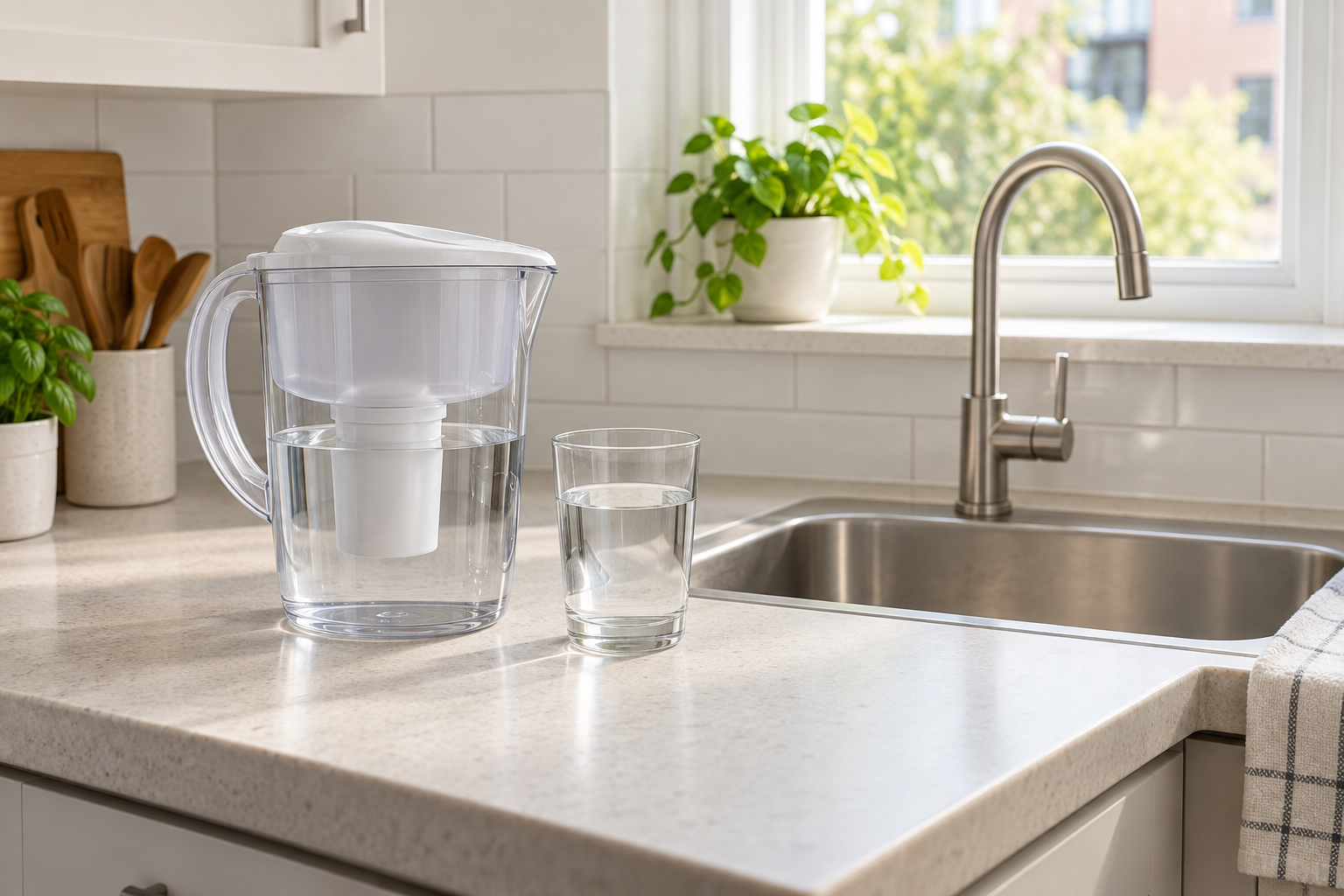

Table of Contents
Table of Contents
- Define Your No-Plumbing Limit
- Check Your Countertop Filter Refill Routine
- Countertop Water Filter for Renters: Buying Record
- Plan the Move Before You Order
- Countertop Water Filter for Renters: Buying Questions
- Your Final Order Check
Define Your No-Plumbing Limit
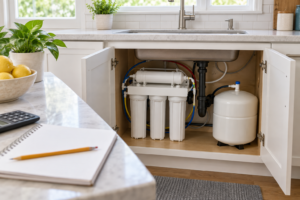
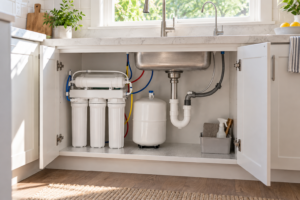
What does “no plumbing” mean in your rental? Write down your limit before comparing models. You might mean no connection to the building’s water system at all. Or you might be willing to attach a removable device to the faucet, if the faucet supports it and your property rules permit it.
These are different purchase conditions:
- Manual-fill setup: You put water into a pitcher, tank, or reservoir. Check the manual to confirm that it needs no supply-line or drain connection. A tank you fill by hand can still need power.
- Faucet-connected setup: The device receives water through a connection at the faucet. Read the exact installation steps and compatibility exclusions. A removable connection is still a connection; “countertop” does not mean it fits every faucet.
- Supply-line or drain connection: If the selected model needs one and your rule is no plumbing changes, stop that purchase. Do not improvise an adapter or alter the rental to make the product fit.
If you are still deciding where to place treatment equipment, our under-sink versus countertop comparison covers that broader decision. Here, the question is narrower: can this particular countertop setup work within your rental’s limits?
For any fixture attachment, check your lease and property rules. If permission is unclear, send the property manager the exact model and installation instructions. Ask whether that attachment is allowed and what condition the fixture must be in when you leave. Keep any required approval. A seller’s “renter-friendly” description does not settle those questions or guarantee a deposit outcome.
Check Your Countertop Filter Refill Routine
Can you complete the refill routine when the kitchen is busy? Use the model manual to walk through breakfast, filling a cooking pot, and the last refill of the day. You don’t need to own the unit to make this plan. Use the manual, not a guess about its output.
Keep these three terms apart:
- Feed-tank capacity: The amount of water you put in.
- Treated-water capacity: The amount you can use after the unit filters it.
- Cartridge service capacity: The filter’s rated use before it needs replacement, under stated test conditions.
These numbers answer different questions. A large tank doesn’t tell you how long its filter will last.
For a refill countertop reverse osmosis (RO) unit, also identify where the remaining concentrated water goes. RO separates treated water from a reject stream. A no-drain-connection design can leave you with water to empty manually rather than remove that task.
For example, the AquaTru Classic owner’s manual, revision 04.25.R4, says to discard the water remaining in the tap-water tank every time you refill it. Its first-use instructions separately require four full tanks before drinking the water. Those are two different routines: daily refills and the first flush. Don’t apply the first-use rule to each day’s refill. Don’t just top up the water left in the tap tank, either.
A powered dispenser is not automatically RO. The Aquasana AQ-CWM2-B Clean Water Machine manual, identified as AQ-CWM2-B-OM-2026, describes a manually filled, powered filtration system. It requires a startup flush that you discard. It also says the water tank, housing lids, and filter cap are hand-wash only. That doesn’t mean it has the same waste-water routine as a refill RO unit.
These manuals were checked on September 18, 2026. Use the current manual for the exact version you buy. Don’t apply either example’s steps to a different machine.
Before ordering, answer these practical questions:
- Where will you fill the tank, and can you carry it comfortably when full?
- How much treated water can you obtain before another fill or processing cycle?
- What water must be discarded during normal use, startup, and cartridge changes?
- Which parts need cleaning, where will you wash them, and how will you follow the cleaning schedule?
- Will the routine fit everyone who shares the kitchen?
If the manual gives only a feed-tank size, ask for clarification about usable output. Do not buy on an assumed full-tank yield. If the lifting, waiting, or emptying is too much work, compare another type. Don’t skip a required step to save time.
Countertop Water Filter for Renters: Buying Record
A useful buying record ends with evidence and a decision. Save the manual, full model number, and the date you checked each item. Use confirmed, ask before ordering, or does not fit beside each section.
Use this short form for each candidate. Keep a blank cell as an open question, not an assumed pass.
| Purchase check | Evidence to save | If the answer is missing |
|---|---|---|
| Water goal and exact claim | Report or test result plus matching model listing. | Ask which claim applies to this model and cartridge. |
| Daily refill and discard | Manual pages for normal use, not just startup. | Ask what remains after each cycle and how to empty it. |
| Space and power | Your measurements and the model’s access and cord rules. | Ask for lid, tank, and filter-removal space. |
| Lease and fixture limits | The rule or any needed approval for this setup. | Send the actual installation page to the property manager. |
| Filter supply | Approved part number and a dated source for replacements. | Confirm the part before buying the main unit. |
| End of tenancy | Removal, storage, and restart instructions. | Ask support about the length of your planned gap in use. |
Treatment Claim: Does This Exact Setup Meet Your Need?
Write the intended drinking-water goal in one sentence. Then match the full system and replacement cartridge to its performance information and current certification listing, where certification is claimed.
NSF explains that certification to a standard does not mean reduction of every contaminant. Standard numbers are not a quality ranking. A logo or a brand-family page is not enough to establish the specific claim you need.
Save the model name, certifier, and exact claim. Note the rated capacity and the limits for use, too. Our guide to verifying water filter certification explains the lookup process. If the listing and seller’s model do not match, ask the manufacturer or certifier before relying on the claim.
Operating Space: Can You Use It Where It Will Live?
Check more than the closed appliance footprint. Mark its proposed position with a paper template. Then allow room to lift the tank, open the lid, and remove a cartridge as the manual shows. Check that your usual bottle or pot fits under the spout.
Can you reach those parts without lifting a full appliance or blocking the shared work area? If dimensions do not show service access, request that information. Do not invent a universal clearance above the unit.
For a powered model, verify the specified supply and a suitable outlet location. Follow the manual’s placement and cord instructions. The AQ-CWM2-B manual, for example, says not to put the cord, plug, or system in water and not to let the cord hang over the counter edge. “No plumbing” is not permission to ignore electrical placement requirements.
Replacement Supply: Can You Maintain It During Your Tenancy?
Find the approved replacement part before buying the appliance. Save its full part number, the seller’s current availability, and the date checked. If the only available listing is for a similar-looking cartridge, compatibility remains unresolved.
Read both the time and treated-volume limits when the manufacturer specifies them. A short lease doesn’t rule out a filter change. Your use and water conditions may differ from the conditions behind a stated lifespan.
Ask what happens if a part is unavailable: is there an explicitly approved substitute, or must you wait? Stock today isn’t a promise of supply next year. If you cannot identify a supported replacement route now, set the purchase aside until that question is answered.
For an RO candidate, use our RO system purchase and upkeep guide to check the full ownership budget. Keep that cost comparison separate from whether the daily routine is workable.
Plan the Move Before You Order
Portability means more than being able to pick up the box. Your purchase record should explain how the filter leaves this rental and returns to use at the next one.
For an allowed faucet attachment, take a photo before you fit it. Keep any original parts you remove. Ask how the property expects the fixture to be restored. Keep those parts with the model instructions, not loose in a drawer where they may be lost. These are practical records, not a guarantee about a landlord’s inspection.
For any format, locate the manufacturer’s shutdown, storage, transport, and restart instructions before moving. If the manual does not cover a long period without use, ask support. Don’t assume a used cartridge can sit unused for months. Emptying the tank may be only one part of the storage steps.
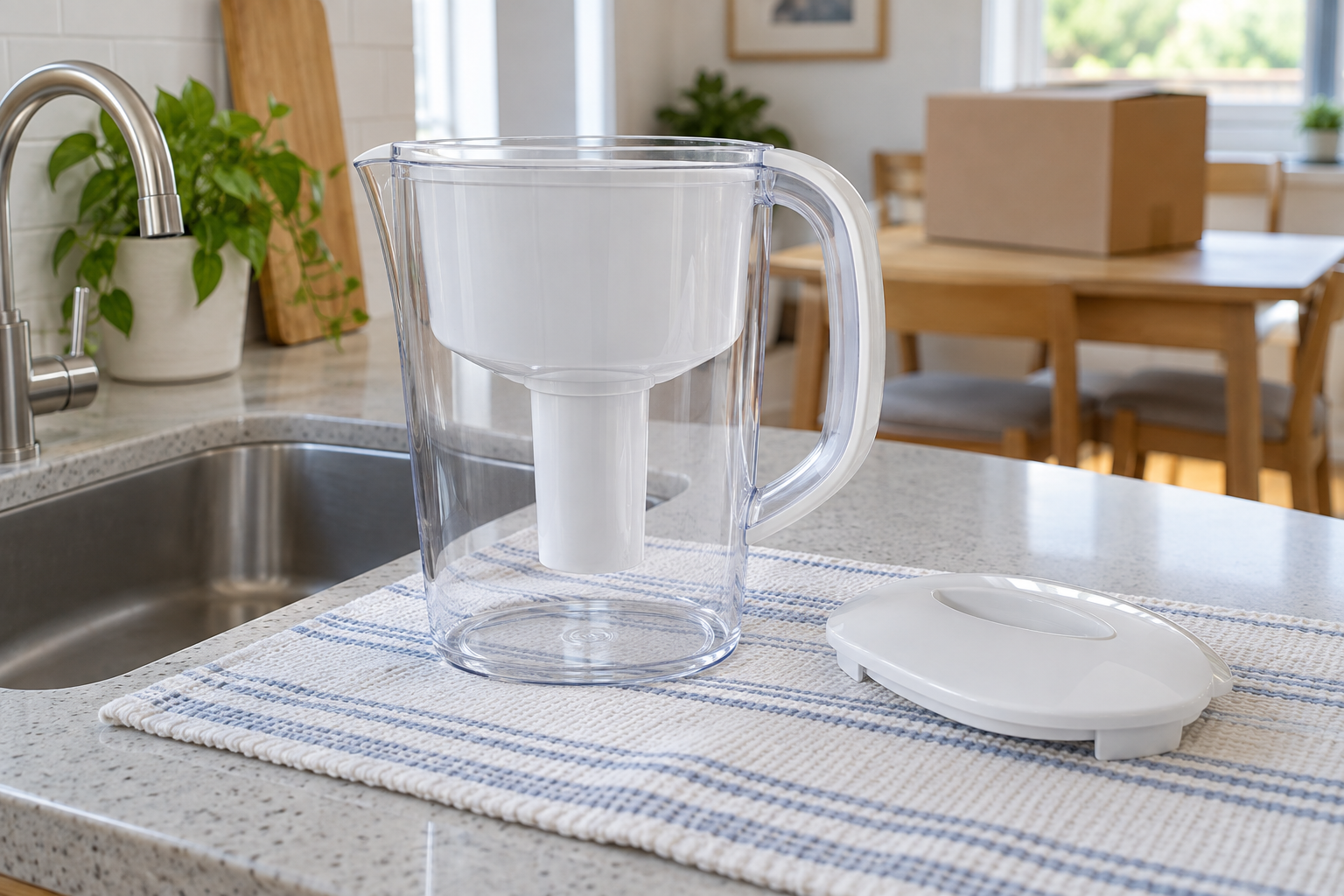
Keep the following with your purchase record:
- The manual and support contact for your exact model.
- Any required permission and agreed restoration conditions.
- Original fixture parts, if an attachment required their removal.
- The filter installation date and maintenance record.
- The instructions for cleaning, storage, and restarting after non-use.
At the next rental, repeat the water-need and physical-fit checks. A different faucet, outlet location, water source, or property rule can change the answer. Use the required startup or restart procedure before drinking treated water. Do not carry over an assumption that a setup approved in one apartment is automatically suitable in another.
Countertop Water Filter for Renters: Buying Questions
What If the Seller Says “No Installation” but the Manual Shows a Connection?
Use the exact model’s installation instructions to identify what the purchase requires. Ask the seller or manufacturer to resolve any conflict before ordering. If the required connection exceeds your rental’s limits, choose another suitable option rather than modifying the instructions.
Can I Skip Discarding Water to Reduce Trips to the Sink?
Not when the model requires it. Distinguish a startup flush from recurring concentrate disposal, then follow both as directed. If that routine is too demanding, the better buying decision is a different suitable setup, not a shortcut after purchase.
Will This Solve My Apartment’s Hard-Water Problems?
A kitchen drinking-water purchase is not a whole-apartment hardness plan. It does not treat the water sent to your shower or washing machine. See hard-water options for renters if scale, laundry, or shower deposits are the actual problem.
Is a Better Taste Enough to Confirm That It Works?
No. Taste can be part of your purchase goal, but it does not verify water safety or a specific contaminant reduction. CDC notes that most home filters are not designed to remove germs. Follow local water advisories and the model’s source-water limits; do not treat a countertop appliance as blanket protection.
Your Final Order Check
Before you pay, read your record once more. Check the treatment goal and the refill routine first. Then check space, power, any needed permission, a source for the right cartridge, and a removal plan.
If one item is unknown, name the next action: ask for the manual, confirm a listing, measure the opening, or contact the property manager. If the answer shows the model does not fit, remove it from your shortlist. There is no need to force a purchase because the product looks compact.
The right countertop water filter for renters is one you can use, maintain, and eventually remove within your actual rental conditions. Save the evidence before ordering, then keep the instructions with the filter. That turns “renter-friendly” from a sales phrase into a decision you can check.