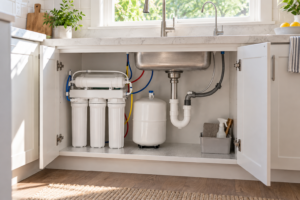


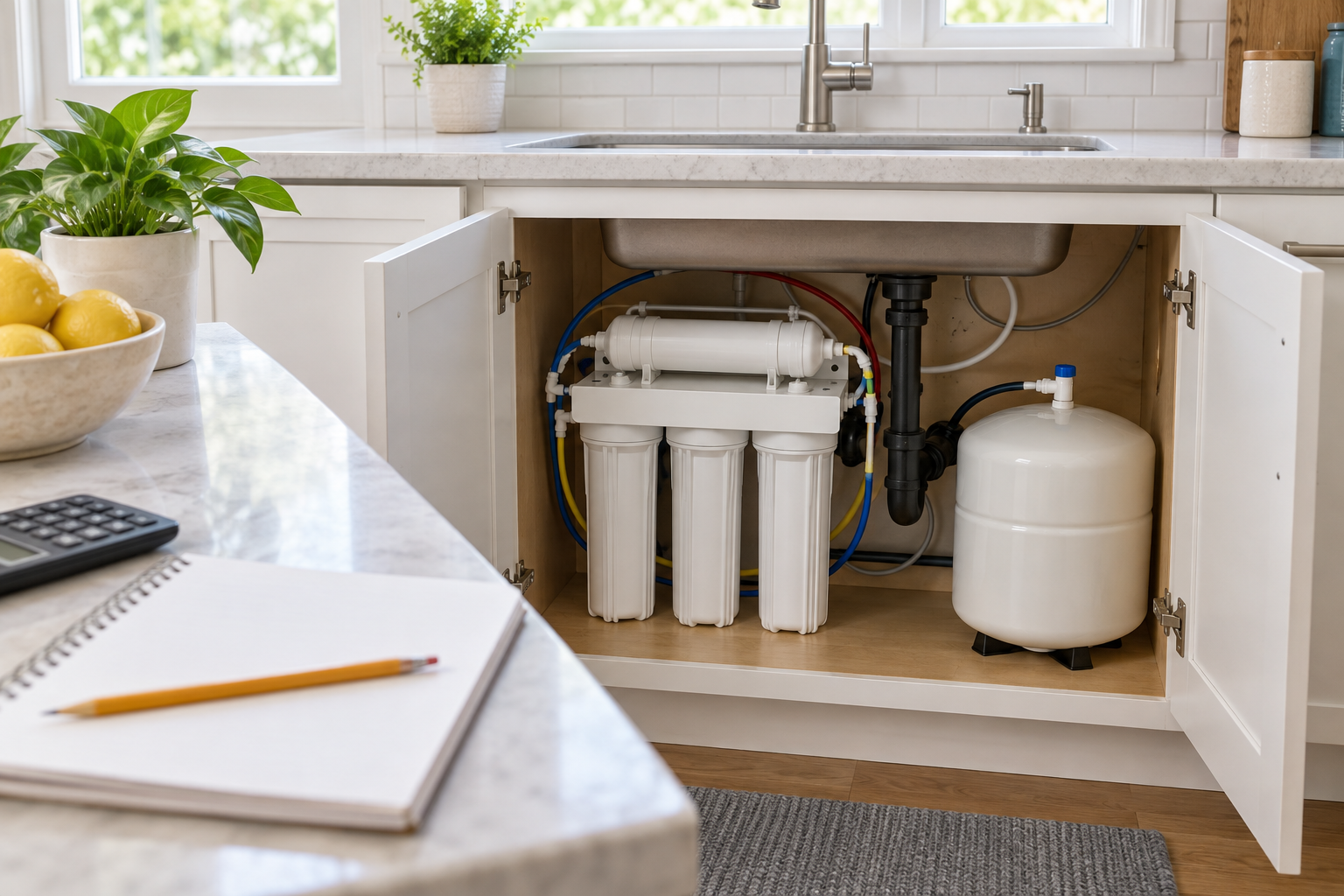

Are you pricing a drinking-water system and asking what a reverse osmosis system cost will be after the first purchase? The system price is only one part of the answer. A point-of-use reverse osmosis (RO) system can also need model-specific filters, a membrane, cabinet space, a drain connection, and sometimes power. Water use can matter, too.
Fortunately, you do not need to guess at a five-year number. Start with the exact model, then write down the listed system price, the parts and intervals in its manual, the installation work you can safely do, and the water-use information. This guide gives you a simple worksheet for that process. It does not provide local labor quotes or measure costs in a home.
Before you budget, confirm that RO matches a documented drinking-water need. CDC guidance on home water filters says to choose a system for the germs or chemicals that concern you, then check the label for the exact claim. If your water does not have a concern that needs treatment, you may not need an added system.
Table of Contents
Table of Contents
- Reverse Osmosis System Cost: The Short Answer
- What Goes Into an RO Ownership Cost?
- Build a Five-Year RO Cost Worksheet
- Use Current Prices Without Treating Them as Promises
- Check Water, Space, and Installation Before You Buy
- Questions Readers Ask
Reverse Osmosis System Cost: The Short Answer
For a point-of-use system, your reverse osmosis system cost has five main parts:
- The system and any required accessory.
- Installation materials or qualified installation, when the manual or your setup requires it.
- Replacement prefilters, postfilters, and membrane.
- Water and electricity used by the exact model, if applicable.
- A repair-or-replace allowance after the warranty or when a part is no longer available.
The first price can look simple because it is visible on a product page. The repeat costs are easier to miss. A system with a lower purchase price can still have higher ownership cost if its approved cartridges are expensive or hard to find. A more expensive system can also be a poor fit if it needs a cabinet layout, drain connection, or power source that you cannot safely provide.
Start with treatment fit, not with the longest feature list. Our reverse osmosis vs carbon filter guide can help you decide whether a simpler filter, or no new filter, meets your documented need. If RO is still a fit, the rest of this guide helps you budget for the model rather than the category name.
What Goes Into a Reverse Osmosis System Cost?
1. The system price and included parts
Record the price and date from the manufacturer’s current page. Then read the included-parts list. A faucet, tank, tubing, adapter, drain hardware, power supply, or first filter set may be included with one model and sold separately with another. Do not assume two systems with a similar gallons-per-day label include the same parts.
The format can change the purchase list. A storage-tank system needs room for the tank and filter assembly. A tankless system may need a powered unit and an accessible outlet. Our tankless vs tank reverse osmosis guide explains those home-fit questions. It does not make either format automatically cheaper.
2. Installation and setup boundaries
Some homes already have a suitable under-sink cold-water connection, drain route, and service space. Others do not. The cost is not only a drill bit or fitting. It can include the work needed to follow the exact manual and protect the plumbing layout.
Do not use a national average or a neighbor’s invoice as your budget promise. Local conditions, the selected system, access, permit rules, and the installer all change a quote. If the work involves a drain connection, plumbing change, electrical work, or an unfamiliar leak, use the manufacturer’s instructions and get a qualified local estimate. Keep that estimate as a separate line in your worksheet.
3. Filters and membrane
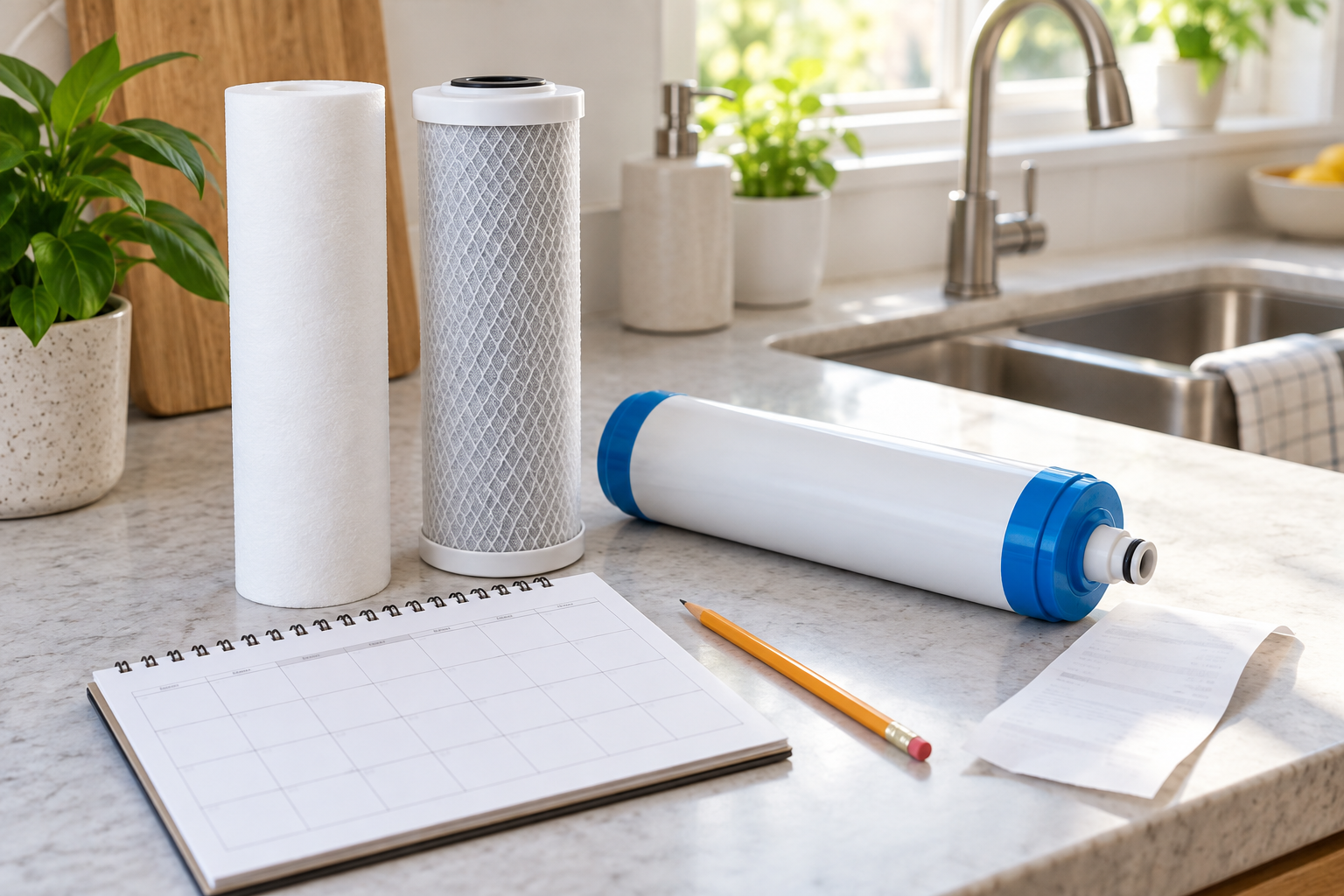
Replacement parts are usually the most predictable recurring cost because the model documentation gives a part number and interval. The interval still depends on the source water and how you use the system. Treat a stated schedule as a planning point, not a guarantee that every household will use exactly the same number of cartridges.
For example, Waterdrop’s current G3 replacement page lists a six-month CF filter, a 12-month CB filter, and a 24-month RO filter for that family. Its listed prices and schedule are model-specific. They are useful for a worksheet only if you confirm that the part number matches the system you plan to own. NSF’s overview of NSF/ANSI 58 also makes the same point in a different way: performance and claims belong to the complete system and its documented components, not to an interchangeable name.
Use our NSF certified water filters guide when you need to check the model, stated contaminant claim, capacity, and replacement part. A certification mark does not tell you that a generic cartridge will maintain the claim.
4. Water and electricity
RO produces treated water and a reject-water stream. EPA says a typical point-of-use RO system may send five or more gallons to the drain for each gallon of treated water, while a WaterSense-labeled model must send 2.3 gallons or less. That difference can affect the water part of your ownership cost. Check the model’s stated metric and the direction of the ratio before doing any arithmetic.
Our reverse osmosis waste water guide explains why a pure-to-drain ratio and a waste-to-product ratio are not interchangeable. Use your utility rate and the exact model’s documented test conditions. Do not turn a manufacturer ratio into a promise for your kitchen, because incoming pressure, temperature, source water, maintenance condition, and use pattern can change operation.
Some systems also use a power adapter, pump, display, or automatic flush function. Put electricity in the worksheet only when the model requires it. Use the wattage and use pattern from the manual if it provides them. Do not add a generic electricity number to every RO system.
5. Repair, warranty, and replacement decisions
Read the warranty terms before you treat a five-year total as final. Save the model number, manual, proof of purchase, and replacement part numbers. If a system has a leak, damaged tubing, a power problem, or a failure outside the manual’s safe steps, shut it down only as the manual directs and contact qualified service.
Do not buy a future repair part before you know the failure and approved part number. A repair may be reasonable when the manufacturer still supports the model and the issue is identified. Replacing the unit can be the better decision when support has ended, repair cost is uncertain, or the system no longer fits your documented treatment need. Keep that decision separate from a routine filter change.
Build a Five-Year Reverse Osmosis System Cost Worksheet
You can compare two models without inventing a local quote. Use the same five-year time period and the same assumptions for each system.
| Worksheet line | What to enter | Where to verify it |
|---|---|---|
| System price | Dated manufacturer or authorized seller price, including required accessory | Current model page and checkout details |
| Installation | Your actual materials cost or a local written quote | Exact manual and qualified installer quote, if needed |
| Year-one filters | Included filters, plus any scheduled parts not included | Included-parts list and manual |
| Years two through five | Each approved part price multiplied by its stated replacement interval | Manufacturer parts page and manual |
| Water | Your utility rate multiplied by the model’s documented ratio and your planned treated-water use | Utility bill and model documentation |
| Electricity | Only for a model that requires it | Manual or product specification |
| Repair reserve | A separate, optional comparison line | Warranty, service availability, and your own risk tolerance |
The calculation is straightforward:
Five-year ownership estimate = system price + installation + scheduled replacement parts + modeled water cost + modeled electricity cost + optional repair reserve.
The word “modeled” matters. Your worksheet is a comparison tool, not a bill. Keep the date beside every price. If one model has a 24-month membrane and another has an 18-month membrane, show the replacement count plainly. If a product page does not state an interval, do not fill the cell with a guess. Mark it as unknown and ask the manufacturer before you buy.
Want a fast comparison? Make one row for each candidate model. Add the same categories in the same order. A blank or unclear replacement schedule is useful information because it makes the future cost harder to plan.
Use Current Prices Without Treating Them as Promises
Price pages change. They may show a sale, a bundle, shipping, sales tax, or an out-of-stock item. The figures below are not a ranking or a recommendation. They show why you should separate the first purchase from the ongoing parts cost.
On September 16, 2026, Express Water’s official RO system page listed under-sink RO systems from $206.99 and a tankless Model 6 at $394.99. Waterdrop’s current under-sink page listed its G2 at $219.99, G3P600 at $399.00, and G3P800 at $699.00. Those are dated manufacturer listings, not market-wide ranges, and they can change without notice.
The replacement plan can tell a different story. Waterdrop’s current G3 page lists a $29.99 CF filter at six months, a $29.99 CB filter at 12 months, and a $92.99 RO filter at 24 months. That is one product family’s schedule and price snapshot. Another system can use standard housings, integrated cartridges, or a different membrane interval. Compare the parts for the exact model, not only the system’s purchase price.
Avoid three common cost mistakes:
- Treating a sale price as a permanent price.
- Comparing a bundled first-year filter set with a bare system price.
- Using a cartridge that fits physically but is not the replacement part named by the manufacturer.
If a price page does not show the complete model number, part number, and availability, keep looking. A clear parts list is often more valuable than a small difference in the first purchase price.
Check Water, Space, and Installation Before You Buy
Budgeting works best after you confirm the system can serve its purpose. CDC recommends identifying the germs or chemicals you need to address and checking the specific filter claim. EPA also notes that lower-water-use treatment methods can be enough in some cases. You do not need to pay for the most complex system when a documented concern has a simpler solution.
Before you buy, answer these questions:
- What report or test result is driving the purchase?
- Does the exact model document the reduction claim you need?
- Is it designed for drinking and cooking water at one fixture, not the whole home?
- Can you reach every filter, valve, and connection for service?
- Do you have the required cold-water, drain, and power setup for that model?
- Can you get the approved replacement parts at the stated intervals?
EPA’s WaterSense point-of-use RO guidance is useful when water efficiency matters. It explains that WaterSense-labeled systems meet independent efficiency and performance criteria, but it does not make every RO system necessary or prove every contaminant claim. Use the label as one comparison point alongside the manual, complete certification listing, replacement plan, and fit in your home.
If you need help organizing your water source, treatment goal, budget, and maintenance questions, Find Your Filter can help you make a short list. Then return to the exact model documents before you spend money.
Questions Readers Ask
How much does an under-sink RO system cost?
The system price varies by model, included parts, capacity, format, and current seller price. Your full cost also includes the filters and membrane, any needed installation work, water use, and possible power use. Use dated manufacturer pages for the system and replacement parts, then build a five-year worksheet for the exact model.
How much does RO maintenance cost per year?
It depends on the model’s approved parts and stated intervals. A system may have separate prefilters, postfilters, and a membrane, or it may use integrated cartridges. Add each current part price at its documented interval. Do not use another model’s schedule as a promise for yours.
Is a tankless RO system cheaper to own?
Not automatically. A tankless model can have a different purchase price, power requirement, water-use metric, and integrated-cartridge plan than a storage-tank model. Compare the complete worksheet, including the exact replacement parts and documented operating requirements.
Does a WaterSense label lower my RO bill?
A WaterSense-labeled point-of-use RO system meets EPA efficiency and performance criteria, and its water-use information can help you model a water-cost line. Your actual cost still depends on your local utility rate, how much treated water you use, the model’s stated conditions, and the system’s maintenance condition.
Plan for the Whole Ownership Cost
The best reverse osmosis system cost estimate is not a single product price. It is a dated, model-specific plan for the system, installation, approved replacement parts, water and power use, and a future repair decision. Start with a documented water need, verify the exact reduction claim, and make the five-year worksheet before you buy.
That approach can keep a low first price from hiding costly parts, and it can keep a higher first price from looking worse than it is. Choose the system that fits your documented treatment need, your cabinet, and the maintenance plan you can keep.