
Are orange stains on your sink caused by iron, hard water, or both? The answer matters because iron vs hard water is not a choice between two names for the same problem. Iron can cause orange-brown staining and a metallic taste. Hardness usually comes from calcium and magnesium, and it is more often linked to white scale, soap scum, spots, and poor lather.
A private well can have iron and hard water at the same time. It can also have one without the other. That is why a stain, a taste, or a white crust is a useful clue, not a complete diagnosis. The right next step is a water test that measures the issue you are trying to solve.
Fortunately, you do not need to guess from a faucet mark. This guide explains the difference, the signs worth noting, and how to use a full well-water result before you choose any treatment.
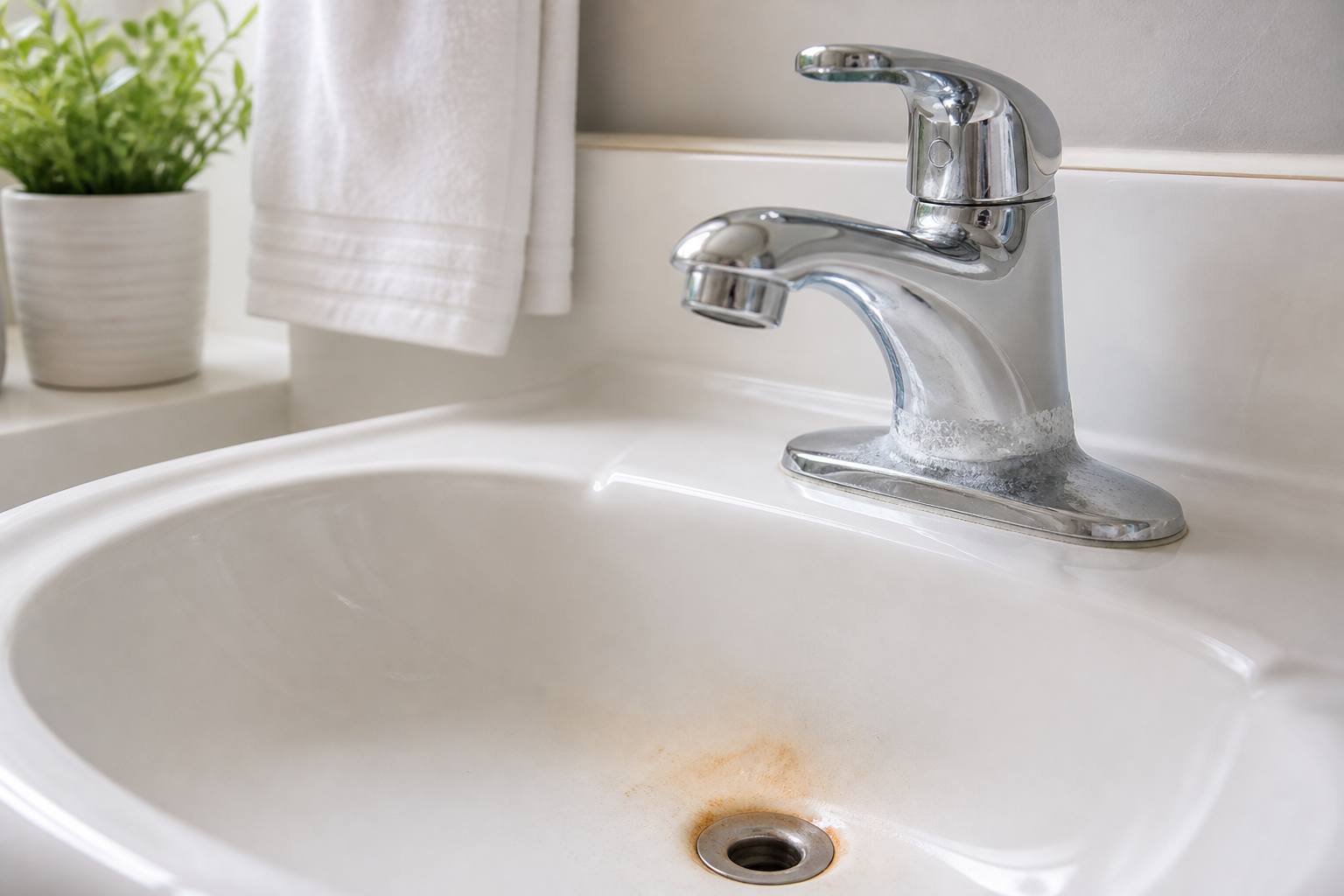
Table of Contents
Table of Contents
- Iron vs. Hard Water: The Short Answer
- Signs of Iron and Signs of Hard Water
- Why Symptoms Can Mislead You
- What to Test for in Well Water
- How to Prepare for a Useful Water Test
- How Results Guide Treatment
- Frequently Asked Questions
Iron vs. Hard Water: The Short Answer
Hardness is a measurement of dissolved minerals, mainly calcium and magnesium. The U.S. Geological Survey explains that groundwater can dissolve these minerals as it moves through soil and rock. A hardness report is commonly expressed in milligrams per liter as calcium carbonate, or in grains per gallon for softener settings.
Iron is a separate substance that can occur naturally in groundwater. It is not the same measurement as hardness. According to Penn State Extension, iron in private water supplies can cause a metallic taste and orange-brown stains or particles, especially after water is exposed to air.
What is the practical difference? Hardness often leaves a pale, chalky deposit. Iron often leaves orange, rust-colored, or yellow-brown staining. But the color alone cannot tell you the concentration, the iron form, or whether another issue is present. A well can contain both findings, so treating only the visible symptom can leave part of the problem behind.
If you have not measured hardness yet, start with our guide to testing water hardness at home. It explains the difference between strips, drop kits, and laboratory testing. For a private well or a treatment purchase, a laboratory panel can give you a more useful comparison than one home screening result.
Signs of Iron and Signs of Hard Water
What should you look for around your home? Use the signs below as notes to bring to a test provider, not as proof of the cause.
| What you notice | It can point toward | What it does not prove |
|---|---|---|
| White crust on a showerhead, kettle, or glass | Hardness minerals concentrating as water evaporates. | The exact hardness level or the absence of other water issues. |
| Spots on dishes and difficulty getting soap to lather | Hardness may be affecting cleaning performance. | That a softener is the only treatment you need. |
| Orange, red, or yellow-brown stains in sinks, toilets, or laundry | Iron or rust-related staining may be present. | The iron concentration, iron form, or the source of the iron. |
| Metallic taste or water that becomes orange after standing | Dissolved iron can oxidize after it meets air. | That the water has no other issue that needs testing. |
| Black staining or particles | Manganese or another source may be involved. | That iron or hardness is the only cause. |
Hardness can be frustrating because it can affect fixtures, laundry, dishes, and soap use. Our list of signs of hard water can help you sort out the common scale and cleaning clues.
Iron can be equally frustrating, but it has different treatment limits. Penn State Extension notes that the amount and form of iron affect the practical treatment approach. Clear water that later develops orange-brown particles behaves differently from water that already contains visible rust-colored particles. That distinction is one reason a test result is more useful than choosing equipment from a stain alone.
Why Symptoms Can Mislead You
Can hard water cause orange stains? Usually, hard water is more associated with white or off-white mineral scale. Orange or brown staining more strongly suggests iron, but old plumbing, corrosion, or a mix of water conditions can also affect what you see.
Can iron make water seem hard? Yes. Iron can make laundry, fixtures, and appliances look dirty or stained. That can feel similar to a hard-water problem, even though the test result and treatment plan may be different. You may also have both problems in the same well.
The USGS overview of groundwater quality describes hardness and excess iron as separate groundwater characteristics. This is the key point: hardness is not an iron test, and an iron result is not a hardness setting.
Avoid using a total-dissolved-solids meter as a replacement for either test. A TDS result measures the total amount of dissolved material. It cannot identify which minerals make up the number, so it cannot tell you whether you have a specific hardness level or an iron concentration.
If you see sudden discoloration, sediment, a strong odor, a change after flooding, or a change after well work, treat that as a wider water-quality question. Contact your local health department, certified laboratory, or qualified well professional. Do not assume a hardness strip can rule out other concerns.
What to Test for in Well Water
What is the best way to tell iron from hard water? Test for both. For a private well, ask a certified laboratory or local health department about a panel that includes hardness, iron, manganese, pH, and the other checks that fit your location and circumstances.
The EPA advises private-well owners to use a certified laboratory and to match the test to the problem. A useful report can show whether you are looking at calcium and magnesium hardness, dissolved iron, oxidized iron particles, manganese, or a combination. Your local authority can also tell you about regional conditions and extra tests that are important in your area.
Use this simple sequence:
- Write down what changed. Note stain color, taste, odor, the date, and whether it happens at every tap.
- Sample the untreated water when appropriate. If you are trying to understand the well supply, ask the laboratory whether to sample before an existing softener or filter.
- Order direct measurements. Ask for hardness, iron, and pH at a minimum when those signs are present. Add the tests your local laboratory or health department recommends.
- Keep the full report. Record the sample point, date, units, and any existing treatment. One number is less useful without this context.
- Plan from the documented result. Compare the treatment capability with the measured problem before you spend money.

Want help reading the hardness part of that panel? Our water hardness scale explains common units such as mg/L, ppm, and grains per gallon. For a broader test-first approach, see how to test and treat hard well water.
How to Prepare for a Useful Water Test
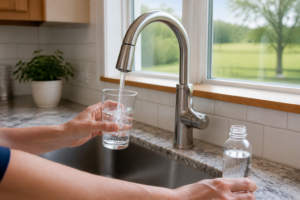
What makes one water test more useful than another? Start by telling the laboratory what you want to learn. Say whether you have a private well, whether the sample is taken before or after existing treatment, and whether you are seeing orange staining, pale scale, metallic taste, particles, odor, or a recent change in the water.
The laboratory may have specific instructions for the bottle, sample location, faucet preparation, holding time, and delivery. Follow those instructions exactly. A sample collected from a kitchen tap after a softener may be useful for checking treated household water, but it does not describe the untreated well supply. If you want to compare water before and after treatment, ask the laboratory how to collect and label each sample.
Keep a copy of the full report. Note the units for hardness and iron, the collection date, the sample point, and any treatment that was running when you collected it. This record makes it easier to compare a later test without confusing a real water change with a different sample location or method.
Do you need to wait for one sign to get worse? No. A persistent stain, a treatment decision, or a change in your water is enough reason to ask for local testing guidance. If a laboratory result identifies a concern beyond iron or hardness, follow the laboratory or health authority advice for that specific result instead of trying to solve it with a general water-treatment purchase.
How Results Guide Treatment
What does a hardness result help you decide? It can help you discuss whether ion-exchange softening fits a confirmed scale and soap-performance problem. It can also provide information for sizing and settings, together with household water use and the equipment maker’s instructions.
What does an iron result help you decide? It helps define a separate treatment question. Penn State Extension explains that conventional softeners can sometimes remove some dissolved iron under limited water conditions, but oxidized iron can foul softener resin. The right approach depends on the measured concentration, the iron form, pH, hardness, flow, and the rest of the water chemistry.
That is why a softener should not be treated as a universal iron solution. A system that is suitable for hardness may not be suitable for visible iron particles, high iron, manganese, sediment, bacteria, or another documented issue. Ask a qualified professional to explain what each stage is designed to remove and how you will confirm the result after installation.
Our guide to what a water softener does to well water explains the limits of softening in more detail. If you are comparing a filter and a softener, keep the test report in front of you. The treatment should match the measurement, not the sales pitch.
Frequently Asked Questions
Is iron considered hard water?
No. Hardness usually refers to calcium and magnesium in water. Iron is a separate result that can occur with hard water or without it. Test both when iron staining and hardness symptoms are possible.
Does orange staining always mean iron in well water?
No. Orange or brown staining can point toward iron, rust, or another local plumbing or water condition. A direct iron test is the reliable way to confirm the result and its concentration.
Can a water softener remove iron?
Sometimes, a conventional softener can reduce small amounts of dissolved iron under the right conditions. It is not suitable for every iron problem. Use a full water test and a qualified treatment recommendation before relying on a softener for iron removal.
Should I test for manganese too?
Ask your certified laboratory or local health department. Manganese can occur with iron and may cause dark staining. A complete report helps you avoid treating one visible symptom while missing another result that changes the treatment plan.
Is a home hardness strip enough for a well-water decision?
A strip can be useful for a quick hardness screen. Choose a laboratory test when you need to compare hardness with iron, manganese, pH, bacteria, nitrate, or other well-water findings before a treatment decision.
The Bottom Line
Iron and hard water can cause different problems, and they can occur together. Hardness is mainly about calcium and magnesium. Iron is a separate finding that can cause staining, particles, and a metallic taste.
Start with a direct test for the conditions you suspect. Keep the full report, ask a certified laboratory or local authority to explain any unclear result, and choose treatment only for the problem you have confirmed. That approach can help you protect your plumbing budget and make a better decision for your well water.