
Choosing a whole house water filter usually starts on a product page. It works better in reverse. Start with what is in your water, decide where treatment belongs, size the system for your home, and verify the paperwork before you pay. We do not rank products, and we do not run laboratory tests.
Table of Contents
Start With Your Water Report, Not a Product
Every decision below depends on one document: your water test results.
If You Are on City Water
Public water systems that must report publish a Consumer Confidence Report each year. Small systems can qualify for reduced or different reporting, so if you cannot find a report, ask your utility. Find your report on the EPA site and read the detected contaminants table, not the summary. Note which contaminants were detected, the highest level reported, and the legal limit for each. A detection below the limit is still a detection, and it may still matter to you. Pay attention to disinfection byproducts, and to any PFAS results. Lead results in a report come from sampling the utility arranged. They are not a test of your own tap, so if you need to know about lead where you drink, arrange your own sample. If PFAS is not listed, ask your utility when it will test.
If You Are on a Private Well
A private well is the owner’s responsibility. No utility reports on it, and testing is your job. Your local health department can tell you which contaminants matter in your area and how often to test for them. About 15 percent of Americans rely on private wells, according to the EPA. Test for bacteria and nitrate every year, and follow local guidance for arsenic, iron, manganese, hardness, pH, sulfate, and sulfide. Use a certified laboratory and keep the report. The CDC well testing guidance and the EPA private well pages explain sampling. Test again after you install treatment.
Whole House Treatment or Drinking Water Tap?
A whole house filter treats every drop that enters the home. A point of use filter treats one tap. The choice follows two facts: what your test shows, and where you meet that water. Use whole house treatment when the test shows a problem you also meet in bathing, laundry, or appliances, or when the problem damages pipes and equipment. Use a point of use system when the contaminant matters mainly in water you drink or cook with, or when no whole house system is certified for that contaminant at your conditions. Whole house treatment costs more to buy, install, and maintain, and it treats water you never drink.
| What you notice | Where treatment belongs | Why |
|---|---|---|
| Chlorine taste and smell in showers and laundry | Whole house carbon | The household meets the water in several places |
| Stains, discoloration, or sediment after rain | Whole house prefilter or media | The issue enters at the main line |
| Scale on fixtures and appliances | Softener, then filtration if needed | Hardness is a mineral issue, not a problem solved by ordinary filtration |
| PFAS, nitrate, arsenic, or lead at the tap | Point of use, with a unit certified for that contaminant | You drink a small share of total water, so treat where you drink |
| Rotten egg smell or iron staining on a well | Whole house oxidation or media | The source water needs treatment before use |
| Bacteria in a well | Certified microbial treatment, for example a UV unit rated for the task | An ordinary filter is not a disinfection step |
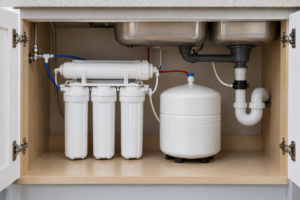
Reverse osmosis is one possible choice for some of these tap contaminants. It is suitable only when the exact system is certified for the contaminant you found and for your water conditions, such as pressure, temperature, and the other dissolved minerals present. It is not a general recommendation for tap water, and some contaminants need a different process.
Our guides on PFAS treatment, reverse osmosis pressure problems, and softeners versus filters go deeper. For well water, read best water filter for well water.
Know What Each Stage Does
A whole house system is a stack of stages. Each stage has one job and one limit.
| Stage | It is designed for | Its limit |
|---|---|---|
| Sediment cartridge | Sand, silt, and rust particles | Does not remove dissolved contaminants |
| Carbon block | Taste, odor, and chlorine | Loads quickly on sediment; check the certificate |
| Ion exchange softener | Hardness minerals | Adds sodium or potassium; not a contaminant filter |
| Oxidation and media | Iron, manganese, and sulfide in well water | Needs backwash drainage and correct sizing |
| UV disinfection | Bacteria and viruses | Needs the water conditions the unit specifies, often limits on turbidity, iron, and hardness, plus the pre-treatment the manufacturer requires |
Power, drain, and clearance requirements vary by model. Some reverse osmosis units need electrical power, while others use supply pressure. Read the exact system manual and ask an installer to confirm the required connections. Ask what each stage costs to keep running.
Size for Flow and Pressure
Size the system for expected simultaneous demand using an appropriate sizing method, then check pressure loss at that flow. Do not treat the sum of fixture nameplate flow ratings as household peak demand. Ask a qualified installer to check the sizing method and expected operating conditions.
Ask a qualified installer for the rated service flow and the expected pressure loss at your demand, with the filter loaded. Compare that with the flow the system delivers, not the highest number in the headline. Ask about bypass, drainage, and clearance.
Record incoming pressure with a gauge before you buy, and again after installation. A gauge shows change over time. A falling reading can mean a loaded filter, and it can also come from other causes in the supply, so confirm the cause before you replace parts. If pressure is already low, treatment will not raise it, and a plumber should inspect the supply and the pipe size first.
Pressure loss occurs in correctly sized systems too. Good sizing keeps it inside the range the manufacturer states for your demand; it does not remove the loss.
Verify the Certificate Before You Buy
Words like “certified” and “removes” mean nothing until you see the listing. Do this in order.
- Write down the exact model number and the exact replacement cartridge or media part number.
- Open the certification body’s public product listing. Our NSF certification guide shows where to look.
- Search the manufacturer name, and confirm the model string matches the unit you will buy, character for character.
- Confirm the listing covers the replacement part you will buy, not only the original.
- Check that the claims in the listing match the manual and the box.
- Ask the manufacturer for the certificate as a PDF, and check the listing identifier, the model, and the date.
- Save the certificate with your water report and your receipt.
- Recheck the listing when you buy replacement filters, because listings change.
If a seller cannot produce a certificate for the exact model, treat the claim as unproven. A certificate also does not prove performance in your home. A test of your treated water for the contaminants you targeted shows whether the system works there; it does not certify the water as safe in every respect.
Maintenance and Cost Worksheet
Fill this in with your own written quotes. Leave a cell blank until you have a number in writing.
| Item | What to record | Your number |
|---|---|---|
| System purchase | Written quote for the exact model | |
| Installation | Plumber quote, including any permit | |
| Prefilter and cartridges | Part number, price, and replacement interval | |
| Media replacement | Rated capacity and service interval from the manual | |
| Testing | Cost of the lab panel you will repeat | |
| Backwash water and power | Any utility cost the system adds | |
| Five year total | Sum of the rows above |
Divide the total by the gallons your household uses in that period, using the usage figure on your bill. Ask for replacement intervals in gallons and in months, and ask what shortens them.
FAQ
Are whole house filters worth it? They are worth it when your water report shows a problem you also meet across the home, and poor value when the problem is only in drinking water.
Will a whole house filter remove PFAS? Some carbon systems reduce some PFAS compounds, and results vary by system and by water. Check the certificate for the exact model.
Do they reduce water pressure? Any filter adds some restriction. Correct sizing keeps the loss inside the range the manufacturer states for your demand, and clean filters keep it stable. Measure your pressure and ask for the rated loss.
Do I need a softener too? Only if your water is hard. Softening and filtration solve different problems.
Your Decision Path
- Get your water report, or arrange a test of your own well or tap.
- Decide where you meet the contaminant, and treat there.
- Match the stage to the problem.
- Size for peak demand, and measure pressure.
- Verify the certificate for the exact model.
- Fill in the cost worksheet with written quotes.
- Install, then test the treated water for the contaminants you targeted.
Our water filtration guide and filter finder can help you compare treatment types. We do not publish ranked picks, because a ranking is only as good as the certificate behind it. Our disclosure page explains how this site is funded.