
Does a PFAS water filter claim cover the chemicals named in your water report? Start there, rather than with a brand or a removal percentage. A certification for PFOA and PFOS is evidence about those named chemicals under specified conditions. It is not a promise to remove every PFAS or a guarantee about the water coming from your tap.
The useful task is to put two records side by side: your water result and the filter’s current certification listing. Match the chemical names, then check the model, cartridge, and limits of the claim. If a detail is missing, you have a specific question to ask before spending money.
This guide helps you make that comparison. It does not rank products or report hands-on tests. For general treatment choices, our home water filtration guide explains the wider options. Here, the focus is narrower: what a PFAS claim proves, what it leaves unanswered, and what to save before you buy.
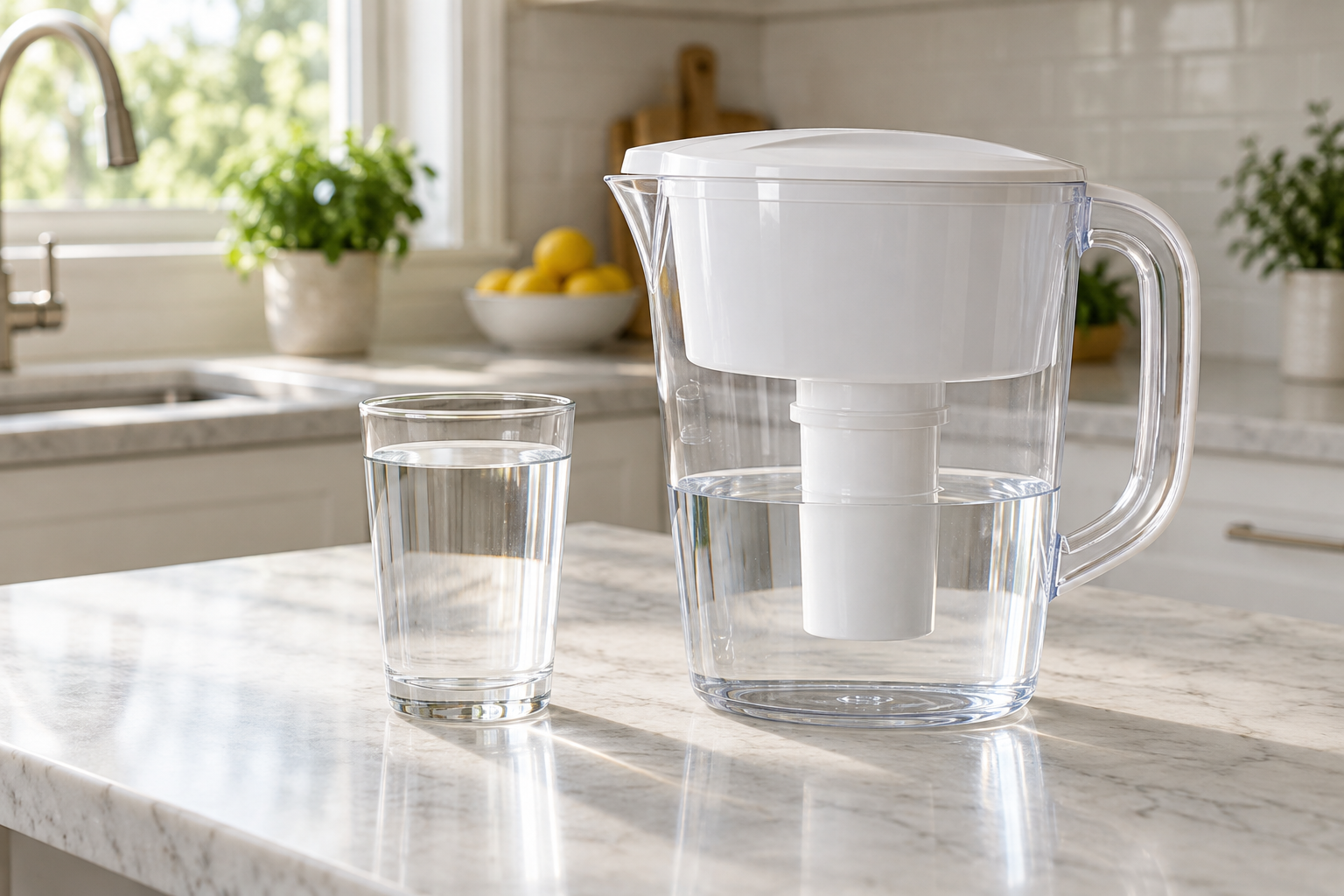
Illustrative image, not a certified product recommendation.
Table of Contents
Start With the PFAS Names in Your Water Result
PFAS stands for per- and polyfluoroalkyl substances, a group of chemicals. PFOA and PFOS are two members of that group, not other names for the whole group. A report can name other PFAS as well. That distinction matters when a package uses the broad phrase “PFAS reduction.”
If your report names several chemicals, copy each name into your notes. Keep the reported concentration, unit, sample date, and sample location beside it. Do not replace the individual results with a single note that says “PFAS found.” You will need the names when you compare the report with a filter claim.
Where Should You Get the Result?
For public water, ask your utility for its available PFAS results and current guidance. EPA’s home-filter fact sheet recommends starting with your local water provider. A utility result describes the sampled supply; keep the date and location attached rather than treating it as a new test of your kitchen tap.
For a private well, you are responsible for arranging testing. CDC’s well-testing guidance says EPA rules for public drinking-water systems do not apply to privately owned wells. CDC recommends a state-certified laboratory and advice from your health department about chemicals of local concern.
Ask specifically whether the proposed laboratory panel includes the PFAS you need to investigate. Do not assume that a general water-quality panel includes them. Let the laboratory supply the sample instructions; this article is not a substitute for its collection procedure.
No PFAS result yet? Ask your utility or health department what information is available before choosing treatment. EPA notes that a filter may not be useful when PFAS have not been measured or are below federal limits. Buying a filter is not the only possible next step.
Read a PFAS Water Filter Claim Chemical by Chemical
A standard number is not enough. NSF/ANSI 53 covers specified health-effect reduction claims; NSF/ANSI 58 applies to reverse osmosis systems. Neither number alone tells you that a particular filter is certified for the PFAS in your report.
EPA’s filter fact sheet directs buyers to certification for PFAS reduction under NSF/ANSI 53 or 58, then to the certifier’s product directory. The phrase “for PFAS reduction” matters. A model with an unrelated claim under one of those standards has not answered your PFAS question.
Use the certification body named on the product, not a retailer’s logo image alone. The NSF certified-products directory is one route when NSF is the named certifier. Other accredited bodies also certify filters, as EPA’s fact sheet explains. The standard’s name and the organization doing the certification are separate details.
Our guide to NSF-certified water filters covers the general model lookup. Once you have the exact listing, make the PFAS-specific comparison:
- Copy the claim exactly. Does it name PFOA, PFOS, a defined group, or a different substance? Do not expand the wording yourself.
- Compare every chemical of concern. Mark which names in your water result appear in the claim and which do not.
- Read any group definition or footnote. If a claim covers a group, find out which chemicals the group includes. “PFAS” without a definition leaves that question open.
- Keep unmatched chemicals visible. Ask the certifier or manufacturer about them. A PFOA/PFOS claim alone does not establish a claim for PFHxS, PFNA, or another PFAS.
This is a check of evidence, not a prediction that an unlisted chemical will or will not be reduced. Missing certification evidence means you cannot rely on that listing to make the claim.
What If the Listing and Product Page Disagree?
Pause the purchase. Save both pages, the full model number, and the date you checked them. Ask the manufacturer to identify the current listing for the exact system and replacement cartridge being sold. If the scope remains unclear, ask the certification body how to interpret its record.
Do not resolve a mismatch by choosing the larger removal claim. Nor should you transfer a claim from a similar model in the same product family. Your question is about the configuration you will receive.
Separate Certification Limits From Drinking-Water Limits
Does “certified” mean your filtered water will meet the EPA limit? Do not make that leap. A filter certification and a public-water regulation answer different questions.
The EPA PFAS drinking-water rule page lists 4.0 parts per trillion for PFOA and 4.0 parts per trillion for PFOS in its 2024 final-rule materials. Parts per trillion are also expressed as nanograms per liter, or ng/L. EPA notes that public-system compliance uses running annual averages at the sampling point.
As checked on October 5, 2026, that page also describes two rules announced on May 18, 2026 as proposals. They concern implementation timing and other PFAS provisions. A proposal is not a final rule. This article does not treat a proposed deadline or rescission as completed.
Those public-system details are not a filter performance sheet. To understand a product claim, ask what concentration was used in testing, what treated-water endpoint applied, and under which capacity and flow conditions the product was evaluated. A percentage by itself cannot answer those questions.
Why the Date of the Claim Matters
EPA’s April 2024 home-filter fact sheet says certifications at that time focused on PFOA and PFOS. It also warns that the certification standards then in use did not establish reduction to the newly set drinking-water limits. That is a dated warning, not proof that every October 2026 listing uses the same limits.
Use it as a reason to check the current documentation. Ask which version of the claim applies to the product you are considering and what its endpoint is. Do not assume either that nothing has changed since 2024 or that an updated standard automatically changes every existing product’s certification.
If your goal is a particular treated-water result, explain that goal to the laboratory or health department helping you. Ask how to check the installed system’s output. Certification evidence can guide product selection, but it is not a measurement from your home.
Keep the Cartridge and Capacity Attached to the Claim
A PFAS reduction claim belongs to a documented system configuration. Record the system model and the specified replacement cartridge together. A cartridge that fits inside a housing is not, on that basis alone, evidence of the same certified performance.
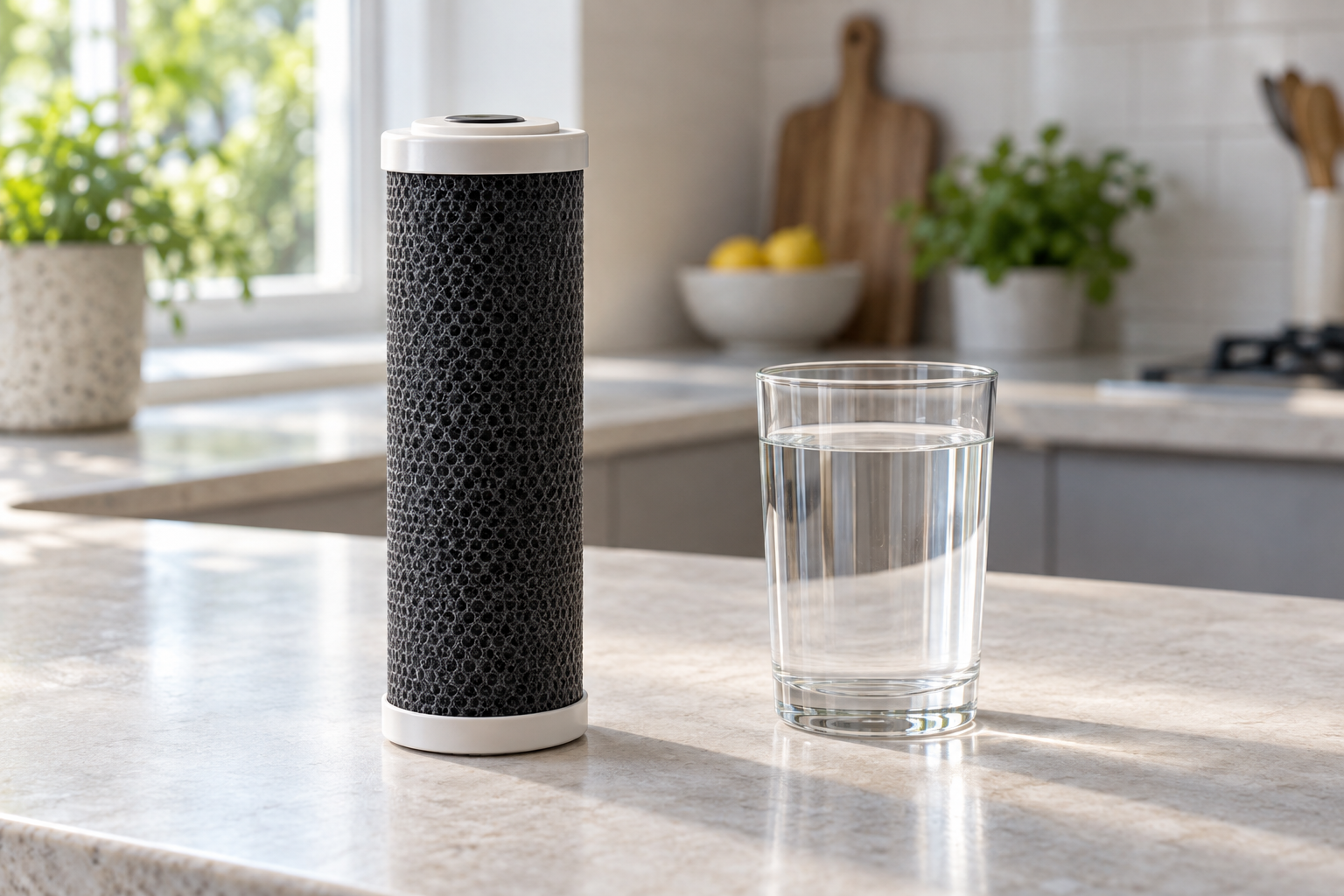
Illustrative cartridge. Appearance does not establish a PFAS reduction claim.
Before buying, locate the performance data sheet and maintenance instructions. If the documents give different capacities for different claims, identify the capacity that applies to the PFAS claim you need. Do not borrow a longer chlorine taste-and-odor capacity to plan PFAS cartridge changes.
Write down the following details without filling gaps from a similar model:
- The complete system and replacement-cartridge identifiers.
- The PFAS names or defined group covered by the claim.
- The rated capacity and any flow limits that apply to that claim.
- The required replacement interval and other maintenance instructions.
- The source document, its date or revision, and the current listing URL.
Can you obtain the required replacement part and follow the instructions? That is part of the buying decision. EPA stresses that filters need maintenance according to the manufacturer’s instructions to remain effective. Do not use a change in taste as your only replacement plan for a PFAS concern.
The technology name is not a shortcut, either. EPA identifies activated carbon, reverse osmosis, and ion exchange as treatment types that can reduce PFAS. That does not certify every product using those materials. Keep checking the exact product rather than assuming one treatment label answers all the questions.
Ask for the Missing Evidence Before You Buy
You do not need to sound like a laboratory specialist. Send the seller a short, specific request:
I am comparing treatment for the PFAS named in my water results. Please send the current certification listing and performance data sheet for the exact system and replacement cartridge you sell. Which named PFAS does the certified claim cover? What treated-water endpoint, capacity, flow limits, and replacement instructions apply to that claim?
Include the chemical names you are asking about. You can leave out personal details that the seller does not need. If the answer is only a broad marketing page, repeat the request for the listing and the model-specific document.
Then make one of three decisions:
- The records match: Keep the evidence and check installation, maintenance, and any follow-up testing with the appropriate provider.
- A detail is missing: Leave that item unresolved and ask the manufacturer or certifier. Do not turn an unanswered question into a positive claim.
- The claim does not match your concern: Continue looking or seek advice about treatment for the specific result.
Once the PFAS claim is clear, Find Your Filter can help you explore formats. Treat the tool as a starting point, not a substitute for the current certification record.
Questions About PFAS Water Filter Certification
Does a PFOA/PFOS Claim Cover All PFAS?
No. Read the exact scope. Those are two named PFAS, and evidence for them should not be extended to every member of the group. If your result names another PFAS, ask for evidence addressing it.
Is Every NSF/ANSI 53 Filter Certified for PFAS?
No. The standard includes different reduction claims. You need the current listing for your exact model and the relevant PFAS claim, not just the standard number on the package.
Does a High Removal Percentage Prove the Output Meets My Goal?
Not by itself. You also need the test conditions and treated-water endpoint. A percentage without the starting concentration and applicable limits leaves out information needed to interpret the result.
Can I Keep a Filter I Already Own?
Start by identifying its exact model and installed cartridge. Check its current claim and maintenance status using the same process. Do not replace equipment solely because the label is unfamiliar, but do not assume an existing taste filter has a PFAS claim.
What Should I Do Next?
Put your water results, the certification listing, and the performance data sheet together. Circle any chemical name or operating limit that does not match, and get an answer before buying. The right PFAS water filter decision starts with that evidence, not a longer list of promises.