
If you’re wondering how often to test water hardness, there is no single calendar rule for every home. A good starting point is to test when you need a current number to make a decision, such as setting up a water softener, checking whether an existing system still matches your water, or investigating new scale and soap problems.
For many homes on municipal water, a result is most useful when something changes. For private-well homes, an annual water-quality routine is a sensible time to revisit hardness too, especially if you use treatment equipment or notice a change at the tap. The important distinction is that a hardness result measures minerals, mainly calcium and magnesium. It does not replace testing for drinking-water safety concerns.
You do not need to chase a perfect schedule. What you need is a repeatable habit: know your baseline, save the result, and take a new sample when it can answer a practical question. That approach works whether you rent, own a home, use public water, or manage a private well.
Table of Contents
Table of Contents
- The quick answer
- A practical water hardness testing schedule
- When to test sooner
- How to make each hardness result useful
- Hardness testing is not a complete water-safety test
- Frequently asked questions
The quick answer
Test water hardness when you need an up-to-date result for a home decision, then retest whenever your water source, treatment setup, or hard-water symptoms change. If you have a private well, include a hardness check in your annual water review when hardness affects your equipment or daily routine. If you use city water and do not have a softener or scale problem, you may only need to test when a new concern appears or before you spend money on treatment.
Why not give every home the same interval? Hardness can be stable in some water supplies and more variable at an individual home because of a private well, a water-softening system, plumbing changes, or a change in the source feeding a public system. The U.S. Geological Survey explains that hardness is generally the amount of dissolved calcium and magnesium in water, and that regional maps are not a substitute for information at your own home or local water supply in its hardness overview.
Before you choose a test, make sure hardness is the question you need answered. Our guide to testing water hardness at home compares the common home and laboratory options.
A practical water hardness testing schedule
The best schedule depends on where your water comes from and what you are trying to manage. Use the table as a decision guide, not as a mandate.
| Your situation | A sensible time to test hardness | Why it helps |
|---|---|---|
| Municipal water, no treatment system | Get a baseline when you notice scale, spots, or soap issues, then retest when those signs change or before a treatment purchase. | A current tap result is more useful for your home than a broad regional estimate. |
| Private well | Add hardness to an annual water review if it affects your softener, fixtures, laundry, or appliances. Test sooner after a meaningful change at the well or tap. | You manage the source and treatment decisions directly. |
| Existing water softener | Test before setting or rechecking the hardness setting, after servicing the system, and when scale or poor lather returns. | A setting based on an old number may no longer fit the water reaching your home. |
| New home or new treatment decision | Test before choosing, sizing, or changing equipment. | You need a measured starting point instead of a guess based on a map or a neighbor’s result. |
| One-time strip or drop-kit result | Retest when the result surprises you, conflicts with household symptoms, or will guide a costly decision. | Repeating a careful sample can show whether the first reading was representative. |
If you use a private well, do not confuse an annual hardness check with a complete annual water test. The Centers for Disease Control and Prevention recommends that well owners test at least yearly for total coliform bacteria, nitrates, total dissolved solids, and pH, then ask local health or environmental officials about other local concerns in its well-testing guidance. Hardness may be useful for managing mineral scale, but it is a separate measurement from that broader safety-focused panel.
Do you need to test hardness every month? Usually, no. A monthly number is more detail than most households need unless you are actively troubleshooting treatment equipment or comparing a new water source. Testing too frequently can make a normal small difference look like a major change, especially when you switch faucets, test after a softener, or use a different kit. Start with a careful baseline, then let a practical trigger tell you when to measure again.
For example, a homeowner who has city water and no scale problem may simply keep the first result with their utility report and revisit it before buying a softener. A well owner with a softener can pair an annual broader water review with a hardness check at the untreated inlet. A household whose dishes suddenly show more spots after a softener repair has a reason to test now, not to wait for the next annual reminder. The schedule should fit the decision in front of you.
When to test sooner
You do not need to wait for a planned date when the situation has changed. A fresh water hardness result is especially useful in these moments:
- You see new white scale on fixtures, spots on dishes, or a change in how soap and detergent perform.
- Your softener was installed, repaired, bypassed, or refilled and you want to check its setting against current raw water.
- You move into a home, change from city water to a private well, or begin using a different water source.
- You are comparing treatment options and need a number before discussing capacity or settings.
- A previous test did not match what you see around the house.
- A flood, land disturbance, repair, or sudden change in taste, color, or odor raises a broader private-well concern.
The last trigger deserves extra care. CDC lists changes in taste, color, or smell, well repairs, flooding, and nearby disturbances as reasons to test private-well water more promptly. In that situation, do not stop at a hardness strip. Contact your local health department or a state-certified laboratory to choose tests that fit the concern.
What if you only want a quick clue before you measure? A no-kit hard-water check can help you notice a soap-lather pattern, but it cannot give you a hardness number. Use it to decide whether a measured test makes sense, not to size equipment.
How to make each hardness result useful
Testing more often only helps when you can compare the results. Keep the next check simple and repeatable.
- Use the same sample point when possible. Test from the same cold-water faucet, unless you are specifically comparing treated and untreated water.
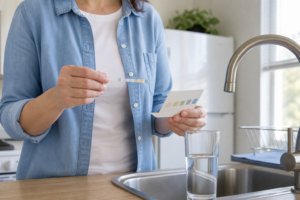
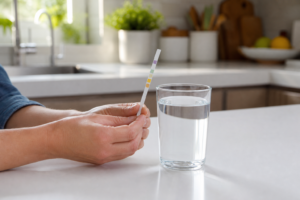
- Follow the exact instructions for that kit. Strip colors, wait times, and units vary by brand. Our guide on how to read water hardness test strips explains why the package chart matters.
- Write down the date, location, method, and units. A result in ppm or mg/L is not directly comparable with a softener setting in grains per gallon until you convert it.
- Record whether the sample is before or after treatment. A softener check should distinguish untreated incoming water from softened water.
- Use the result with the problem you are solving. A hardness number can explain scale or soap use, but it is not an automatic instruction to buy equipment.
If you repeat a strip test, don’t compare color blocks from memory. Take a photo of the kit’s chart if its instructions allow it, or write down the reported range exactly as the manufacturer presents it. Note whether the faucet ran for a few minutes before sampling and whether a softener was in service. Those small details make a second result easier to interpret without pretending that two different methods are identical.
Once you have a number, use our water hardness scale to place it in context. USGS commonly groups results as soft from 0 to 60 mg/L as calcium carbonate, moderately hard from 61 to 120 mg/L, hard from 121 to 180 mg/L, and very hard above 180 mg/L. Those ranges help you interpret a measurement, but your household symptoms, water use, and equipment guidance still matter.
Hardness testing is not a complete water-safety test
Hardness is about minerals. It can explain scale on a kettle, extra soap use, cloudy glassware, or a softener setting. It cannot tell you whether water contains bacteria, lead, nitrate, arsenic, or another contaminant.
That is why the question “how often should I test my water hardness?” should sit beside another question: “What am I trying to learn?” EPA’s home drinking-water testing guidance advises homeowners to select tests based on their water source and the concern they need to investigate. If you have a private well, an unusual taste, a household health concern, or a local contamination notice, ask a local health department or qualified laboratory about a broader test panel.
For public-water customers, your utility’s consumer confidence report can provide useful system-level context. It still may not describe the exact water at your tap after household plumbing or treatment. Use the report as background, then take a current sample when you need a home-specific hardness result.
If a test result is unexpected, pause before treating it as proof of a safety issue. First confirm the sample location, method, and units. Then decide whether the concern is mineral scale, an equipment setting, or a broader water-quality question. That sequence keeps a simple hardness result in its proper lane and helps you spend testing money where it answers a real question.
Frequently asked questions
Should I test water hardness every year?
Annual testing can be a practical habit for a private-well household when hardness affects a softener, appliances, or cleaning routine. It is also a good time to review the broader annual well-water testing recommended by CDC. For municipal water, an annual hardness test is optional unless you use the number to manage treatment or notice a change that needs explaining.
How often should I test water hardness with a water softener?
Test before you set or revisit the softener’s hardness setting, after meaningful service, and when scale or soap problems come back. Check both the untreated incoming water and the softened water when your setup allows it, then follow your equipment manual for the correct setting process.
Can a water hardness result change?
Yes. A private well can respond to seasonal conditions, groundwater changes, and treatment changes. A public supply can also vary with source blending or treatment operations. That is why a fresh result is better than a regional map when you are making a decision for your home.
Is a hardness test the same as a water-quality test?
No. A hardness test measures mineral content, usually calcium and magnesium. A water-quality test may look for bacteria, nitrate, lead, or other issues depending on the panel. Choose the test that matches the question you need to answer.
The bottom line
Test water hardness when you need a number you can act on, then retest when your water, treatment system, or household symptoms change. Private-well owners can include hardness in an annual review when mineral scale or a softener matters, while still following a broader well-water testing plan for safety-related concerns.
Start with a careful sample, write down the result and units, and compare it with the water hardness scale. If the result will guide a major treatment decision, confirm the method and get advice that fits your water source rather than relying on a one-time guess.