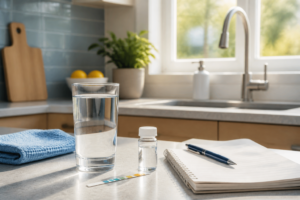

Lead in drinking water usually comes from lead-containing pipes, solder, faucets, or other plumbing materials as they corrode. Water can leave a treatment plant and pick up lead on its way to your glass.
You can’t detect dissolved lead by looking at, smelling, or tasting water. Start with your service line records and a lab test at the tap. You can take steps to reduce exposure while you investigate. Clear water and a newer faucet do not establish that the whole plumbing system is free of lead.
This guide explains what to ask your utility, how to collect a useful sample, and what federal action levels mean for your home.
Table of Contents
In This Guide
- How lead gets into tap water
- Check your service line
- Arrange a lead water test
- Understand the action level
- Reduce exposure while investigating
- Common questions
How Lead Gets Into Tap Water
A service line is the pipe connecting a home to the water main. When that pipe contains lead, it is typically the most significant source of lead in the home’s drinking water. Ownership may be divided between the utility and the property owner, so information about both portions matters.
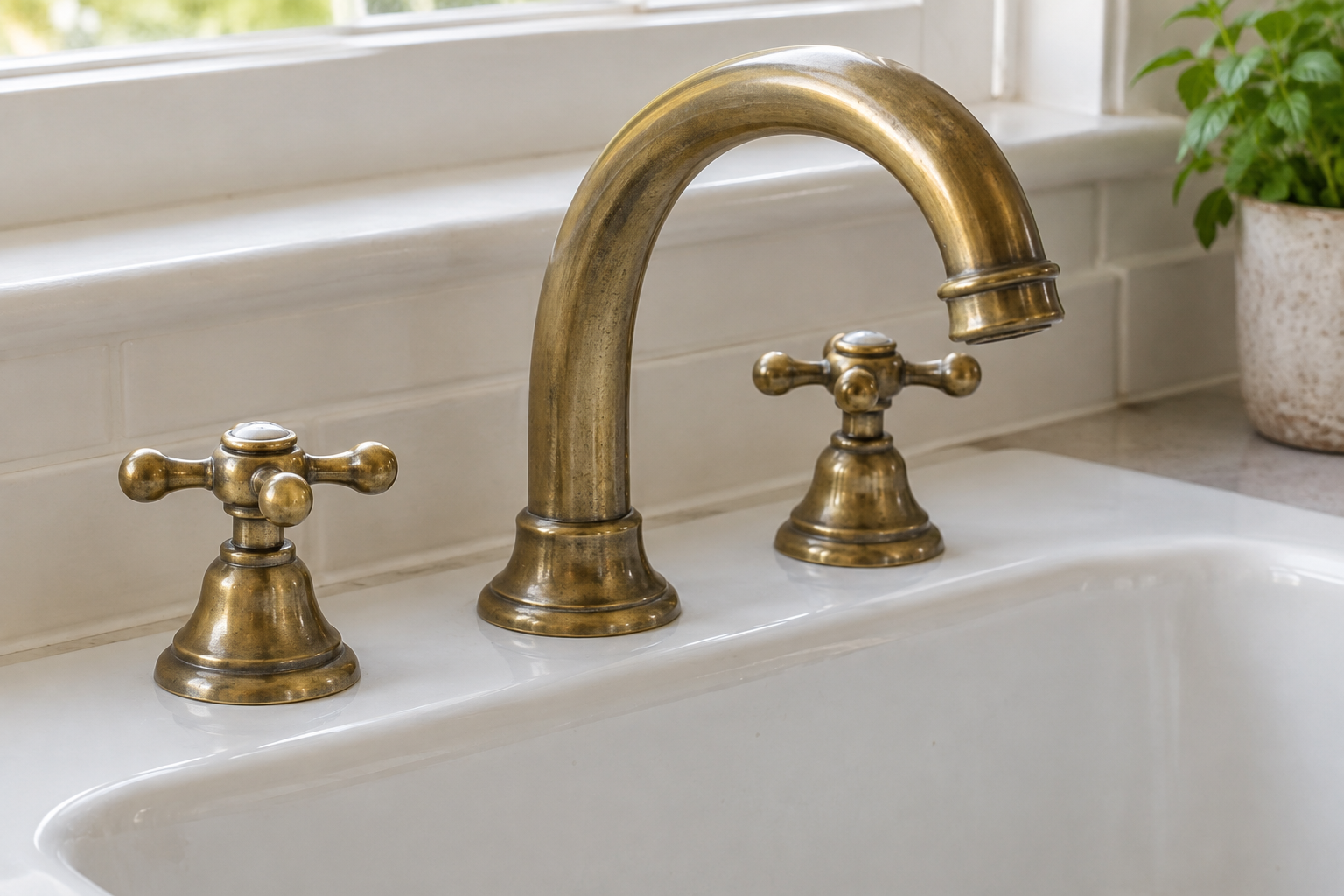
Inside the home, lead can also come from solder joining copper pipes and from some brass faucets, valves, and fixtures. CDC also lists galvanized iron pipes among possible sources in homes without lead service lines.
Homes built before 1986 are more likely to contain lead pipes, fixtures, or solder. However, the home’s age alone cannot establish whether lead is present. Renovations may have replaced only part of the plumbing, and a home without a lead service line can still have other lead-containing components.
Water chemistry, temperature, plumbing condition, and the time water sits in pipes can affect how much lead enters it. That is why a utility-wide report cannot tell you exactly what comes out of your kitchen faucet. See EPA’s basic information about lead in drinking water for the underlying sources and exposure-reduction guidance.
Start by Checking Your Service Line
Contact your water utility and ask for the service line inventory entry for your address. A public map or lookup tool may provide it, but ask for clarification if the entry is missing or unclear.
Useful questions include:
- What material is recorded for the utility-owned and customer-owned portions?
- Was that classification verified through inspection or based on records?
- Is any portion listed as lead, galvanized requiring replacement, or unknown?
- Is testing available, and is replacement planned for this address?
- What flushing instructions apply to this property?
An “unknown” entry means the material has not been established. It is not confirmation that the line is lead-free. Likewise, a copper pipe visible inside your basement does not prove that the buried pipe is copper all the way to the main.
EPA’s “Protect Your Tap: A Quick Check for Lead” resource can help you understand accessible service line materials. Treat a visual check as supporting information, and ask the utility or a qualified plumber to resolve uncertainty. Avoid disturbing old plumbing to identify it.
If you rent, request the same information from your landlord or property manager. Ask for any previous lead water test reports, including where and how samples were collected.
Arrange a Lead Water Test at the Tap
Use a laboratory certified by your state to analyze lead in drinking water. Your utility or state drinking-water program can help you locate one. Ask whether the utility offers household testing and whether participation has specific eligibility or sampling requirements.
Tell the laboratory what you want to learn. Testing water from the kitchen cold tap addresses a different question from evaluating a filter’s output or investigating a particular fixture. Explain whether you have a known lead service line, recent plumbing work, or an existing filter.
Before collecting anything, confirm:
- Which faucet to sample and whether the filter should be included or bypassed.
- Whether water must sit unused beforehand, and for how long.
- Whether the sample should be first-draw, collected after flushing, or part of a sequence.
- Which bottles to use and how quickly to return them.
Keep sampling instructions separate from everyday flushing
Follow the laboratory’s collection instructions exactly. Do not flush, clean the aerator, or change the faucet setup immediately before sampling unless instructed. Those actions can change the result and may undermine the purpose of the test.
Routine flushing to reduce exposure is a separate activity. A first-draw sample may intentionally capture water that has been standing in the plumbing. A flushed sample answers a different question. Neither should be substituted for the other without the laboratory’s guidance.
Keep a record of the sampling location, filter status, recent plumbing work, and collection time. A result describes the water collected under those conditions; one low result does not guarantee that lead will remain low at every tap or time.
For a private well, plumbing can still contribute lead. Our guide to getting well water tested explains how to organize laboratory testing. Specifically request lead analysis when investigating this concern.
What the Lead Action Level Means
An action level is a regulatory trigger for a public water system. It is not a personal safe-exposure limit or a pass/fail standard for an individual glass of water.
Under EPA’s Lead and Copper Rule Improvements, or LCRI, the new lead action level is 10 micrograms per liter, written as 10 µg/L. In water reports, that is equivalent to 10 parts per billion, or ppb. Most new requirements begin in late 2027, three years after publication of the final rule.
As of October 2026, the new 10 µg/L action level should not be presented as the universal current compliance trigger. The preceding federal framework uses 15 µg/L, and applicable requirements can depend on the implementation timeline and state rules.
Utilities assess action levels through required sampling and calculations across selected homes. A household result below either number does not establish that exposure is harmless. EPA’s maximum contaminant level goal for lead is zero. This health-based goal is distinct from an enforceable regulatory action level.
The LCRI generally requires water systems to replace lead service lines and certain galvanized lines under their control within 10 years or less. A small number of systems can have longer deadlines under the rule. That program does not guarantee replacement at your address by a particular personal deadline. Ask your utility about its schedule, access requirements, funding, and responsibilities for your property. The EPA LCRI overview explains the federal framework. EPA’s LCRI questions and answers explain the compliance timeline.
Reduce Exposure While You Investigate
You can take practical steps before the plumbing investigation or replacement is complete. If your utility has issued instructions following service line work or a water-quality notice, follow those instructions.
Flush according to utility guidance
After water has been sitting in the plumbing, flushing the cold-water line can help reduce lead exposure. Ask your utility how to do this for your home.
There is no single flushing duration that fits every property. Service line length, plumbing layout, and recent work can matter. Flushing also does not remove the underlying lead source or guarantee that every subsequent sample will be lead-free.
Use cold water for consumption
Use cold tap water for drinking, cooking, and preparing beverages or infant formula, then heat it separately as needed. Hot water can dissolve lead more readily.
Cold water can still contain lead. If contamination is known or suspected, use water from an appropriate, properly maintained lead-reduction filter or another suitable drinking-water source while resolving the issue. Follow formula preparation instructions separately.
Clean the faucet aerator
Particles containing lead can collect in the screen at the end of a faucet. Clean the aerator according to the faucet manufacturer’s directions and your utility’s advice, particularly after plumbing disturbances.
Remember that preparation for a laboratory sample may require a different procedure. Ask before cleaning the aerator if you are about to collect water for testing.
Verify a filter’s exact lead-reduction claim
Choose a filter with independent certification specifically for lead reduction. CDC recommends a point-of-use filter certified to NSF/ANSI 53 for lead reduction and NSF/ANSI 42 for particulate reduction. A standard number alone does not establish that every certified product reduces lead.
Check the certification directory for the exact system model and replacement cartridge. Confirm that lead reduction is listed and follow installation, capacity, and cartridge-change instructions. An overdue or incorrectly fitted cartridge may not perform as intended.
Our NSF-certified water filter guide explains how to verify a model’s claims. The water filtration guide provides broader context for matching treatment to a measured water problem.
Never boil water to remove lead
Boiling does not remove lead. Do not use boiling as a substitute for lead-reduction treatment.
If a boil-water advisory is also in effect, follow the utility’s instructions for the microbial hazard and ask how to address lead at the same time. Boiling and lead reduction solve different problems.
Frequently Asked Questions
Can I shower or bathe in water containing lead?
CDC states that bathing and showering should be safe because human skin does not absorb lead in water. Avoid swallowing the water. Drinking and food preparation remain the priorities for reducing exposure. See CDC’s guidance on lead in drinking water.
Why is formula preparation mentioned specifically?
CDC notes that infants consuming formula prepared with lead-contaminated water may have greater exposure because of the amount of water they consume relative to their size. CDC also states that no safe blood lead level has been identified for young children. These facts support checking preparation water without assuming that any particular household is contaminated.
Does a utility report replace a home test?
No. A utility report describes system monitoring, while lead can enter water through your service line or household plumbing. Request the report for context, then use properly collected tap samples to investigate your own water.
Does replacing the kitchen faucet fix the problem?
It may address one source, but it will not remove lead from a service line, solder, or other upstream components. Identify the likely sources before treating a fixture replacement as a complete solution. Ask about flushing and follow-up testing after work.
What should I do with a detectable lead result?
Share the full laboratory report and sampling details with your utility or local drinking-water program. Ask about source investigation, interim precautions, and repeat testing. Continue exposure-reduction measures while the cause is addressed.
To address lead in drinking water, start with records, testing, and local guidance. If treatment is part of your plan, use Find Your Filter to narrow the options, then independently verify the exact model’s lead-reduction certification before buying.