
If you are asking what size water softener for family of 4 works best, start with your measured water hardness and actual daily water use. A 32,000- to 48,000-grain unit is often a starting range for moderate hardness, but it is not a universal answer. A family using 300 gallons per day at 10 grains per gallon needs a much different capacity than the same family at 30 grains per gallon.
Start with a current hardness result, then calculate the amount of hardness the system must remove each day. That approach is more useful than choosing a model from household size alone. It also helps you avoid a unit that regenerates too often or holds more resin than your household can use efficiently.
If you do not yet have a hardness result, begin with how to test water hardness at home. For a result reported in ppm or mg/L, the water hardness scale explains the units before you size equipment.
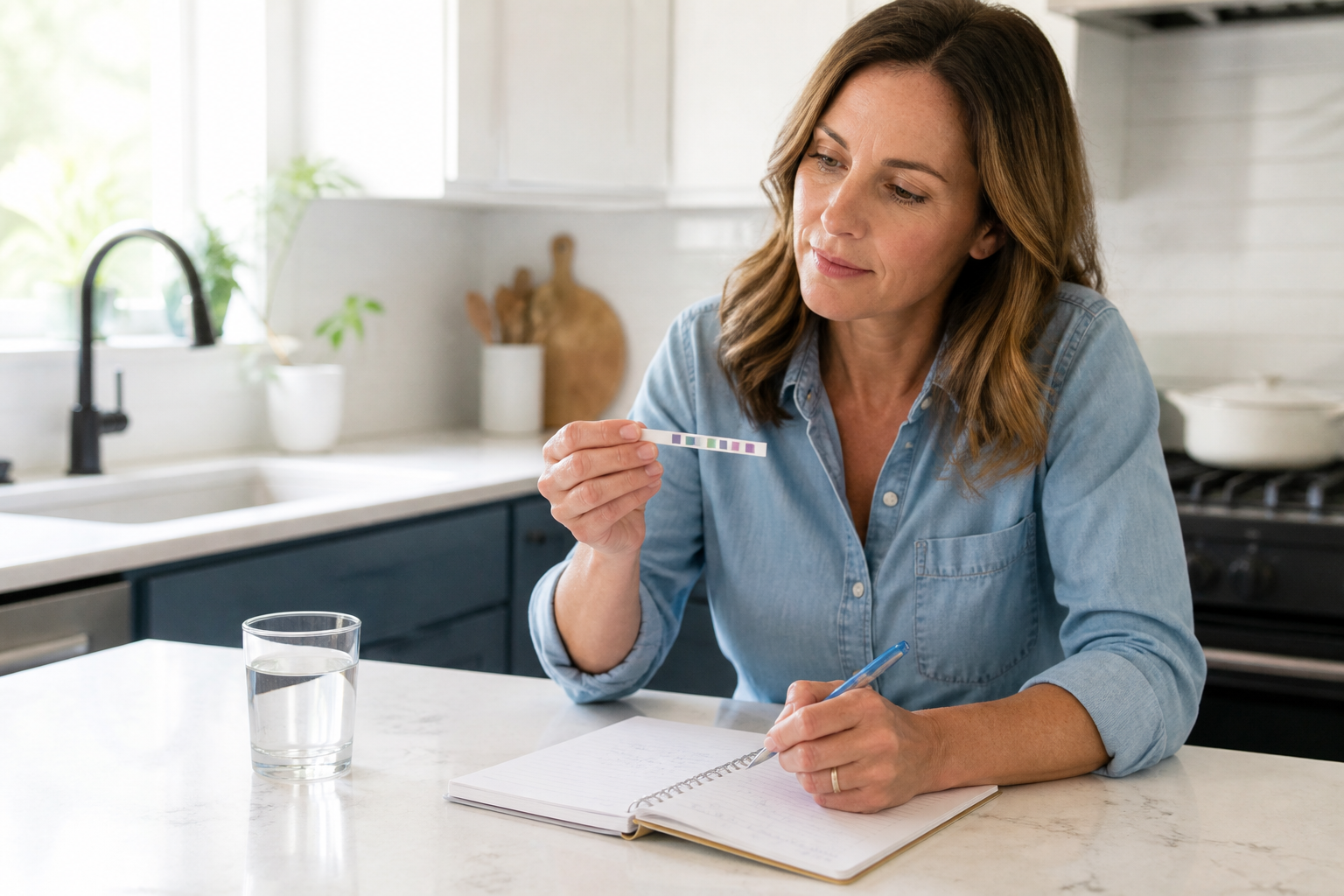
Table of Contents
The short answer for a four-person household
Use this calculation as a planning estimate:
daily water use in gallons × hardness in grains per gallon = daily grain load
Then choose a softener capacity that covers several days of normal use, based on the manufacturer’s usable capacity and regeneration settings. Whirlpool uses 75 gallons per person per day as a general estimate, so a four-person household starts near 300 gallons per day. Your water bill or meter data is better if it shows a different pattern.
For example, a family that uses 300 gallons per day with water at 15 gpg has a daily load of 4,500 grains:
300 gallons × 15 gpg = 4,500 grains per day
Over seven days, that is 31,500 grains. The result does not mean every household should buy a unit labeled 32,000 grains. Rated capacity, salt dose, reserve capacity, peak flow needs, and the maker’s settings all matter. Treat the math as the starting point for comparing suitable models and installation quotes.
Get the three numbers before you compare softeners
1. Household water use
People in the home are only a proxy for water demand. A family of four with frequent laundry, long showers, a large soaking tub, or guests may use more water than another family of four. Look at a recent water bill, smart meter, or utility portal if it shows daily or monthly use.
If you do not have that data, use 75 gallons per person per day as a temporary estimate. That gives a four-person starting point of 300 gallons each day. Do not include outdoor irrigation or pool filling if that water will bypass the softener. The EPA recommends bypassing water-intensive outdoor uses that do not need softening to reduce salt and water use.
2. Incoming water hardness
Use the hardness of the untreated water entering the system. A home test, a certified laboratory result, or a utility report can provide the number. A value from a neighbor or a citywide average may be useful context, but it should not be the only input for a purchase.
Water hardness may be reported as grains per gallon, ppm, or mg/L as calcium carbonate. USGS guidance states that 1 gpg is about 17.1 mg/L as CaCO3. If your report gives 171 mg/L as CaCO3, the approximate conversion is:
171 ÷ 17.1 = 10 gpg
Check the report label before converting. A result that lists another substance or another unit may need help from the laboratory, utility, or treatment professional.
3. Desired operating range
The softener removes a fixed amount of hardness before it regenerates the resin with brine. You want enough capacity for ordinary demand, but you do not need to choose only by the largest number on the box. A manufacturer may publish both a maximum capacity and a capacity at a specific salt setting.
As a general manufacturer example, Whirlpool describes regeneration about every 3 to 10 days as an efficient operating range. The EPA also recommends demand-initiated regeneration instead of a fixed timer when available. Ask the seller which capacity, salt dose, and expected regeneration interval were used in the recommendation.
Calculate the daily grain load
Once you have household gallons and hardness in gpg, the math is direct:
| Household estimate | Untreated hardness | Daily grain load | Seven-day load |
|---|---|---|---|
| 300 gallons per day | 10 gpg | 3,000 grains | 21,000 grains |
| 300 gallons per day | 20 gpg | 6,000 grains | 42,000 grains |
| 300 gallons per day | 30 gpg | 9,000 grains | 63,000 grains |
These examples show why a family-of-four label alone cannot select a softener. At 10 gpg, a 32,000-grain model might be a reasonable comparison point. At 20 or 30 gpg, the same household may need more usable capacity or a different regeneration plan. Do not assume that a nominal grain rating equals the usable capacity at the salt setting you intend to use.
You can also calculate a shorter planning interval. At 20 gpg, a household with a 6,000-grain daily load needs 30,000 grains over five days. That is a better question to take to an installer than, “What size fits four people?”
How to compare a 32,000-, 40,000-, or 48,000-grain softener
Grain capacity is the amount of hardness a softener can remove before regeneration. It is not a promise that one capacity fits every home. For a family of four, compare the system against your daily grain load and the manufacturer’s stated efficiency data.
- Around 32,000 grains: Often worth comparing when the water is moderately hard and actual demand is close to the 300-gallon planning estimate. Confirm the usable capacity and expected regeneration interval.
- Around 40,000 to 48,000 grains: Often worth comparing when hardness is higher, household demand is above average, or you want more reserve without forcing frequent regeneration.
- Higher capacities: May be appropriate for very hard water, more daily water use, or specific water-treatment conditions. They are not automatically more efficient for a four-person home.
The EPA advises buyers to consider NSF/ANSI 44 certification, water efficiency, and salt efficiency. The WaterSense guide identifies voluntary efficiency values of 5 gallons or less per 1,000 grains removed and more than 3,350 grains exchanged per pound of salt. Those details help you compare operating cost and waste, not just purchase price.
Do not ignore peak flow and plumbing needs
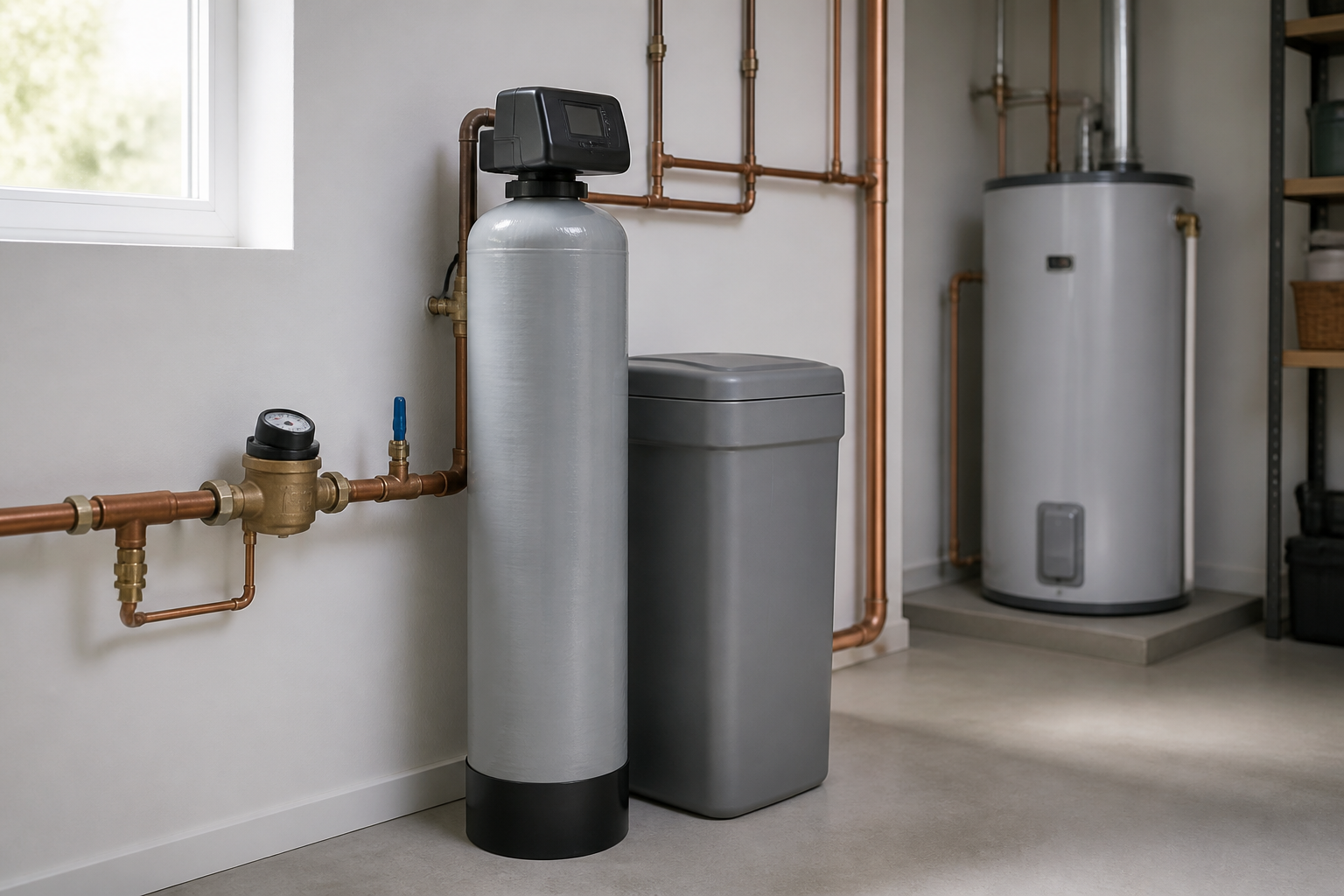
Capacity tells you how much hardness the resin can remove. It does not tell you whether the system can supply enough softened water when two showers, a washing machine, and a dishwasher run at the same time.
Ask about service flow rate, plumbing size, number of bathrooms, and whether the softener will serve the whole home or only selected fixtures. A system that has enough grain capacity but an unsuitable flow rate can still feel inadequate during busy periods. Installation needs also include a drain connection, power when the control requires it, and a bypass valve.
Before choosing a unit, check local requirements. The EPA notes that some jurisdictions limit softener installation or set requirements to reduce salt discharge and water waste. Your water utility, plumber, or local building office can help identify rules that apply to your address.
What changes when you have well water, iron, or manganese?
For a private well, hardness may not be the only treatment question. Iron, manganese, pH, sediment, bacteria, nitrate, or other results can change the system design. A conventional softener is designed to reduce hardness minerals. It is not a general-purpose filter or disinfectant.
Use a complete water test when a well has staining, odor, color, unusual particles, or a change in water quality. The well-water softener guide explains what a softener can and cannot do. If you have hard well water, test and treat hard well water before you select a treatment train.
Iron or manganese can affect a softener’s load and maintenance needs. Do not add a generic adjustment factor from a sales chart without confirming the result, the form of the metal, pH, and the system maker’s guidance. A treatment professional should explain how those values change the capacity and regeneration settings.
Use your hardness result after installation
Sizing is not the last step. Program a demand-initiated softener with the incoming hardness value and settings specified by the manufacturer. Then check whether the system is performing as expected.
You can use a hardness test on treated water to confirm that the equipment is reducing the condition it was selected to address. The water-softener hardness setting guide explains why the incoming-water number, not the softened-water result, usually guides the control setting.
Watch for changes such as new scale, poor soap lather, an unexpected regeneration pattern, low flow, or a change in untreated water. These are reasons to test again or call the installer. Do not change a control setting based only on a guess about regional hardness.
Questions to ask before you buy
Bring these questions to a seller or installer:
- What untreated hardness value and unit did you use for this size?
- What daily water-use estimate did you use for my household?
- What usable capacity does this model provide at the proposed salt setting?
- How often should it regenerate under normal demand?
- Does the quoted flow rate fit my bathrooms and appliances?
- Is the model NSF/ANSI 44 certified, and what are its water and salt-efficiency ratings?
- Does my water test show iron, manganese, or another condition that needs treatment before or after the softener?
- What local discharge, plumbing, or installation rules apply?
A clear answer should connect your test results to the equipment configuration. If the recommendation is based only on the number of people in the home, ask for the calculation behind it.
Frequently asked questions
Is a 48,000-grain water softener too big for a family of 4?
Not always. It can be a reasonable option when the household has higher hardness, greater water use, or a design that needs more usable capacity. It can also be larger than needed for a lower-demand home with moderately hard water. Compare the model’s expected regeneration interval and efficiency data with your daily grain load.
How many grains does a family of 4 use each day?
It depends on water use and hardness. At 300 gallons per day and 10 gpg, the daily load is 3,000 grains. At the same water use and 20 gpg, it is 6,000 grains. Test the water and use your own household demand when possible.
Should I size a water softener from my city water report?
A utility report can be a useful starting point, but hardness can vary by source and season. Use a current report for your service area or test the water entering your home if you need a sizing decision. For private wells, use a current laboratory result that covers the conditions relevant to your property.
Does a water softener remove contaminants?
A conventional ion-exchange softener reduces hardness minerals, mainly calcium and magnesium. It does not replace treatment for bacteria, nitrate, sediment, or every other water-quality issue. Choose other treatment only when a test result supports it.
The bottom line
The best water softener size for a family of four comes from your actual daily water use and measured water hardness, not from household count alone. Calculate the daily grain load, compare usable capacity and regeneration settings, and check flow rate and efficiency before you buy.
Test first, ask for the sizing calculation, and use the maker’s setup guidance after installation. That gives you a better chance of selecting a water softener that matches your home instead of a generic family-size label.