
Are you trying to find the best water filter for well water and running into 20 different answers? That is normal. Well water does not come from one standardized source, so the right filter depends on what is actually in your well.
A home with orange stains probably needs iron treatment. A home with rotten egg smell may need sulfur treatment. A home with bacteria risk needs disinfection. A home with PFAS or arsenic concerns may need a targeted drinking water system, not just a whole house filter.
Fortunately, the decision gets much easier once you stop shopping by brand first and start shopping by water problem. This guide will show you what to test for, which filter type matches each result, what certifications matter, and when a whole house system makes more sense than an under-sink filter.
Not sure which filter type fits your well, budget, and water concern? Use Find Your Filter to narrow your options by water source, contaminant, setup type, and price.
Table of Contents
Table of Contents
- The Best Water Filter for Well Water Depends on Your Test Results
- Best Well Water Filter Types by Problem
- How to Choose a Whole House Filter for Well Water
- Do You Need Reverse Osmosis for Well Water?
- What Certifications Should You Look For?
- Installation and Maintenance Costs
- FAQ
- Conclusion
The Best Water Filter for Well Water Depends on Your Test Results
The best water filter for well water is the system that matches your specific test results. That sounds obvious, but it is the step many homeowners skip.
According to the EPA’s private wells guidance, private well owners are responsible for the safety of their own drinking water, and private wells are not regulated by the federal government under the Safe Drinking Water Act. EPA also notes that around 15% of the U.S. population relies on private wells, and a USGS study found that about one in five sampled private wells had at least one contaminant above a human-health benchmark.
So what should you test before buying anything? The CDC recommends testing well water at least once every year for total coliform bacteria, nitrates, total dissolved solids (TDS), and pH. CDC also recommends using a state-certified laboratory and asking your local health or environmental department which local contaminants to include.
For a practical buying decision, your first well water test should usually include:
- Total coliform and E. coli
- Nitrates and nitrites
- pH and TDS
- Hardness
- Iron and manganese
- Hydrogen sulfide indicators or sulfur-related testing
- Arsenic, lead, and other local metals of concern
- Volatile organic compounds (VOCs), pesticides, or herbicides if you live near farms, fuel storage, industry, or older infrastructure
- PFAS if your area has known contamination sources, such as airports, military sites, industrial facilities, or firefighting foam history
Do you need every test every year? Usually not. Annual bacteria, nitrate, pH, and TDS testing is the baseline. A broader panel makes sense when you buy the home, drill a new well, notice a sudden change in taste or smell, experience flooding, repair the well, or live in an area with known contaminant concerns.
Best Well Water Filter Types by Problem
There is no single filter that fixes every possible well water problem perfectly. Most effective well water setups are treatment trains: one device handles sediment, another handles iron or sulfur, another disinfects, and a final drinking water filter handles specific health-related contaminants.
Here is the practical match-up:
| Water Problem | Common Signs | Best Filter Type | Whole House or Drinking Water? |
|---|---|---|---|
| Sediment, sand, grit | Cloudy water, clogged fixtures, visible particles | Sediment spin-down filter or cartridge filter | Whole house |
| Iron | Orange stains, metallic taste, rusty water | Air injection oxidation, catalytic media, or iron filter | Whole house |
| Manganese | Black stains, dark particles, bitter taste | Oxidizing filter or greensand-style media | Whole house |
| Hydrogen sulfide | Rotten egg smell | Air injection, catalytic carbon, or oxidizing media | Whole house |
| Bacteria | Positive coliform or E. coli result | UV disinfection after sediment filtration | Whole house for disinfection |
| Hardness | Scale, dry skin, appliance buildup | Water softener | Whole house |
| Arsenic | Usually no taste, smell, or color | Reverse osmosis or arsenic-rated media | Drinking water, sometimes whole house |
| Nitrates | Usually no taste, smell, or color | Reverse osmosis, distillation, or nitrate-selective resin | Drinking water |
| PFAS | Usually no taste, smell, or color | Certified reverse osmosis or activated carbon system | Drinking water first |
Notice how many serious contaminants have no obvious taste or smell? That is why test results matter more than a product page.
Best for Sediment: Spin-Down or Cartridge Pre-Filter
If your well produces sand, silt, rust flakes, or visible particles, start with sediment filtration. A spin-down sediment filter is a reusable screen-style filter that catches larger particles before they reach the rest of your equipment. A cartridge sediment filter catches finer particles but needs replacement.
For many wells, sediment filtration is not the final answer. It is the first line of protection. It keeps grit out of iron filters, carbon filters, UV units, water heaters, washing machines, and faucets. If you install a UV system without good sediment filtration first, cloudy water can reduce how well the UV light reaches microorganisms.
Best for Iron and Manganese: Oxidizing Whole House Filter
Does your water leave orange stains in toilets, sinks, or laundry? Iron is one of the most common reasons homeowners start looking for a whole house filter for well water.
Iron filters usually work by oxidizing dissolved iron into solid particles, then trapping those particles in media. Air injection oxidation, catalytic media, and greensand-style filters are common options. The right one depends on your iron level, pH, flow rate, and whether manganese or sulfur is also present.
What should you avoid? Do not assume a basic carbon filter will fix heavy iron. Carbon may improve taste and odor, but iron can foul carbon media quickly. If your well test shows elevated iron, use a filter designed for iron removal.
Best for Rotten Egg Smell: Sulfur Treatment
Rotten egg smell usually points to hydrogen sulfide gas or sulfur bacteria. The smell can show up in cold water, hot water, or only at certain fixtures. If it is only in hot water, the water heater’s anode rod may be part of the problem.
For whole house sulfur treatment, air injection and catalytic carbon are common choices. If the odor is strong, you may need an oxidizing system that can handle both hydrogen sulfide and iron. If bacteria are involved, disinfection may also be needed.
The key question is simple: does the smell come from the well water itself, or from the plumbing and water heater after the water enters your home? Testing and a plumber’s inspection can save you from buying the wrong system.
Best for Bacteria: UV Disinfection
If your well water test comes back positive for total coliform or E. coli, treat that as a safety issue, not a taste issue. Filters that improve flavor are not the same as disinfection.
Ultraviolet (UV) systems use UV light to inactivate microorganisms as water passes through a chamber. They are often installed as a whole house treatment step, but they need the water to be clear enough for the light to work properly. That means sediment filtration comes first.
NSF explains that NSF/ANSI 55 covers ultraviolet treatment systems. Class A systems are intended to inactivate or kill bacteria, viruses, and cysts in contaminated water, while Class B systems reduce non-disease-causing bacteria in disinfected drinking water.
If flooding, a damaged well cap, or a pressure loss caused the issue, contact your local health department or a well contractor. The CDC’s emergency well guidance recommends using bottled water when contamination is suspected until the water is confirmed safe.

How to Choose a Whole House Filter for Well Water
A whole house well water filtration system treats water where it enters your home. That makes sense when the problem affects showers, laundry, plumbing, appliances, and every faucet.
Here is the easiest way to narrow your options:
- Start with the well test. Identify the contaminants and their levels.
- Separate aesthetic issues from health issues. Iron stains are frustrating. E. coli, arsenic, nitrate, lead, and PFAS need more careful treatment choices.
- Match each problem to a treatment step. Sediment first, then iron or sulfur treatment, then softening if needed, then UV if bacteria risk exists.
- Check flow rate. A system that cannot support your household’s gallons per minute (GPM) will hurt water pressure.
- Check maintenance. A cheaper system with frequent cartridge changes may cost more than you expect over five years.
- Check certifications and claims. Look for the specific contaminant reduction claim, not just general language like “cleaner water.”
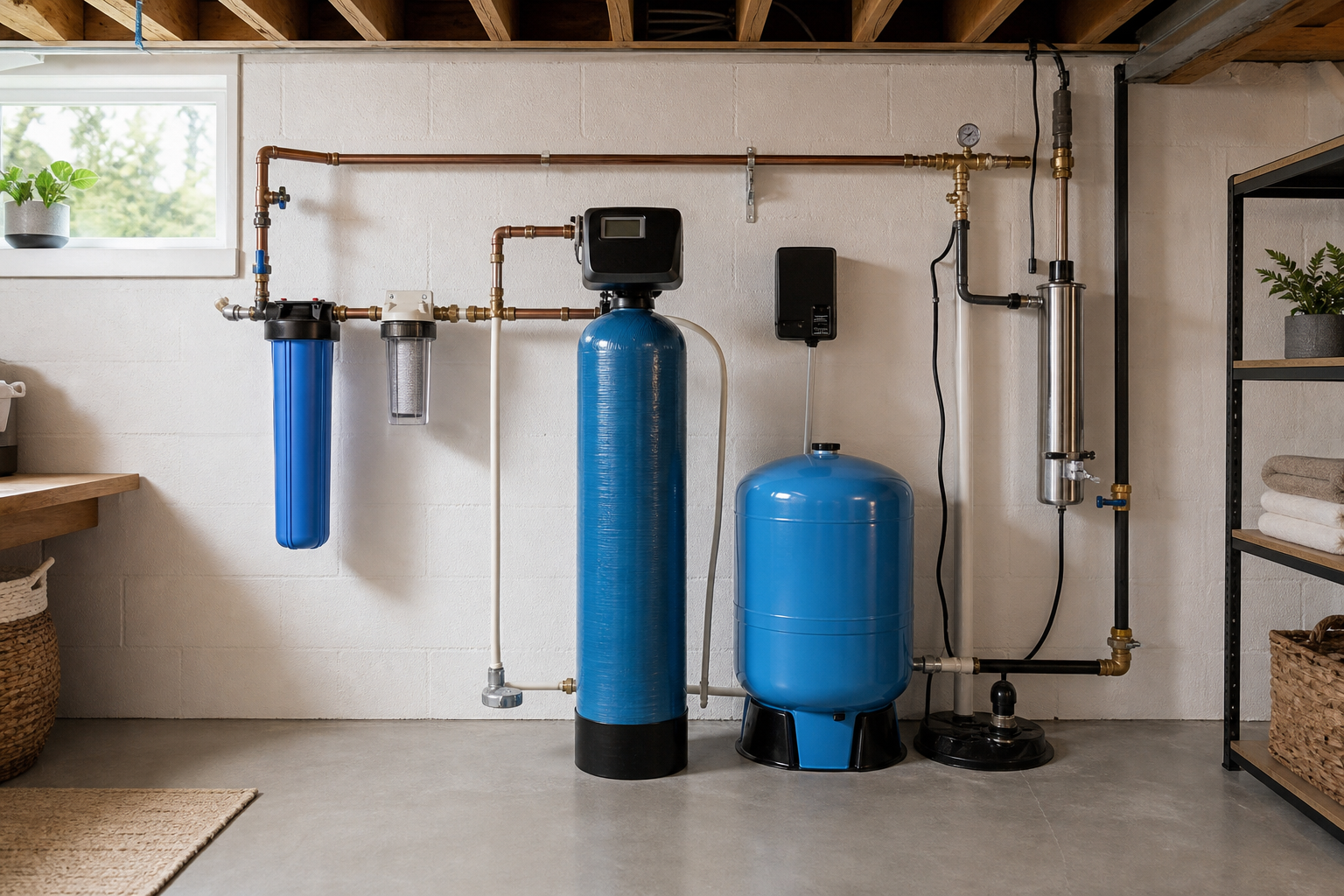
For many well homes, a strong whole house setup looks like this:
- Spin-down or cartridge sediment filter
- Iron, manganese, or sulfur filter if needed
- Water softener if hardness is high
- UV disinfection if bacteria risk is present
- Under-sink reverse osmosis for targeted drinking water contaminants
Does that sound like a lot? It can be. Fortunately, you may not need every step. A well with mild sediment and no bacteria does not need the same system as a well with iron, sulfur odor, and a positive coliform result.
If you want a faster way to sort those choices, Find Your Filter walks you through the same decision path and points you toward the filter category that fits your water.
Do You Need Reverse Osmosis for Well Water?
Reverse osmosis (RO) is often the best drinking water filter for contaminants that whole house filters may not remove reliably, including arsenic, nitrates, many dissolved solids, and PFAS.
But do you need RO for every well? No. RO is usually installed at the kitchen sink because it treats drinking and cooking water at a slower rate. Whole house RO exists, but it is expensive, wastes more water, needs storage, and usually requires careful pretreatment.
The EPA’s PFAS drinking water page lists enforceable Maximum Contaminant Levels (MCLs) for several PFAS compounds, including 4.0 parts per trillion for PFOA and PFOS under the 2024 rule materials. EPA’s page was also updated in May 2026 with proposed implementation-related changes, so PFAS rules and deadlines are worth checking before you make a treatment decision.
If PFAS is your main concern, ask for a filter certified for PFAS reduction. NSF notes that NSF/ANSI 53 covers filters certified to reduce contaminants with health effects, while NSF/ANSI 58 applies to reverse osmosis systems. Do not rely on generic activated carbon claims unless the product lists the specific PFAS reduction certification or test data you need.
What Certifications Should You Look For?
Water filter certifications can feel confusing, but the basics are manageable. The number is not a quality ranking. It tells you what type of claim the product was evaluated for.
Common standards to know:
- NSF/ANSI 42: Aesthetic effects, such as chlorine taste and odor.
- NSF/ANSI 53: Health-related contaminant reduction claims, such as lead or certain VOCs when certified for those claims.
- NSF/ANSI 55: UV treatment systems.
- NSF/ANSI 58: Reverse osmosis systems.
- NSF/ANSI 44: Water softeners for hardness reduction.
- NSF/ANSI 401: Emerging contaminants, depending on the product’s certified claims.
What is the most important shopping rule? Match the certification to the contaminant. A filter certified for chlorine taste and odor is not automatically certified for arsenic, nitrate, bacteria, or PFAS.
Also, look for capacity and flow rate. A filter that works well at one faucet may not be designed to treat a whole home. Point-of-entry systems should support the peak flow your home needs when showers, laundry, and faucets run at the same time.
Installation and Maintenance Costs
Well water systems vary widely in price because the water problems vary widely. Here are practical cost ranges:
| System Type | Typical Equipment Cost | Maintenance Pattern |
|---|---|---|
| Sediment pre-filter | $50 to $300 | Flush screen or replace cartridges |
| Cartridge whole house filter | $150 to $700 | Replace cartridges every few months to annually |
| Iron or sulfur filter | $800 to $2,500 | Media/backwash maintenance, occasional media replacement |
| Water softener | $600 to $2,000 | Add salt or potassium, periodic resin care |
| UV disinfection | $400 to $1,200 | Replace lamp yearly, clean sleeve |
| Under-sink RO | $200 to $800 | Replace prefilters, postfilters, and membrane on schedule |
Professional installation often adds $300 to $1,500 depending on plumbing complexity, drain access, electrical needs, bypass valves, and whether the installer has to rework the main line.
How can you keep the system affordable? Buy the treatment you need, not the biggest bundle on the page. If your test shows iron and hardness but no bacteria, you may need iron treatment and a softener, not UV. If your only concern is PFAS in drinking water, an under-sink RO system may be more practical than a premium whole house system.
Maintenance matters just as much as purchase price. A neglected filter can reduce flow, stop removing contaminants effectively, or create plumbing headaches. Before buying, write down the replacement schedule, annual cost, and what happens if you miss maintenance by a month.
FAQ
What Is the Best Water Filter for Well Water Overall?
The best water filter for well water is usually a whole house treatment train based on a certified well water test. For many homes, that means sediment filtration first, then iron or sulfur treatment if needed, UV disinfection if bacteria risk is present, and reverse osmosis at the kitchen sink for drinking water contaminants.
Is a Whole House Filter Better Than an Under-Sink Filter for Well Water?
A whole house filter is better for problems that affect all water in the home, such as sediment, iron, sulfur odor, manganese, hardness, and bacteria risk. An under-sink filter is better for targeted drinking water contaminants, such as arsenic, nitrates, and PFAS.
Will a Carbon Filter Make Well Water Safe to Drink?
Not by itself. Carbon filters can reduce taste, odor, chlorine, some VOCs, and certain contaminants when certified for those claims. A basic carbon filter does not reliably solve bacteria, nitrates, arsenic, heavy iron, or hard water.
Do I Need a Water Softener or a Water Filter for Well Water?
You may need both, but they do different jobs. A water softener reduces hardness minerals like calcium and magnesium. A water filter targets sediment, iron, sulfur, carbon-based contaminants, or other specific problems. If you have hard water plus iron or sulfur, a softener alone is not enough.
How Often Should I Test My Well Water?
The CDC recommends testing at least once a year for total coliform bacteria, nitrates, TDS, and pH. Test sooner after flooding, well repairs, a pressure loss, a new odor or color, a nearby contamination event, or any unexplained illness that could be water-related.
Can I Install a Well Water Filter Myself?
Some cartridge filters and sediment filters are DIY-friendly if you are comfortable cutting and joining plumbing. Iron filters, UV systems, softeners, and multi-tank systems often need professional installation. If bacteria or electrical work is involved, bring in a qualified well or plumbing contractor.
Conclusion
The best water filter for well water is not the system with the loudest marketing claim. It is the system that solves your actual water problem.
Start with a certified well water test. If your water has sediment, protect the rest of the system with a pre-filter. If it has iron or sulfur, choose a whole house filter designed for oxidation and media filtration.
If bacteria show up, add proper disinfection. If arsenic, nitrates, or PFAS are your concern, focus on a certified drinking water system such as reverse osmosis.
Fortunately, you do not have to guess. Test first, match the treatment to the result, and check the right certification before you buy. That approach saves money, protects your plumbing, and gives you far more confidence every time you turn on the tap.
Ready to turn your test results into a short list? Start with Find Your Filter and choose your water source, main concern, setup type, and budget.