
If you are comparing a salt free conditioner vs water softener, the first question is simple: do you need lower measured hardness, or do you need a documented scale-management option? A conventional water softener is designed to reduce calcium and magnesium hardness. A salt-free water conditioner uses a different method and may help reduce scale when its documentation supports that claim, but it does not remove hardness ions from the water.
That difference matters before you buy a system for white scale, spotted dishes, soap film, or a water-heater concern. Start with a water-hardness test and decide what result you need: lower measured hardness, less scale, or treatment for a separate verified condition.
Table of Contents
Table of Contents
- The Short Answer
- Salt-Free Conditioner vs. Water Softener at a Glance
- How a Conventional Water Softener Works
- What a Salt-Free Conditioner Does
- How to Choose for Your Home
- Frequently Asked Questions
The Short Answer
Choose a conventional water softener when you need to reduce the calcium and magnesium in your water and confirm that change with a hardness test. Choose a salt-free conditioner only when a documented scale-reduction result matches your goal and you accept that the water can still test as hard.
The EPA WaterSense guide makes the distinction clear. Cation-exchange softeners remove hardness ions. Salt-free conditioners use another method to condition those ions for scale reduction without the same salt and regeneration process. A product name alone is not enough. Read the exact performance claim and the standard behind it.
What is your water hardness now? Our water hardness scale guide can help you read a result in grains per gallon, parts per million, or mg/L as calcium carbonate. The result gives you a useful baseline before you compare equipment.
Salt-Free Conditioner vs. Water Softener at a Glance
| Question | Conventional water softener | Salt-free water conditioner |
|---|---|---|
| Main purpose | Reduce calcium and magnesium hardness. | Reduce scale formation when the device documents that outcome. |
| Typical method | Cation-exchange resin exchanges hardness minerals for sodium or potassium ions. | Technology varies by model. Some use media intended to change how hardness minerals form scale. |
| Does it lower a hardness-test reading? | Yes, when it is operating and sized correctly. | Not necessarily. A conditioner is not a hardness-removal system. |
| Salt and regeneration | Uses sodium chloride or potassium chloride for regeneration. | Does not use the same salt regeneration process. |
| Useful certification signal | NSF/ANSI 44 for a cation-exchange softener. | IAPMO/ANSI Z601 for a scale-reduction device, when the exact model is certified. |
| Best first question | Do you need lower measured hardness? | Is scale reduction, rather than hardness removal, your real goal? |
This is not a contest between a modern system and an outdated one. They do different jobs. The wrong choice happens when a homeowner expects a conditioner to make hard water test soft, or expects a softener to treat an unrelated water-quality concern.
How a Conventional Water Softener Works
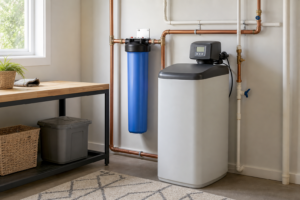
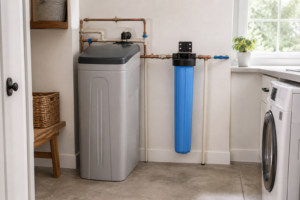
A conventional softener uses cation-exchange resin. As water moves through the resin, calcium and magnesium hardness ions are exchanged for sodium or potassium ions. The resin later needs regeneration with sodium chloride or potassium chloride.
That is why a softener has a brine tank or another regeneration arrangement. Penn State Extension explains the ion-exchange process and notes that the resin must be regenerated after its exchange sites are used. The output water has lower hardness, so a before-and-after hardness test can show whether the system is working.
Look for a claim that matches this mechanism. NSF/ANSI 44 applies to residential cation-exchange softeners that reduce hardness. It also covers important performance and construction requirements. Certification is not a promise that every system fits every home, but it is a useful way to check that the product category and claim line up.
What are the tradeoffs? A softener needs salt or potassium chloride, a drain connection for regeneration, and regular maintenance. It can also add sodium to the treated water when sodium chloride is used. The Minnesota Department of Health advises that the amount depends on incoming hardness and notes that people with individual health needs should consider that factor. If sodium is a concern, talk with a qualified clinician and review potassium-based regeneration and plumbing options with a treatment professional.
What a Salt-Free Conditioner Does
Salt-free conditioner is a broad marketing term, not a guarantee that every product uses the same process or reaches the same result. Some systems use media intended to influence how calcium and magnesium form scale. The important boundary is that they do not make the dissolved hardness ions disappear in the way an ion-exchange softener does.
The EPA describes salt-free conditioners as an alternative to traditional ion exchange. It says they condition hardness ions to reduce scale without added chemicals or water waste, rather than removing those ions. So if you measure the water before and after a conditioner, the hardness number may remain similar even when a supported scale-reduction claim applies.
This is why you should be careful with the phrase “salt-free water softener.” It can blur two different outcomes. If your goal is a lower hardness reading, less mineral content in treated water, or more predictable soap performance, choose a system documented for hardness reduction. If your goal is primarily scale management and you want to avoid regeneration salt and drain water, consider a conditioner only after you check the specific system claim.
What should you verify? The IAPMO/ANSI Z601 standard covers residential scale-reduction devices and their testing requirements. Ask whether the exact model, not merely the brand or product family, is certified or tested to that standard. Ask for its stated operating range, flow rate, media-replacement schedule, pressure limits, and any water-chemistry limits.
Do not extend a scale claim beyond what it says. A salt-free conditioner does not prove that your drinking water is safe, remove every contaminant, or replace testing for a private well. If you also have sediment, iron, odor, bacteria, lead, or another concern, select treatment for that verified condition. Our water softener vs. water filter guide explains why water treatment must match the specific problem.
What a conditioner’s claim cannot tell you
Scale reduction is not the same as a full prediction of how every surface in a house will look. Water temperature, how often water dries on a surface, fixture finish, flow, and incoming water chemistry can all affect what you see. A good product document should state the test method and conditions. It should also state what maintenance keeps the media working.
Be skeptical of broad language such as “solves hard water” when it does not say whether the claim is hardness reduction or scale reduction. Ask the seller for the product manual, the exact model number, the relevant certification listing, and the test result that supports the claim. Keep those details with your pre-purchase water test. That makes it much easier to compare systems fairly.
How to Choose for Your Home
The best decision starts with the outcome, not the equipment label.
- Measure your untreated water hardness. Test before an existing softener or request a current utility or laboratory result. Keep the date and unit with the result.
- Name the problem you want to solve. Is it recurring scale on hot-water equipment, hard-water spots, soap film, a high hardness number, or a separate condition?
- Choose the required outcome. For lower measured hardness, compare cation-exchange softeners. For a documented scale-reduction goal without salt regeneration, compare conditioners carefully.
- Read the exact claim and standard. Look for NSF/ANSI 44 on a softener and IAPMO/ANSI Z601 on a scale-reduction device. Also check the system capacity, flow rate, maintenance, and installation requirements.
- Check the whole treatment plan. Hardness is only one water-quality measure. A separate verified condition may need its own filter or treatment stage.
Questions to ask an installer or seller
You do not need to become a water-treatment engineer to ask useful questions. Take your hardness result and use this short list:
- Does this exact model reduce hardness, reduce scale, or do both?
- Which certification or test standard supports that claim?
- At my hardness level and expected household flow, what result should I reasonably expect?
- What media, salt, drain, electrical, and service needs does it have?
- Does my water have iron, manganese, sediment, or another condition that needs treatment first?
Clear answers help more than a large capacity number or a general promise. If the seller cannot separate hardness reduction from scale reduction, don’t buy yet. A qualified installer can also check local plumbing and discharge rules. Those rules can affect where a conventional softener drains and which fixtures you want to treat.
How hard does water need to be before you consider a softener? The Minnesota Department of Health says water above 7 grains per gallon, or 120 mg/L, may make a softener useful for appliances and household effects. It is still a personal treatment choice, not a requirement for every home. Our guide to what water hardness needs a softener walks through the practical decision.
Could you use both systems? Possibly, but only for separate, documented purposes. A conditioner should not be added as a substitute for a softener when the needed result is lower hardness. A softener should not be sold as a catch-all answer for every water concern. For another common point of confusion, see does a whole-house filter soften water?.
Frequently Asked Questions
Does a salt-free conditioner remove hardness from water?
No. A salt-free conditioner may make a scale-reduction claim, but it is not designed to remove calcium and magnesium hardness in the same way as a cation-exchange softener. Confirm the result you need before you buy.
Will a hardness test show that a salt-free conditioner works?
Not by showing lower hardness. A hardness test measures dissolved calcium and magnesium. That number can remain similar after conditioning. Use the model’s documented scale-reduction evidence and maintenance instructions to evaluate the claim instead.
Is a salt-free conditioner better for every home?
No. It can be worth considering where a documented scale-reduction result, no salt regeneration, and no regeneration wastewater match the household goal. It is not the right choice when you need confirmed hardness reduction.
Can a water softener remove other water problems?
Not automatically. A conventional softener is for hardness reduction. Test for other concerns and select a system with a documented claim for each one. This is especially important for private wells or a sudden change in water quality.
Can I use potassium instead of sodium in a water softener?
Some softeners can use potassium chloride for regeneration, but you should follow the specific manufacturer instructions. It still uses the ion-exchange and regeneration process. Ask a treatment professional about the cost, setting, and local installation requirements for your home.
Should I soften all the water in my home?
Not always. The Minnesota Department of Health notes that households often soften showers, sinks, and laundry connections, while outdoor taps and other high-volume uses may not need treatment. Your plumbing layout, local rules, and the goal of treatment all matter. Discuss the layout with an installer before adding a whole-home system.
The Bottom Line
For salt free conditioner vs water softener, begin with the result you need. A conventional ion-exchange water softener reduces measured hardness. A salt-free conditioner can be a scale-management option when its exact documentation supports that outcome, but it does not turn hard water into soft water.
Test first, read the exact claim, and match the system to the verified problem. That approach helps you avoid buying a system that sounds right but cannot deliver the result your home needs.