
Does your reverse osmosis TDS reading look higher than yesterday’s? Before you order a membrane, check what you measured. A first glass after an idle night, a sample after a mineral cartridge, and freshly produced membrane water do not necessarily represent the same thing.
A handheld total dissolved solids (TDS) meter can help you track an installed reverse osmosis (RO) system. It uses electrical conductivity to estimate the amount of dissolved charged particles. It does not identify individual contaminants, detect germs, or prove that water is safe to drink. A low number is not a safety certificate, and a higher number is not a diagnosis by itself.
Use the same method each time. Find your model, follow its sample instructions, and record inlet and product readings. Read the results within that model’s limits.
This guide explains the math and when it can mislead you. It does not replace your manual or a lab test for a named substance.
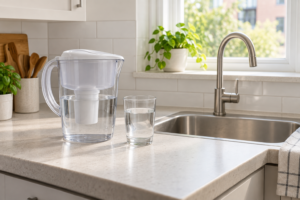
Illustrative AI-generated scene, not a photograph of product testing.
Table of Contents
Table of Contents
- What Does a Reverse Osmosis TDS Reading Measure?
- Make Your Reverse Osmosis TDS Reading Repeatable
- Calculate an RO Rejection Estimate Carefully
- What Can Cause High TDS After RO?
- Decide Between Service and a Laboratory Test
- Questions About RO TDS Readings
- Keep a Useful Record, Not Just a Number
What Does a Reverse Osmosis TDS Reading Measure?
A handheld conductivity meter measures how well water carries an electric current. Dissolved charged particles carry that current. The meter converts the result into an estimated TDS value, shown in parts per million, or ppm.
That conversion matters. The result is not a list of everything in the glass. Different meter settings can give different estimates.
In its TDS meter usage and calibration instructions, HM Digital explains that conductivity is converted to ppm using a conversion factor. It also describes different calibration standards used by meters.
What does the number leave out? The same instructions state that these meters do not detect bacteria or viruses and do not detect neutral, uncharged compounds. A display cannot tell you whether a particular chemical is present at a relevant concentration.
Use the reading for the question it can help answer: has this system’s measured dissolved-ion reduction changed under comparable conditions? Do not use it to answer whether every contaminant has been removed.
Certification is a separate check. Match the complete model and replacement components to the specific reduction claim you need. Our NSF certified water filters guide explains how to read those claims without treating a certification logo as a promise to remove everything.
Make Your Reverse Osmosis TDS Reading Repeatable
Want readings you can compare next month? Start with the method, not the target number. Find both the RO manual and the meter instructions before collecting water.
1. Identify the System and Sample Points
Record the model number and whether the system has a storage tank, a mineral-adding stage, or an integrated display. Check where the manual says to collect feed water and treated water.
The feed sample must come from the water that enters the RO system. A kitchen tap may be suitable if it supplies the same water. Check first for other filters, blending, or separate plumbing branches.
Cannot find the right sample point without opening the system? Ask the maker or a qualified service provider.
The treated sample location matters just as much. Water from the drinking faucet may have passed through a storage tank and additional cartridges. Call it a final-faucet sample in your record. Do not label it as water taken straight from the membrane.
2. Check the Meter Before Use
Use the same meter and settings for both samples. Check the units too. Follow its cleaning and calibration instructions.
Check how deep the sensor must go. Wait for a stable reading. Heat, trapped air around the sensor, and residue can affect the result.
Do not submerge a meter beyond its stated limit or measure directly in a running stream unless its instructions allow that method. A clean sample vessel makes it easier to obtain a stable reading without air passing between the electrodes.
If the meter cannot give stable repeat readings, fix that problem first. Do not judge the RO system from an unstable meter. A weak measurement is not a reason to buy replacement parts.
3. Collect and Record a Paired Set
Use separate clean vessels for the inlet and treated samples. Follow the system’s sampling and flushing directions and the meter’s rinsing instructions. Keep soap, drink residue, and fingers away from the sample and sensor surfaces.
Measure both samples close together in time. Use the same method. Let the meter stabilize as instructed. Record the units and sample temperatures if available, along with whether the system had been idle or recently used.
Do not use a flushing time from another model. A new system may need one flush method. A new filter may need another. A routine check may use a third method.
Record which procedure you followed so the next comparison is meaningful.
4. Keep the Plumbing Intact
This guide covers external readings and what they mean. It does not cover work inside the system. Do not disconnect tubing, bypass a tank or mineral cartridge, change a drain restrictor, or adjust pressure to obtain a more favorable number.
If the manual’s diagnostic test requires opening the system, use qualified help when you cannot safely carry out that exact procedure. A final-faucet trend can still be useful, provided its limits are clear.
Calculate an RO Rejection Estimate Carefully
The Water Quality Association’s RO performance guidance defines rejection by comparing a substance’s concentration in feed water with its concentration in permeate. Permeate means water that has passed through the membrane. Both readings must use the same units. This percentage is also called the RO rejection rate.
For a suitable paired TDS measurement, work through the calculation in three steps:
- Subtract the product reading from the feed reading.
- Divide that difference by the feed reading.
- Multiply the result by 100 to express the reduction as a percentage.
Hypothetical example, not a Water Advisor test: suppose a suitable feed sample reads 300 ppm and the corresponding membrane-product sample reads 15 ppm. The difference is 285 ppm. Dividing 285 by 300 and multiplying by 100 gives an estimated TDS rejection of 95%.
That does not mean the system removed 95% of every contaminant. It describes the change in the TDS estimate for those samples. To calculate rejection for one contaminant, you need lab results for that substance. The meter’s combined estimate cannot do that job.
Is your sample suitable for a membrane calculation? If it comes after a mineral-adding cartridge, the comparison includes that cartridge’s effect. If it comes from stored water, it may reflect water produced earlier under different inlet conditions. Record it as a system or final-faucet comparison unless the manufacturer’s method supports a more specific interpretation.
Do not calculate a percentage with a zero feed reading. With very low feed readings, a small meter error can cause a large change in the percentage. Check the meter’s range and accuracy. Do not report more precision than it can support.
Finally, rejection is not water-use efficiency. A TDS percentage describes a concentration change; it does not tell you what share of incoming water becomes drinking water or goes to the drain.
What Can Cause High TDS After RO?
A changed reading deserves a check, but the meter cannot identify the cause on its own. Consider the sample history and the system layout before deciding that the membrane has failed.
The Incoming Water Changed
A product reading alone leaves out half the picture. The source water may differ from the water used for your earlier comparison. Keep both values in the record rather than comparing today’s final number with last month’s final number alone.
Operating conditions matter too. WQA identifies temperature, operating pressure, storage-tank back pressure, and other conditions as factors in membrane performance. A lab rating is not a promise that each home test will match it.
You Measured First-Draw Water
Have you noticed a higher number after the system sits unused? WQA describes TDS creep: dissolved ions can continue to move across the membrane while normal water production has stopped. Water first drawn after an idle period can therefore differ from water collected during normal use.
That is a possible explanation, not permission to dismiss every rise. Note the idle period, follow your model’s instructions, and compare repeat measurements under the same conditions. Do not invent a universal number of glasses to discard or minutes to run the tap.
A storage tank also contains water produced over time. The tank versus tankless RO guide explains the delivery difference. For this measurement task, the key point is whether your sample represents stored water or current production.
A Cartridge Adds Minerals After Treatment
Some RO systems add minerals after the membrane. This stage is called remineralization. For a concrete layout example, the Aquasana AQ-RO-3 owner’s manual routes the manifold’s faucet outlet through a remineralizer before the drinking faucet.
On that documented setup, a faucet sample is downstream of the remineralizer. It does not measure membrane output alone. This is an example of why sampling location matters, not a recommendation for the model or a claim about another system’s layout.
Check your own manual and cartridge arrangement. If you need a membrane-only assessment and the sample point is not safely accessible, ask for qualified service rather than removing a stage just to lower the reading.
Decide Between Service and a Laboratory Test
Use the manual and service support to check the system. Use a suitable lab test to check for a contaminant. Sometimes you need both, but they answer different things.
For a performance change, first confirm the meter method, sample points, recent use, and paired readings. Then compare the result with the exact model’s performance and troubleshooting guidance. Check the recorded installation and replacement dates, and follow the specified maintenance schedule.
If repeat readings fall outside the maker’s guidance, contact the maker or qualified service. Share the paired readings and the conditions rather than only saying that the water has “high TDS.” Do not replace a membrane solely because an online chart labels one ppm number bad.
A low reading does not extend a cartridge’s scheduled service life. Carbon stages, the membrane, and other components have different jobs. For ownership planning, our reverse osmosis system cost guide separates replacement parts and ongoing upkeep from the initial purchase.
When the question is whether a named chemical or germ is present, a TDS pen is the wrong test. CDC guidance on choosing home water filters recommends testing for the substances of concern and contacting a health department for advice and help finding a state-certified laboratory.
Follow the laboratory’s sampling instructions, not this meter routine. Each test can have its own rules for bottles, collection, and handling. Do not let a reassuring TDS value override a drinking-water advisory or a contaminant-specific result.
If you see a leak, damaged parts, or an electrical problem, stop the test. Follow the manufacturer’s safe shutdown guidance and get qualified help. Do not open pressurized housings or alter safety controls to troubleshoot a number.
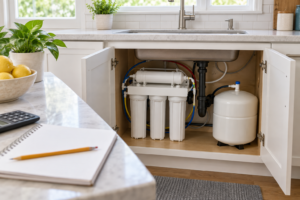
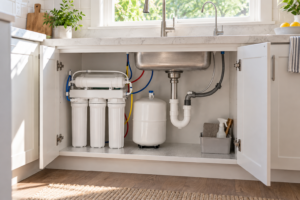
Illustrative AI-generated scene. Keep actual readings and sampling details in your own record.
Questions About RO TDS Readings
Does RO Water Have to Read Zero?
No universal zero-ppm requirement applies to every home setup. Interpret the result using the exact system, sample location, meter limits, and manufacturer guidance. A mineral-adding stage further changes what the final-faucet reading represents. Zero is not proof of drinking-water safety.
Does High TDS Mean the Membrane Needs Replacement?
Not by itself. Check the inlet reading, meter method, idle period, mineral stage, and model instructions first. A repeated result outside that model’s guidance needs service attention. There is no single replacement threshold that this guide can truthfully apply to every RO unit.
Can TDS Tell Me Whether a Carbon Filter Works?
Not reliably. A carbon filter’s stated job may be chlorine taste and odor reduction or a specific contaminant claim, rather than reducing overall dissolved ions. Our RO versus carbon filter comparison explains why the technologies are not judged by the same simple number.
Why Does the Built-In Display Differ From My Meter?
Check what each device measures and where its sensor sits. Their sample points, timing, settings, or accuracy limits may differ. A display label alone does not show that you are testing the same water. Ask the manufacturer if the manual does not explain the sensor location.
Can a Good TDS Result Replace Laboratory Testing?
No. It cannot identify individual contaminants or confirm their absence. Use the test recommended for the specific concern, with the laboratory’s collection instructions. Keep performance monitoring and water-safety testing separate.
Keep a Useful Record, Not Just a Number
Your next reverse osmosis TDS reading will be more useful if you can explain how you obtained it. Save the model, meter, units, feed and product locations, paired values, idle period, and any recent service. Add the date and the manual procedure you followed.
Compare like with like. Use a rejection estimate only when the samples support it, and label a final-faucet comparison honestly. Follow the model’s maintenance and service guidance rather than chasing a universal ppm target.
If the result raises a broader treatment question, return to our water filtration guide with your water report or relevant laboratory findings. The goal of a reverse osmosis TDS reading is not the smallest number on a screen. Keep a clear record, know what it cannot tell you, and choose the right next step.